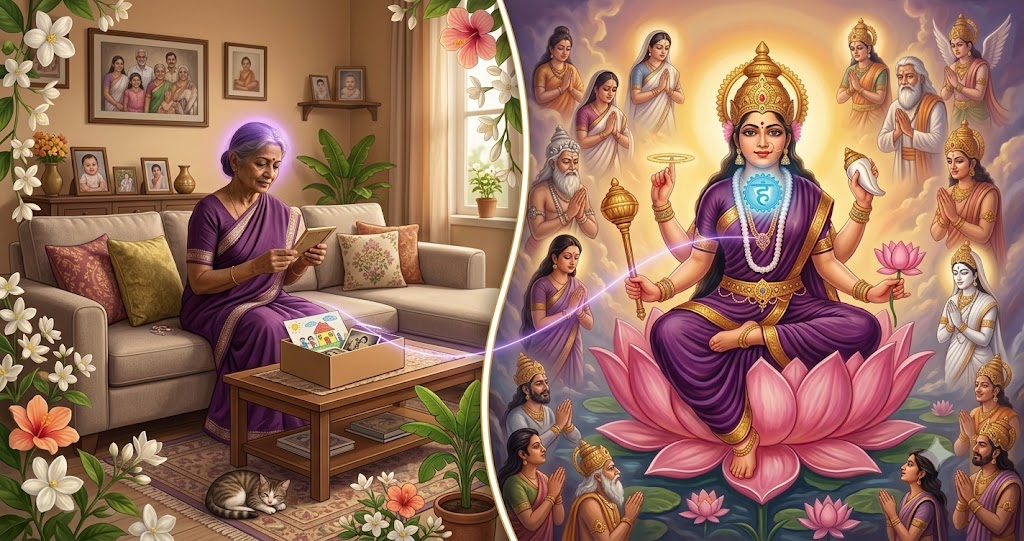
The Threshold
Do you remember going through your mother’s belongings?
Not as a child. Later. When she was older. Or after she was gone.
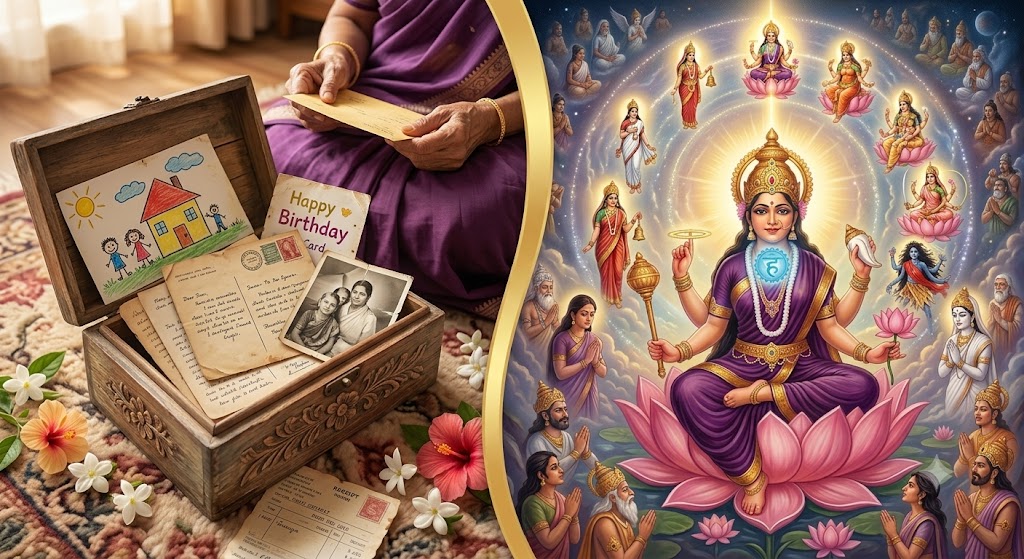
A cupboard she had not opened in years. A box at the back of it. And inside, everything you had ever given her.
The drawing you made when you were six. A house, a sun, two stick figures. She had written your name on the back, and the year.
A birthday card, when you were nine, with the spelling all wrong. She had kept it anyway. All of it. Even the envelope.
A letter from your hostel. You had written it because you were homesick, and you had forgotten it the week after. She had kept it for thirty years.
A photograph of the two of you at a wedding. You do not remember the wedding. You do not remember the photograph being taken. She is holding your hand.
And at the bottom of the box, a receipt. For a toy she bought you when money was short. She had kept the receipt.
She kept all of it.
And she did not keep it in a drawer and forget it. She went back to it. When you were away. When you were too busy to call. When the house was too quiet, and she was missing you.
She would open the box. Take out the drawing. Hold it for a while. And then put it back, carefully, in the same place.
And sigh.
You had forgotten the drawing. You had forgotten the card. You had forgotten writing the letter. But she had not. She had gone back to them, again and again, and held them, and remembered you.
And in that moment, you understood something. Not about her. About yourself. You had been loved, completely, for your whole life. And you had not noticed. Not properly. Not the way it deserved.
The Turn
On the ninth night of Navaratri, the Mother comes as Siddhidatri.
Siddhi means attainment, perfection, fulfilment. Datri means the giver. She is the one who gives fulfilment.
Think of what she was before this.
On the first night, she stood alone on the mountain. She did not know how to walk. She simply stood.
On the second night, she walked. Slowly. One step at a time.
On the third night, she found her voice. She was frightened, and she spoke anyway.
On the fourth night, she created. From almost nothing. Because she had a little warmth, and she gave it away.
On the fifth night, she held a child. And she did not move all night.
On the sixth night, she drew a line. She did not want to. She did it anyway.
On the seventh night, she carried the darkness. Alone. And no one knew.
On the eighth night, the morning came. And she was still warm.
And now, on the ninth night, it is finished.
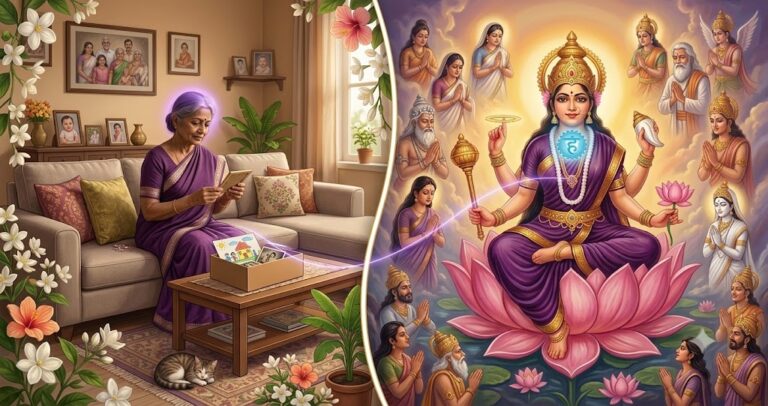
She is seated on a fully bloomed lotus. She is surrounded by the gods, the sages, and the celestial beings. All of them have come to her, with their hands folded. She does not stand. She does not ride. She is at rest. And the whole cosmos has gathered around her.
Here is the detail that matters most about this night.
She did not arrive here by collecting anything. She did not earn her way up, one virtue at a time, until she had enough. She arrived here by walking the whole path, and discovering, at the end, that what she was looking for had been with her the entire time.
The word siddhi does not mean getting what you want. It means attaining what is real. The eight powers described in the old texts are not things you earn. They are things that arrive, quietly, when you stop looking for them.
That is what the box is. That is what your mother’s box is. She was not waiting for you to become something. She was holding what you already were.
This is the ninth night. Shailaputri taught us to stand. Brahmacharini taught us to walk. Chandraghanta taught us to stay steady. Kushmanda taught us to create from joy. Skandamata taught us to hold. Katyayani taught us to draw the line. Kalaratri taught us to carry the dark. Mahagauri taught us to return to the light. Tonight, the Mother teaches us that the whole journey was not about becoming. It was about noticing. Your mother was not waiting for you to become someone. She was already proud of who you were.
Meeting the Mother
Her name is Siddhidatri.
She sits on a fully bloomed lotus. Her skin is luminous. She wears red, or sometimes a deep purple, the colour where all the others blend. She has four arms, and in them she holds a conch, a disc, a mace, and a lotus. She is calm. She is unhurried. She is not doing anything.
Around her, the whole cosmos has gathered. The gods. The sages. The celestial beings. They have all come, and they have all folded their hands. They are waiting for her to give them what they came for.
And she does. She gives without asking who deserves it. She gives without checking who is worthy. The texts tell us she is worshipped by gods and demons alike, by sages and by ordinary people, by anyone who arrives. No one is turned away. Being made whole was never kept for the deserving. It was only ever something to be received.
There is one story about her that is worth knowing.
Shiva himself worshipped her. Pleased by his devotion, she blessed him so completely that he became one being holding both of them at once. Half Shiva, half Siddhidatri. Not two beings standing side by side. One being, finally whole.
That is what she does. She does not add anything. She does not make you into something else. She simply joins what was always meant to be joined. And what is joined turns out to have been one thing all along.
And she says one thing, to you, today.
“You already have everything you came here to find. I only helped you see it was already yours.”
That is what your mother was doing, all those years. She was not waiting for you to become someone. She was already holding who you were. She was not hoping you would turn out well. She was already proud. She kept a box of drawings and cards, not because she was expecting more from you, but because she already had everything she needed. It was in the box.
You simply had not opened it yet.
What She Carries
Look at what she holds. Everything is a teaching.
The conch. It is sound. The same sound Mahagauri’s drum carried, and the same sound the bell made on the third night. Here, it is not calling anything into being. It is simply announcing that the work is done.
Your mother had a sound like this. The sound of the pressure cooker in the afternoon. The sound of her slippers on the floor. The sound of her humming from another room. You did not think about those sounds. You simply knew, without checking, that everything was all right.
The disc. It is focus. The same clarity Katyayani needed to aim her fire. Here, it has settled. It does not need to be sharpened for anything. It simply sees.
Your mother saw too. She saw the day in your shoulders before you said a word. She saw what you were struggling with before you told her. She did not need to ask. She simply knew.
The mace. It is strength. The same strength Chandraghanta carried on the third night. But here, it is at rest. It is not raised. It is simply held.
Your mother’s strength was at rest too, in the later years. She did not need to prove anything anymore. She had raised her children. She had kept the house. She had walked through her dark year. And now she simply sat, with her strength held quietly, and no one needed to be reminded.
The lotus. It is the same lotus that has appeared in every night of this series. Shailaputri carried it without offering it. Skandamata sat upon it while holding a child. Kushmanda held it while creating a world. Katyayani carried it in the same hand as her sword.
And here, on the ninth night, it is fully open.
She is all of them. Every chakra, from the root to the crown. Not one centre, but every centre, working together at last. That is what wholeness is. Not a place. A harmony.
That is what your mother was, all along. Not a woman waiting to be something. A flower that had been opening the whole time. You simply did not notice. You were busy growing up.
What She Teaches
Three lessons. Each one quiet. Each one the last.
You were never missing anything.
Whatever you have been searching for, you already have. Not in a finished form. In a folded form. Waiting for a little warmth to open it. The search itself was the unfolding.
Your mother knew this. She did not love you because you were becoming someone. She loved you as you were, on the day you were born, and every day after. She did not need you to grow into anything. You were already what she was proud of.
Being whole does not mean needing no one.
We are taught that strength is standing alone. That needing people is a weakness. Siddhidatri says the opposite. She sits surrounded by the whole cosmos, and she is the most complete figure in the series. Your mother was never alone. She had her faith. She had her people. She had the ones who came when she called, and the ones she never had to call, because they knew. She was whole because she was held. And she held others in return.
Fulfilment is not at the end of the journey. It is what you notice along the way.
The eight siddhis are not prizes at the finish line. They are what grows in a person who keeps walking. And the ninth night is not the arrival. It is the moment you look back and realise you arrived a long time ago.
Your mother did not become whole at the end of her life. She was whole the entire time. She simply did not announce it. She did not need to.
The Offering
For those who follow the daily traditions, Siddhidatri is honoured with the colour purple. The colour where all the others finally blend. Red, white, gold, orange, green, and the deep blue of night. All of them, together, in one shade.
Her offering is coconut, sesame sweets, or halwa. Something made whole from many small parts. Offer it with the thought, Mother, I offer you everything these nine nights have grown in me, and ask you to help me carry it forward.
Place a fully open flower near your altar today. Or a picture of all nine forms together. A quiet echo of the whole journey.
If you wish, whisper her name. Om Siddhidatryai Namah. Or simply, Siddhidatri, help me carry all of them with me.
A Quiet Moment
If you light a lamp today, do not ask her for anything new. Thank her for everything these nine nights already gave you. Quietly. Without you always noticing at the time.
Sit quietly. Let her look at you. Feel her hand on your head, and on your heart.
You do not need to explain anything. You do not need to ask for anything. Being seen is enough.
She smiles. Calm. Complete. Holding nothing back.
And in that quiet, you understand.
You are not the same person who began these nine nights. Something in you has shifted. Not dramatically. Not overnight. But it has moved. The way a river moves. You cannot see it. But you are not who you were nine days ago.
You were never missing anything. You were only walking toward something that was already inside you. And now, at the end, you have arrived. Not at a place. At yourself.
The nine nights are finished. The nine forms are finished. But they have not left you. They have simply folded into one another. And that one thing is what you carry forward now.
You are not finishing something. You are only beginning to carry it.
Walking with Her Today
Where is your mother’s wholeness needed in you today?
Look back over these nine days. Write down, in one line each, what each form gave you. Not as homework. As a small list of how much you have actually been given.
Notice one place today where you are trying to do something completely alone. Something that was never meant to be done alone. Let someone in. Let their hand meet yours the way your mother’s once did in that kitchen.
Give one thing away today, freely, the way Siddhidatri gives. Not because you have extra to spare. Because giving is simply what a full heart does.
If you can, do one small thing your mother used to do. Sit in her chair for a moment. Use her cup. Say the thing she always said at the end of the day. Not as mourning. As continuation.
When you feel unfinished, or not enough, whisper to yourself, I am not becoming whole. I already am. I am only remembering it.
Let the seeking settle. Let the reaching settle.
Beneath all of it, you are already here. Whole. Held in her blessings.
That is the wholeness she carried. That is the wholeness you carry too.
The Return
And now, back to your mother.
Think of that box again. The drawings. The cards. The letters. The receipt for a toy she bought when money was short.
You did not know she had it. You did not know she went back to it, again and again, on the evenings you did not call.
But she did. She opened the box, and she held your drawing, and she remembered the child who made it. And then she put it back, carefully, in the same place. And she sighed.
That was the whole of her, in one box. She was not waiting for you to become anyone. She was already holding who you were. And she went back to it, quietly, on the days she missed you.
You did not know you were being held. That is the thing about being held. You only feel it when it stops. And hers never stopped.
She is holding you still. Even now. Even if she is not in the room. Even if she is no longer here.
Because that is what a mother is. Not a person who raises you. A person who never puts you down.
That is the ninth night.
Not a goddess on a lotus. A woman with a box, on an evening when the house was too quiet.
The same love, in two forms.
Jai Siddhidatri.
Author Biography: – R Srinivasa Murthy, the author, is a corporate leader, an independent writer, and a student of Hindhu Philosophy. He Identifies as a Demystic, committed to removing unnecessary mysticism from traditions to offer practical systems for the next generation. His upcoming book, Logic of And: Sanatana Dharma as a Toolkit for the Contemporary Seeker, aims to bridge ancient wisdom with modern life to foster an inclusive, living civilisation.

With a journalistic long journey, we bring you https://primepost.news, a dynamic platform committed to unraveling the intricate tapestry of Indian politics, particularly delving deep into the heart of Telangana and Andhra Pradesh. Our blog is not just a source of news; it’s a reservoir of insights, analysis, and thought-provoking reviews.

Beautiful sir. 🙏🌺 May Maa Siddhidatri bless everyone with happiness, peace, and prosperity. Jai Mata Di! 🙏