The Threshold
Do you remember the power cut?
The one that lasted for hours. The whole street went black at once. No warning. No sound except the fan slowing down and then stopping.
You remember how fast the fear came. Faster than you expected. The kind that makes a familiar room feel strange. You could not see the furniture. You could not see the door. You reached out in the dark, without meaning to, just to know that she was there.
She did not switch on a torch right away.
She just held you. And she said, calm as anything, “Nothing has changed, dear. The room is the same. Your eyes just need a minute.”
You did not believe her. Not completely. But you stayed where you were, with her hand in yours, and slowly, the room stopped feeling like a stranger.
That was the darkness you saw.
But there was another darkness in the house, and you did not know about it. It lasted a year. Perhaps longer. Something was wrong. Something she never named. You only noticed, much later, that she went quiet for a while. That she sat up after everyone else had gone to bed. That she stared at nothing, sometimes, when she thought no one was watching. You did not ask. You were a child. You did not know there was anything to ask. And every morning, she was up before you. She made breakfast. She asked whether you had finished your homework. She found your socks. She packed your tiffin.
As if nothing was wrong.
That was the darkness you did not see.
And that is the darkness this night is about. Not the one she walked you through. The one she walked through alone.
You did not understand it then. You understand it a little more now.
She did not remove the darkness. She carried it. Quietly. In the same house. While being your mother.
The Turn
On the seventh night of Navaratri, the Mother comes as Kalaratri.
Kala means time. And it also means darkness. Ratri means night. She is the night of time. The darkness that consumes.
Think of what she was before this.
On the first night, she was the daughter of the mountain. She stood alone, and the ground beneath her became holy. She had not walked yet. She had not spoken yet. She simply stood.
On the second night, she began to move. She walked a long path, slowly, a rosary in one hand and a water pot in the other. She walked toward the one she loved, and she did not stop.
On the third night, she found her voice. She rang a bell, and the sound was courage. She learned that she did not need to be loud to be certain.
On the fourth night, she created. She laughed, and the cosmos was made. She gave from what little she had, and it became more than enough.
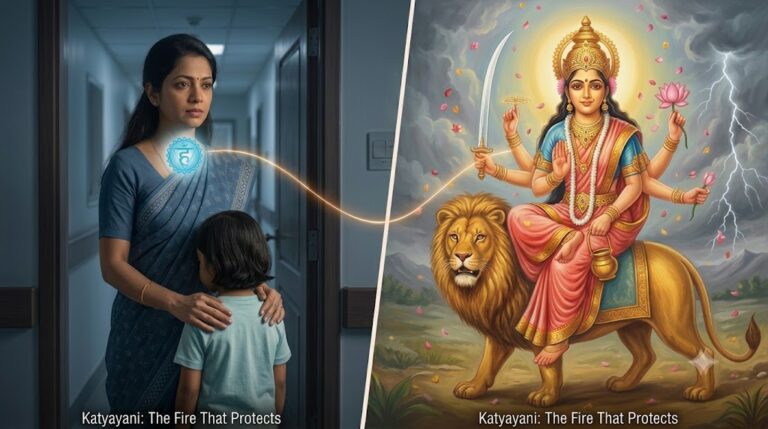
On the fifth night, she held the world she had made. She sat with a child on her lap and did not move all night. She learned that love can carry weight for years and still call itself light.
On the sixth night, she drew a line. She saw something wrong, and she ended it. She learned that some anger is not a flaw. It is a duty.
And now, on the seventh night, she becomes what we most fear.
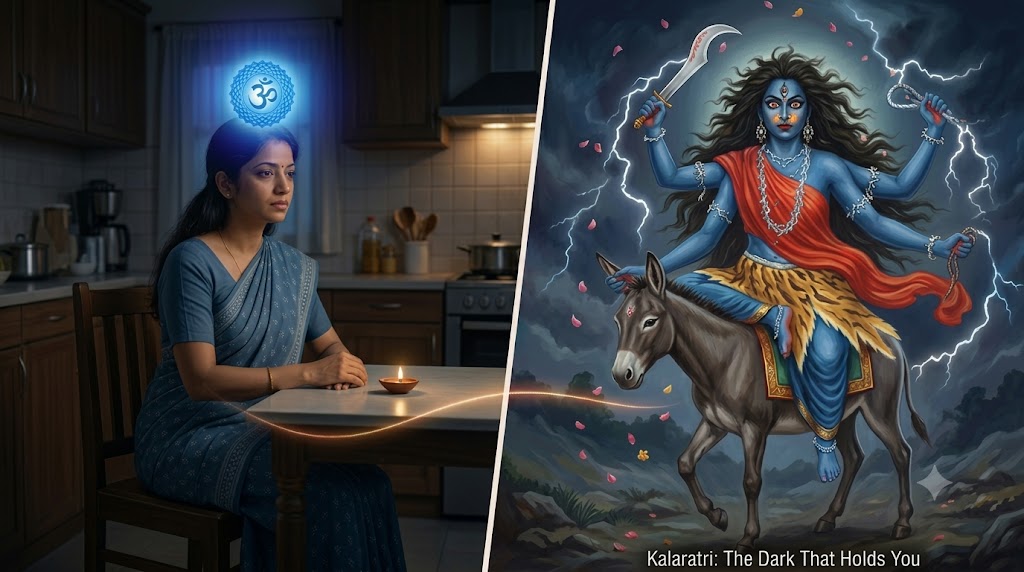
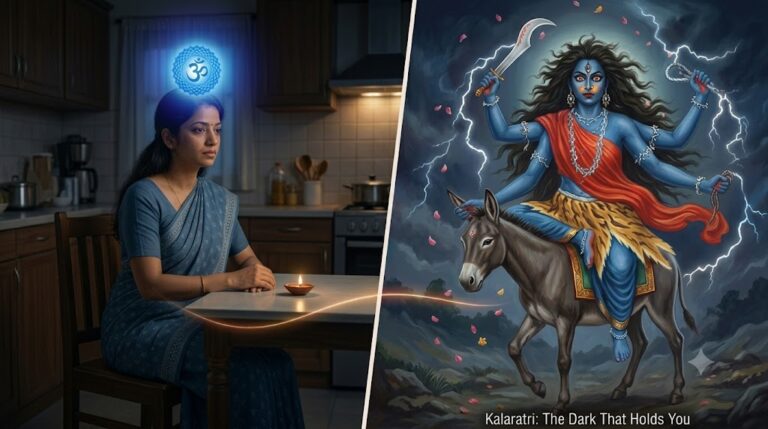
She has a dark complexion, almost black. Her hair is wild and unbound. She has three eyes. Flames come from her nostrils. She wears a garland of lightning. She rides a donkey. She carries a scimitar and a noose.
The lotus is gone. The bell is gone. The child is not on her lap.
This is the Mother with every comfort removed. And every one of those comforts is still inside her. She simply cannot show them tonight.
This is the seventh night. Shailaputri taught us to stand. Brahmacharini taught us to walk. Chandraghanta taught us to stay steady. Kushmanda taught us to create from joy. Skandamata taught us to hold. Katyayani taught us to draw the line. Tonight, the Mother teaches us that darkness is not always the enemy. Sometimes, darkness is the one holding you steady until the light comes back. And think of this, before we go further. The Mother you are about to meet, dark and wild and unadorned, is not a stranger. She is the one who sat up after everyone else had gone to bed. She is the one who stared at nothing when no one was watching.
You have seen her before. You simply did not know it was her.
Meeting the Mother
Her name is Kalaratri.
She has a dark complexion, almost black. Her hair is wild and unbound. She has three eyes, wide and intense. Flames come from her nostrils when she breathes. She wears a garland of lightning around her neck.
She rides a donkey. Humble. Unglamorous. The animal that keeps walking even when the path is hard to see.
She carries a scimitar and a noose. One to cut. One to hold. She is not gentle to look at. And she is not meant to be.
The old texts call her Shubhankari. The one who makes auspicious. The one who brings good. It is a strange name for a figure this frightening. Until you understand what she actually does.
In the stories, the demons Shumbha and Nishumbha had a general named Raktabeeja. Every drop of his blood that touched the earth became another Raktabeeja. Cut him once, and a hundred more rose from the ground. No weapon could end him.
It was Kalaratri who found a way. She caught each drop before it touched the earth. She drank it. She took the darkness into herself, so that it could not multiply.
She did not do this out of cruelty. She did it because some things cannot be defeated by fighting them. They can only be absorbed. Held. Swallowed. Until they lose their power.
And she says one thing, to you, today.
“I wear the darkness, so that you do not have to.”
That is what she does with your darkness. The fears you cannot name. The nights you do not talk about. The things you carry that no one knows. She absorbs them, quietly, so that your life can stay bright.
That is what your mother did too. In her dark year. She did not tell you what was wrong. She kept it inside, and in the morning, she made your breakfast. And you ate it. Without knowing. Without ever asking why her eyes looked tired.
What She Carries
Look at what she holds. Everything is a teaching.
Her dark skin. It is the night itself, wrapped around her like a shawl. And the night has never once been the thing to fear. It is only ever the space where fear becomes visible.
Your mother had this darkness too. In her quiet year. The year she did not speak about. You saw it in her face, in her silence, in the way she sat up later than everyone else. You did not know what it was. You only knew it was there.
She is the Sahasrara. The crown. The place at the top of the head where the self dissolves into something larger. The centre that is reached only by those willing to walk through the dark.
Her sword. It is not for battle in the ordinary sense. It is for cutting what needs to be cut. The thing that has gone on too long. The thing that cannot be repaired. She does not negotiate with it. She ends it.
Your mother did this too. In her dark year, something had to end. A habit. A hope. A version of herself she had been holding onto. And she let it go, quietly, without telling anyone. She cut it herself.
The noose. It is for holding. Not for strangling. It is the thing that keeps what must be kept. She cuts with one hand and holds with the other. Destruction and preservation, in the same woman.
Your mother held too. She held the family together. She held her own grief inside. She held the pieces of a life that was quietly coming apart, and she did not let them fall. Not one of them. Not while you were watching.
The donkey. Humble. Unglamorous. It keeps walking even when the path is hard to see. It does not need to be admired. It does not need to be thanked. It simply carries her through the dark, one step at a time.
Your mother walked like this. Through her dark year. No one applauded. No one even knew. She simply kept going. Because there were children to raise, and a house to run, and a life that had to continue.
What She Teaches
Three lessons. Each one difficult. None of them spoken aloud.
Some things cannot be fixed. They can only be carried.
We are taught to solve problems. To fix what is broken. To find a way through. But some things do not have a solution. A loss. An illness. A grief that does not end when everyone else has moved on. Those things are not solved. They are carried.
Your mother did not fix her dark year. She carried it. And she carried it so quietly that you did not know it was happening.
The darkness you carry for someone else is a form of love.
You have done this already. You have hidden your own tiredness so that your child would not worry. You have kept a fear to yourself so that your partner could sleep. You have absorbed a hurt so that no one else had to feel it.
That is Kalaratri. That is what she does with Raktabeeja’s blood. She takes the darkness into herself so that it cannot spread.
Not everything has to be spoken to be healed.
Some things are healed in silence. In a long night. In a quiet year. In the hours you spend alone, sitting with something you cannot name.
Your mother did not talk about her dark year. She did not go to anyone and explain it. She simply sat with it. And over time, it changed. Not because she solved it. Because she held it long enough for it to soften.
The Offering
For those who follow the daily traditions, Kalaratri is honoured with the colour royal blue. The colour of the deepest sky. Of what is vast, and quiet, and holds everything. The colour of the night just before the light returns.
Her offering is jaggery and honey. Sweetness that holds up even in the hardest conditions. Offer it with the thought, Mother, I offer you the parts of myself I have been afraid to look at.
Place a single unlit diya near your altar today. Or a small dark cloth. A quiet echo of the night she carries.
If you wish, whisper her name. Om Kalaratryai Namah. Or simply, Kalaratri, walk with me through what I have been afraid to face.
A Quiet Moment
If you light a lamp today, do not ask her to remove the darkness completely. Ask her to stay with you inside it, until you can see clearly again.
Sit quietly. Let her look at you. Feel her hand on your head, and on your heart.
You do not need to explain anything. You do not need to ask for anything. Being seen is enough.
She stands quietly in the unlit room. Entirely at ease.
And in that quiet, you understand.
There is something you have been carrying. You know what it is. You have known for a long time. You have not said it out loud to anyone. You have not even fully said it to yourself.
She is not asking you to say it now. She is only asking you to stop pretending it is not there.
You do not have to fix it tonight. You do not have to solve it. You only have to let it sit beside you, without running from it.
That is what she does. That is what your mother did. She did not run from her dark year. She sat with it. Until it softened. Until the morning came.
And it will come for you too. Not because you fixed anything. Because you stayed.
Walking with Her Today
Where is your mother’s courage in the dark needed in you today?
Name one thing you have been avoiding looking at directly. You do not have to fix it today. Just admit, honestly, that it is there. That alone is enough.
Sit for five minutes tonight without any screen, without any noise, in whatever dim light you have. Let your eyes adjust. You will notice that the room was always the same. It only felt different because you could not see it.
Think of a family you know who lost someone. The house they live in is the same house. The street is the same street. The chair is still in its place. And yet nothing is the same, and everything is the same, and they are learning to live in both at once. That is what your mother did in her dark year. She lived in both at once. And she did it quietly, for you.
If grief or anger has been building quietly, let it be there for a moment without pushing it away. Ask yourself, gently, What is this trying to end, so that something new can begin?
Think of someone you know who is in their own dark year right now. You may not be able to fix anything for them. You do not have to. Just let them know you are there. That is what your mother would have wanted, in her own dark year.
When you feel afraid of your own feelings, whisper to yourself, This dark has not changed the room. I just cannot see it clearly yet.
Let the fear settle. Let the resistance settle.
Beneath all of it, you are still here. Quiet. Held in her blessings.
That is the night she carried. That is the night you carry too.
The Return
And now, back to your mother.
Think of that year again. The year she went quiet. The year she sat up later than everyone else. The year she stared at nothing when she thought no one was watching.
You did not know what was happening. You were a child. You had homework, and friends, and a life that was still simple.
And she made sure it stayed simple.
She did the thing that Kalaratri does. She took the darkness into herself, so that it would not touch you. She carried it alone. She did not hand any of it to you. Not one piece.
She did not tell you what was wrong. She did not explain. She simply went to bed later than you, and got up earlier than you, and in between, she was your mother.
That is the seventh night.
Not a goddess with a garland of lightning. A woman sitting alone in a dark kitchen after everyone has gone to bed.
The same love, in two forms.
Jai Kalaratri.
Author Biography: – R Srinivasa Murthy, the author, is a corporate leader, an independent writer, and a student of Hindhu Philosophy. He Identifies as a Demystic, committed to removing unnecessary mysticism from traditions to offer practical systems for the next generation. His upcoming book, Logic of And: Sanatana Dharma as a Toolkit for the Contemporary Seeker, aims to bridge ancient wisdom with modern life to foster an inclusive, living civilisation.

With a journalistic long journey, we bring you https://primepost.news, a dynamic platform committed to unraveling the intricate tapestry of Indian politics, particularly delving deep into the heart of Telangana and Andhra Pradesh. Our blog is not just a source of news; it’s a reservoir of insights, analysis, and thought-provoking reviews.
Wonderful sir.
How the Evil spread in Earth and How Kalaratri Amma saves the Human beings .
She did Good to Save the Earth.
Today only I knew the Myth of this spritual Divine.
Thanks sir👍🙏🤩😍🎉