Raging Waters: The Devastating Power of Glacial Outburst Floods
Huge wall of water and mud tossing aside buildings, buses, cars, inundating the streets and frightened people with an elemental fury was witnessed on our television sets in a shocking manner. How utterly helpless humanity can be before raw power of nature! When, where exactly and with what ferocity they come no one can foretell. The water and mud come through rivers, rockfalls and landslides turning human habitations into rubble and fertile farms into slime-no one can envision. Nepal is the latest victim of catastrophic flash floods, sweeping down from mountains just across the border with Tibet (China), caused by what is technically termed a Glacial Lake Outburst Flood (GLOF).
Anatomy of a Catastrophe
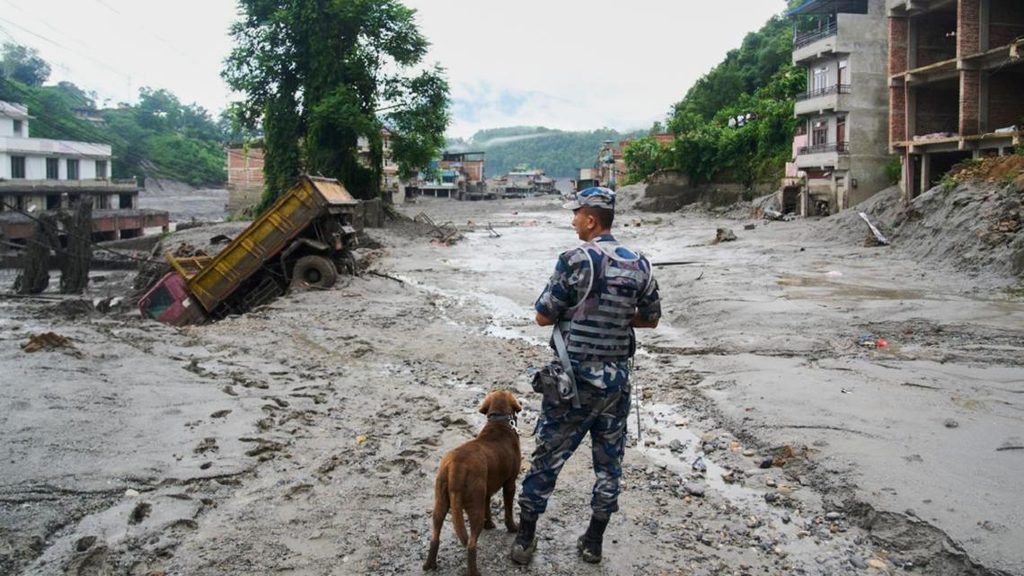
The deadly water took with it many lives, more than 1000 at last count as of September 2. Those alive are now without livelihood or dwellings. Life as is known to them is buried under the hardened mud. The mud brought in by the killer flood is hardening fast. Places where there were people last week are now look like rock faces. / gorges which were narrow before the catastrophe now flattened and widened into valley-like spreads with rocks, debris, mud and dead bodies strewn across them. On the bank of river Trishuli, someone was pulling a child from the ruins of a house. The glacial avalanche-cum-landslide fell in river Lhende Khola and triggered the floods.
These days the glaciers on the mountain are melting very fast and forming lakes there which were temporarily bound by avalanches or broken icebergs. When an earthquake occurs, these borders give away and the lakes come down the mountain with ferocious speed creating havoc. It may have been triggered by 4.4 magnitude earthquake occurred there minutes before the disaster.
India’s Vulnerability and the Urgency of GLOF Preparedness
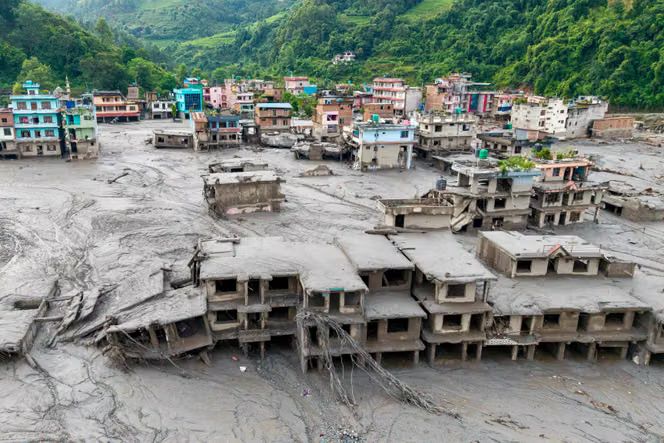
Seismologists have been warning the world in general, and India in particular, of impending earthquake of very high scale with a potential of devastating large parts of northern India. It lies under the quake shadow of the Himalayas. Had the same flood fury occurred in lower Nepal or still lower bordering Uttar Pradesh, what would have happened? Is India prepared to face such a danger? What really happened in Nepal is yet to be fully known. Whether it is the earthquake that caused the GLOF or is it the other way round is yet to be ascertained.
The unlimited human and economic cost of the catastrophe that struck Nepal on August 26 should serve as a stark reminder to countries like India of the urgent need to strengthen their disaster resilience. As per the UN Development Programme, Nepal had experienced 26 GOLF events since the 1970s. According to the researchers, there are 48,000 square kilometers glaciers spread over the Himalayas. Another 18,000 square kilometers are located in the Karakoram. About 5,000 glacial lakes have been found on the Himalayas of which about 500 are classified as hazardous. There have been at least 380 recorded instances of GOLF occurring in Himalaya-Karakoram mountain ranges. There are many Indian tourists among the missing including NRIs. India has promptly responded and plunged in rescue and rehabilitation activities. More than 22,000 security personnel and 16 helicopters have been deployed in rescue operations. Nepal’s Prime Minister Balendra Shah said on Monday that more than 11,000 persons have been pulled to safety so far. The UN estimates that about 65,000 persons need drinking water and sanitation.
Relearning Lessons from the Himalayas to the Alps
The Himalayan mountains range is the wellspring of rivers and shapes the monsoon. The region has several pilgrim centres considered very important by the Hindus. Of late, the system has increasingly become fragile. What happened with Bhoti Koshi river last week was the grim reminder of the reality. It is not an isolated incident. Two years ago, a glacial lake outburst led to massive flooding. The studies by scientists belonging to IIT Roorkee, IISc, Bengaluru, University of Dayton and two other universities in 2021 found out there is instability around South Lhonak lake in Sikkim. The warning the scientists gave was not taken seriously and two years later the lake burst killing at least 50 persons.
Moreover, infrastructure facilities are being built notwithstanding the reports by IPCC and several other bodies which documented the retreat of glaciers in the rapidly warming Himalayas. The expansion of roads, hydropower plants and tourism facilities in the valleys has added to the risk. Though all these things are necessary for the human activities and survival, facts regarding the instability of the landscape have to be taken into account while building the infrastructure. The glacial menace is there in Alps mountains also. They have a better warning system. The experience of Switzerland in 2025 when advance monitoring and fast evacuation measures helped to reduce the number of casualties can be lesson worth learning. The information and expertise have to be shared by the countries around Himalayas. China and Nepal may have that facility but China does not share information with India nor India has the inclination to give its findings to China. This has to be changed.
Compensation, not charity
Nepal is seeking “climate related compensation” from the US, India and China which the Himalayan nation named as the major greenhouse emitters for deadly flash floods in the Bhotkoshi River that swept away villages across at least three districts in the country a week ago. Emergency teams have so far recovered more than 11,00 bodies. But nearly 4,500 people remain still missing after the gigantic wave of freezing water, rocks, and debris triggered by a high-altitude glacial collapse. Nepal Foreign Minister Shisir Khanal asserted that post-disaster aid should be treated as a matter of ‘moral liability,’ and not as ‘charity.’ He pointed out that despite contributing “virtually negligible” greenhouse gas emissions, Nepal is bearing the disproportionate consequences of global warming, rapid glacier melt and the resultant mountain disasters. “We are paying the ultimate price for a global crisis we did not create. The rapid melting of glaciers and these catastrophic mountain tsunamis are direct consequences of global climate change,” the foreign minister said in an interview with Kantipur TV. “This is not a matter of charity, it is a matter of legal and moral liability,” he said.
“The major industrial emitters such as China followed by the US and India have historical responsibility to compensate vulnerable nations like Nepal,” he observed.

Prominent Journalist
Dr. K. Ramachandra Murthy is a versatile journalist with a distinguished career. Dr. Murthy began his extensive career with Andhra Prabha of The Indian Express group in Bengaluru. He was editor of Udayam, Vaartha and Andhra Jyothy. Dr. Murthy founded and edited HMTV news channel and The Hans India, an English newspaper. He was also editorial director of the Telugu newspaper, Saakshi. He was awarded Ph. D for his research work in rural reporting. Dr. Murthy’s five decades in journalism showcases his influential roles across both print and electronic media. He wrote the political biography of NTR published by Harper Collins.
Email: murthykondubhatla@gmail.com
Mobile: 9908002211