Status Before Income: Think TCO Twice to buy a Car
Why Income Below: This Level Makes Car Ownership a Financial Trap
Quietly Drains Household Wealth
How Car Ownership is Draining India’s Middle-Class Budget
The Illusion of Prestige
For millions of middle-class families in India, buying a car is rarely just a mobility decision—it is a deeply emotional social rite of passage. Seen as a ultimate symbol of prestige, success, and family comfort, a shiny four-wheeler parked outside the home signals to society that one has “arrived”. However, behind the glossy showroom deliveries and celebratory sweet distributions lies a stark financial reality. What begins as a proud milestone often transforms into an overwhelming recurring burden that destabilizes household budgets, derails long-term housing aspirations, and subjects families to predatory practices within the automotive ecosystem.
The Real Cost: Running 12,000 Km per Year
Many buyers calculate affordability based solely on the showroom price or the initial loan Equated Monthly Installment (EMI). However, the true Total Cost of Ownership (TCO) extends far beyond the bank’s monthly debit. For a standard hatchback or compact petrol sedan driven an average of 12,000 km annually (1,000 km per month), the recurring running expenses break down into substantial monthly allocations.
Fuel Expenses: At an average city-highway blend mileage of 15 km/litre and petrol priced around Rs 100–105/litre, driving 1,000 km requires roughly 67 litres of fuel, translating to Rs 6,700–Rs 7,200 per month (Rs 80,000–Rs 86,000 annually). Maintenance & Routine Servicing: Annual scheduled services, oil changes, wheel alignment, and consumable top-ups cost approximately Rs1,200–Rs1,800 per month (Rs15,000–Rs 22,000 per year). Insurance & Depreciation: Comprehensive annual insurance premiums and essential wear-and-tear items (tyres, battery replacement amortized over time) add another Rs 1,500–Rs 2,500 per month.
Accessories & Miscellaneous: Floor mats, seat covers, wash/cleaning services, parking fees, and highway tolls add approximately Rs 800–Rs 1,500 per month. Excluding the loan EMI, simply keeping a car operational costs Rs10,000 to Rs 13,000 every month. When an EMI of Rs 10,000–Rs15,000 is added, the monthly drain reaches Rs20,000–Rs28,000.
The “Garage Trophy”: Low Usage and the Debt TrapA significant portion of middle-class urban buyers fall into the trap of purchasing a vehicle primarily for status. Due to chaotic traffic, lack of office parking, and cheap metro or ride-hailing options, many owners use their personal cars only two or three times a month—typically for weekend mall trips or occasional family visits. For a person earning less than Rs1,000,000 per annum (under Rs 80,000–Rs 85,000 net monthly salary), taking on a Rs12,000 EMI plus Rs 5,000 in fixed monthly overheads means diverting 20% to 30% of their total take-home pay toward a depreciating asset. If a car sitting idle in a parking spot costs Rs 18,000 per month and is driven only 200 km in that period, the owner is effectively paying Rs 90 per kilometer—a staggering inefficiency compared to public transport or taxis. Industry lending data reflects this growing leverage: over 75% to 80% of personal cars sold in India are funded through bank loans.
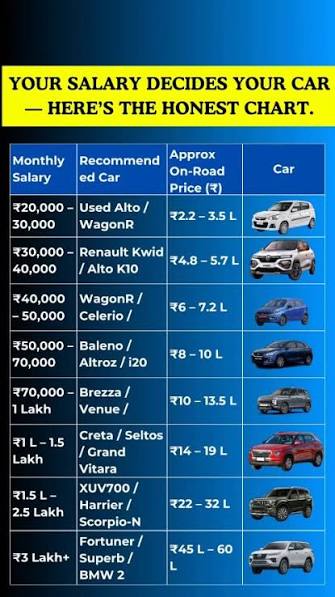
Financial planners generally recommend that total vehicle-related expenses (EMI + fuel + maintenance) should never exceed 10% to 15% of net monthly income. To comfortably afford a basic hatchback without financial anxiety or taking debt that strains monthly living costs, an individual or family should have a combined net monthly income of at least Rs 1.2 lakh to Rs 1.5 lakh. Below this threshold, unforeseen car expenses directly collide with essentials like school fees, groceries, and medical emergencies.
Modus Operandi of Service Centers
The Hidden Squeeze -The financial drain does not end with the bank loan; it extends into authorized showroom service centers. Once the initial free-service period ends, vehicle owners frequently encounter inflated invoices and aggressive upselling tactics.
Unnecessary Add-Ons on Job Cards: Service advisors routinely insert non-essential treatments—such as “engine flushing,” “decarbonization,” “AC disinfection,” “anti-rust undercoating,” and “caliper greasing“—onto the job card without clear consumer explanation. Pushing Premium Consumables: Recommending expensive fully synthetic engine oils over the standard mineral or semi-synthetic grades specified in the owner’s manual, doubling or tripling the oil bill.
Premature Component Replacement: Advising replacement of brake pads, clutch plates, or suspension bushes at 30% wear under the guise of “precautionary safety,” rather than replacing them when actually required. Inflated Labor Charges: Charging separate, steep labor fees for minor diagnostic checks that take only minutes. A routine Rs 4,000 oil service frequently inflates into a Rs12,000 to Rs 15,000 bill due to these padding techniques, leaving non-technical car owners feeling exploited yet reluctant to dispute charges for fear of compromising safety.
The Social and Physical Toll: “Unscheduled Taxi Duty”
Beyond pure balance sheet mechanics, owning a vehicle introduces underappreciated social obligations that tax the family head both physically and financially. In Indian societal structures, owning a car turns the household head into an designated chauffeur for extended family members, neighbors, and visiting relatives. Unexpected requests—such as driving relatives to railway stations at odd hours, picking up guests from distant airports, or commuting across cities for family functions—impose direct costs. Unplanned long drives consume Rs 2,000–Rs 4,000 in fuel and tolls per trip, expenses that are rarely compensated by relatives.
Physical & Mental Fatigue: Navigating congested Indian traffic, battling poor road infrastructure, and managing night driving creates severe physical fatigue and stress. Weekends intended for rest or family bonding are frequently lost to acting as a convenience provider for others.
Crushing Long-Term Goals: The Compromised House Plan
The most severe impact of middle-class car ownership is its compounding effect on long-term wealth creation, specifically home ownership.A car is a rapidly depreciating asset, losing 20% to 30% of its value in the very first year and up to 60% within five years.
Consider two middle-class financial scenarios over a 5-year period
Scenario A (Car Purchase): A buyer puts down Rs 2 lakh upfront and pays Rs15,000/month EMI for 5 years on an Rs 8 lakh car. Adding running expenses of Rs 7,000/month, the total cash outflow over 5 years exceeds Rs 15 lakh. At the end of 5 years, the resale value of the car is barely Rs 3.5–Rs 4 lakh. Scenario B (Housing Fund Investment): The same individual invests the Rs 2 lakh down payment and the monthly Rs 22,000 (EMI + running costs) into a systematic investment plan (SIP) earning an average 11–12% annual return. In 5 years, this fund accumulates to approximately Rs18 to Rs 20 lakh—providing a solid down payment for an independent apartment or residential land.
By prioritizing a status-driven car purchase, middle-class families lock up their credit capacity and exhaust the surplus capital required to secure a permanent home loan. What provides a fleeting sense of prestige outside the home ultimately delays or permanently forfeits the stability of real estate ownership inside it.

Editor, Prime Post
Ravindra Seshu Amaravadi, is a senior journalist with 38 years of experience in Telugu, English news papers and electronic media. He worked in Udayam as a sub-editor and reporter. Later, he was associated with Andhra Pradesh Times, Gemini news, Deccan Chronicle, HMTV and The Hans India. Earlier, he was involved in the research work of All India Kisan Sabha on suicides of cotton farmers. In Deccan Chronicle, he exposed the problems of subabul and chilli farmers and malpractices that took place in various government departments.
Email: ravindraseshu7@gmail.com
Mobile: 9063718675