Constitutional Foundations: The Dual Framework of Rights and Social Obligations
Economic Disembedding and the Moral Imperative for Institutional Renewal
The questions of freedom of the Press and questions regarding the independence and abilities of the Press to be impartial, non-partisan, objective and inform the citizenry about how their collective power vested in the hands of their representatives – and the political executive chosen by such representatives – and members of the permanent establishment is being used, and the consequences thereof are conjoined. Therein may lie the answers to the question regarding “trust”. Any artificial separation of these three questions, (on grounds of extreme form of individualism or extreme form of collectivism or even facetious defense of freedom of expression without concern for truth or larger social good) necessarily leads to socio-political dysfunctionalities and misdirection of the constitutional values.
The Interconnected Triad: Free Expression, Public Interest, and Capitalist Pressures
To be sure, the text of the Constitution speaks about “freedom of expression” subject only to reasonable restrictions by the State. When that phrase, “freedom of expression” is read in conjunction with the Preamble, and the emphasis within the Constitution on realization of progressive ideals of social justice, and stability of democratic polity, it becomes apparent that there is both a deontological element as a right and a utilitarian justification to ensure as well as progressively realize the complete protection of dignity of individuals qua individuals and as groups. Freedom of the Press was read in as a necessary extension, within the penumbra of meanings of the phrase “freedom of expression”, to include the platforms on which “expression” of thought and opinion could be organized. And now that extends to all forms of the media, irrespective of whether they have the capacity to be transmitted widely or not.
Given the foregoing, why then is there such gnashing of the teeth, and significant angst, regarding suffocation of that freedom of expression – both of the individuals and of groups and organizations? There are of course a long list of reasons that can be advanced by reasonable people engaging in reasoned and reasonable debate. Rather than engaging in a long list, we could look for the angst from a broader perspective, and that possibly lies at the conjunction of diminishing role of the media in showing a true mirror to powers that be and the predatory del of capitalist political economy that has been unleashed on the Indian society and economy.
Constitutional Directives, Market Capture, and the Muzzling of the Democratic Watchdog
In order to frame the foregoing concern we need to look to the Directive Principles of State Policy in general, and more particularly Articles 38 and 39(b). Article 38 (1) of course recognizes that promotion of a social order in which justice – social, economic and political informs all institutions of national life as sine qua non for the promotion, and hence protection, of the welfare of the people. Article 38(2) then doubles down on the foregoing and exhorts the State to strive to eliminate inequalities in status, facilities and opportunities. And finally, Article 39(b) unequivocally states that the State should direct its policy such that ownership and control of the material resources are so distributed as to best subserve common good. To be sure, the Directive Principles are not judicially enforceable, directly. But that cannot mean that they are any less fundamental to and mandatory foundations for constitutional governance. And to the extent that the agents of the people, the political executive, the permanent machinery of the State, and the principal beneficiaries of the predatory political economy that has been instantiated over the past few decades have spurned the spirit and text of the Directive Principles of State Policy, we necessarily have to conclude that what we have is a state of affairs that could be deemed to be a flagrant disavowal of many of the core elements of the Constitutional pact.
The fact that the Courts are limited by the non-justiciability feature of the Directive Principles, they can of course give directions when the non-enforcement of the Directive Principles are of such magnitude and of such consequences that fundamental rights of a vast majority of the populace are substantially truncated or effectively eliminated and/or the consequences could be of such nature and intensity that fraternity of groups and integrity of the nation is threatened. Let us set aside the question, for the moment, as to what the Courts can or cannot do, or actually do or don’t do.
Most reasonable people would agree that the Press and the Media in general is an important institution of national life, and vital for sustaining an accountable wielding of collective power by the legislators, the political executive, and permanent machinery of the State. A significant part of the media has come to be owned and directed by large corporate houses and others with large business interests, that are significantly dependent for their profits, expansion and even sustenance on crony – nay predatory and rapacious political economy. The watchdog consequently has gone nearly silent. And in many instances this watchdog not merely snarls but also threatens to bite or enable the mauling of the very people whose rights they ought to be protecting (and which forms the foundation of their very existence).
Institutional Surrender, Structural Constraints, and the Threat to Constitutional Integrity
It may not be an exaggeration that much of the media now behaves as quislings qua our Constitutional imperatives. The meager protections that Working Journalists and Other Newspaper Employees] (Conditions of Service) and Miscellaneous Provisions Act, 1955 gave to any independent minded journalist has vanished with the repeal of that law, and no new law being brought into effect. While the social media may appear to be promising, the fact remains that “social media” is also organised on the fat funds of large corporations, and the State can and does effectively, and not always legitimately, demand removal of any and all posts that it arbitrarily deems to be “anti-national”. A recent report in Indian Express about the number of such demands by the Government of India, states that it was to the tune of 24,000 just last year. Presumably, some or many of those subject to such URL takedowns were making statements or sharing content within the reasonable limits set forth to “freedom of expression” by Article 19 of the Constitution. The few who do dare to still express, are subject to criminal actions initiated by a pliant police force, that is all too willing to stoop to serve, and the courts look the other way willingly subverting the legal principles of statutory and constitutional interpretation. And where the above fails, organised armies of trolls, (widely acknowledged to be organised and funded by one or a few political or cultural or business organizations), viciously attack seeking to demonise, defame and worse threaten use of force and perpetrate the vilest of crimes.
Many decades ago, when a debate had emerged about the extent of privatisation and liberalisation, a good friend of mine, and a former Union Minister, Shri. S. Jaipal Reddy had warned the principal proponents of privatisation that they should not push it to such an extent where “the State begins to work like the market, and the Market begins to behave like the State”. We need to be aware of the lessons that history has taught us. And one of the great lessons of history that Karl Polanyi talks about is the “double movement” in which when the dis-embedding of the economy from the economy assumes monstrous proportions, the social sphere seeks to re-embed it within the limits of social acceptability. Institutions of national life – such as, but not limited, to the polity, the judiciary and the press – have a vital role to play in modulating how the society re-embeds the economy and the economic interests. When they fail, there is a great danger that this process can be cathartic, and even destructive of the larger compact itself.
After the Constitution of India was ratified, Babasaheb – one of its main architects – presciently warned that the very temple of democracy could be destroyed, and India could lose its way again, if the contradictions of social and economic inequalities are not urgently sought to be eliminated. The deficiencies in articulation, understanding and acting of/on those moral urgencies of course may be endemic to all institutions of national life. This necessarily also implicates the Press and the Media.
The Price of Silence: Media Responsibility, Street Resistance, and Democratic Reckoning
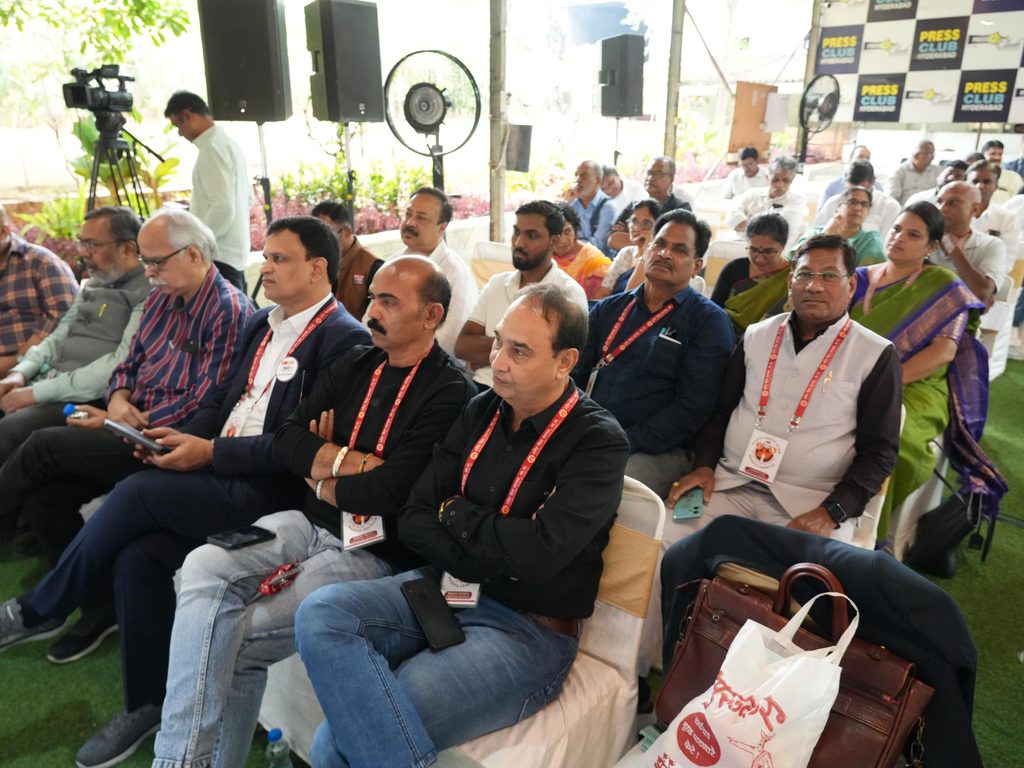
This is a moment for deep soul searching. And not merely for the people at large, but also journalists and media persons. Has the near complete forsaking of the Constitutional compact of egalitarianism, social justice and abdication of the responsibility of being the platform for the disenfranchised, the voiceless and those being left behind, in large swathes of the media, come back to haunt it? Wouldn’t the abandonment of foundational Constitutional values, to protect the world views of the owners given to rapacious loot and their unholy alliance with the mainstream political powers, necessarily make the media blind to the struggles of those being left behind, and whose critical voices are now described as anti-national?
Many decades ago, a great social thinker and freedom fighter of India, Ram Manohar Lohia had pointedly advised that: “jab sadak khamosh hota, toh sadan awaara hoga.” As we see the angst and the turmoil of youngsters erupt on the streets, we also need to ask whether large sections of the mainstream media did not and has not continued to strangle their voices, and worse still demonize them? Maybe, if he were still alive, Ram Manohar Lohia may have also said: “lekin jab sadak phir se goonj uthta hai, jo gala dabaane mein lage teh phir unka kya alam?
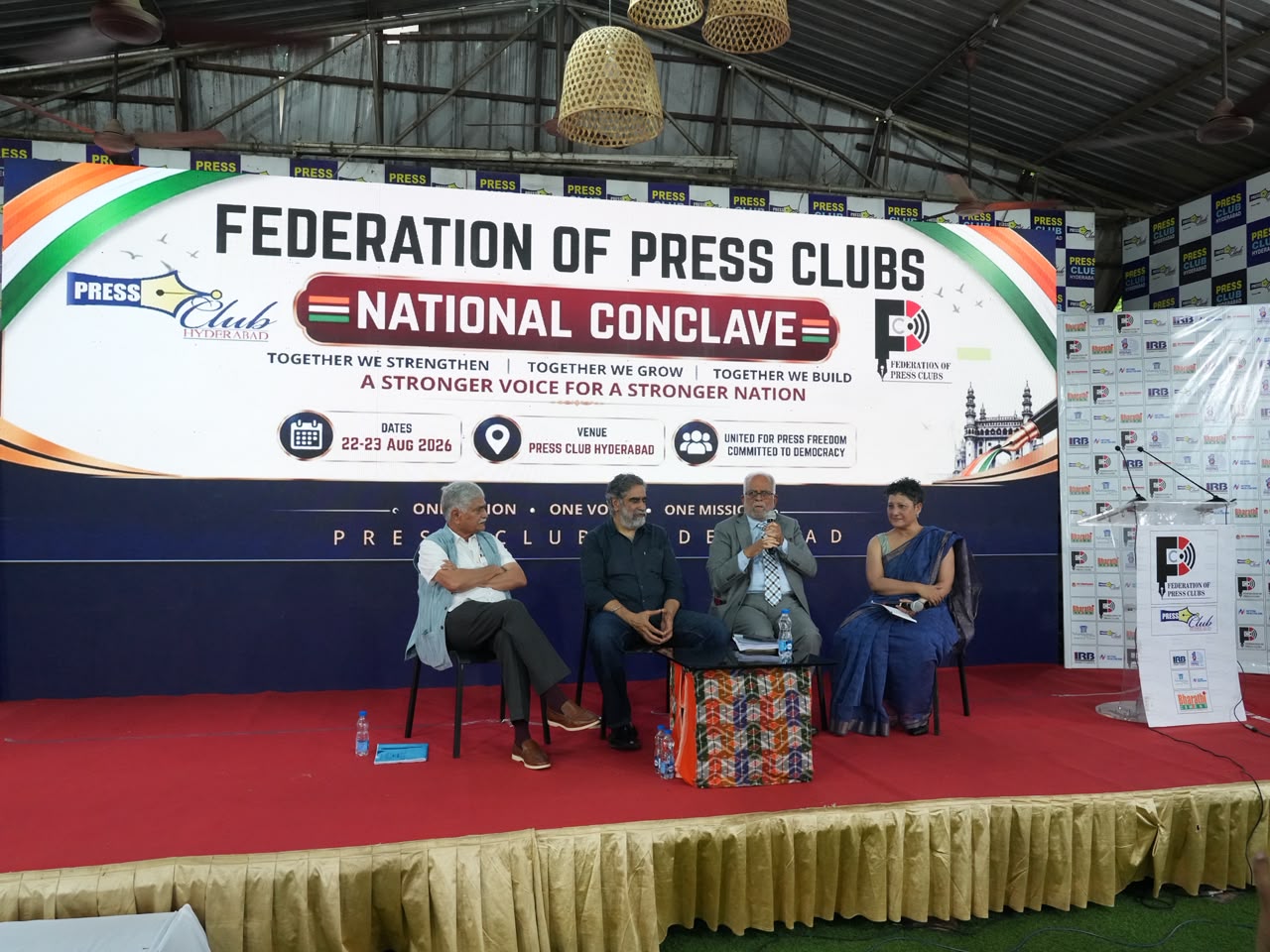
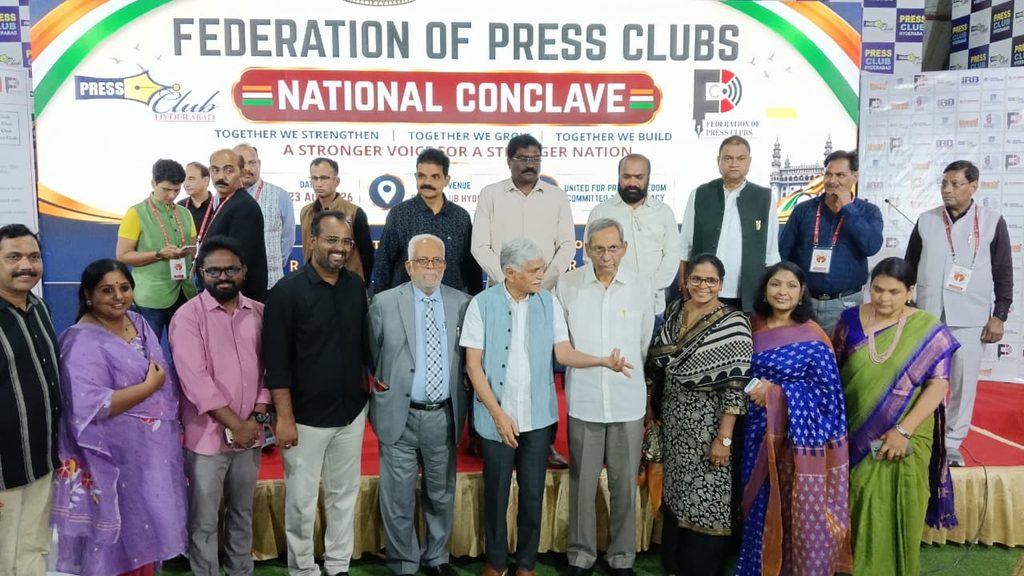
(Justice B Sudershan Reddy spoke during a panel discussion at the Federation of Press Clubs national conference held at the Hyderabad Press Club on August 23, 2026.)
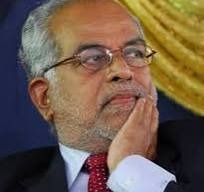
Justice B Sudershan Reddy is a former judge of rhe Supreme Court. He was a judge of erstwhile Andhra Pradesh High Court and Chief Justice of Assam High Court. He is known for his radical judgment in Salwa Judum case. He has been carrying a copy of the Constitution in his pocket for about five decades. He was the candidate of the combined Opposition in the election of Vice President of India recently.