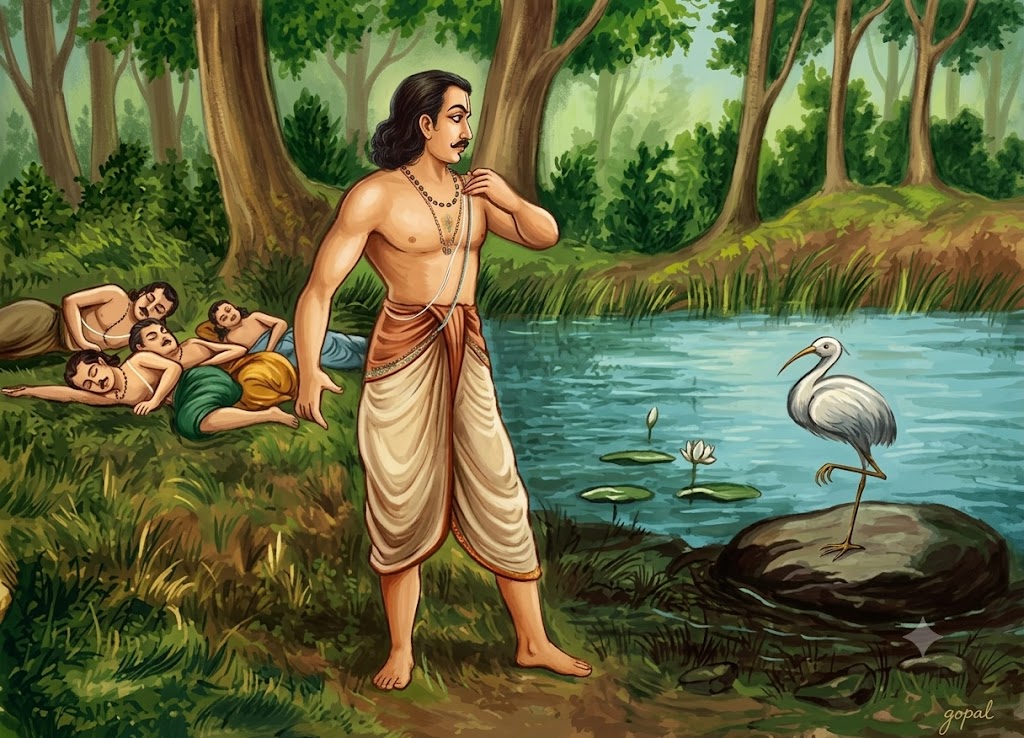
Yaksha Prashna-Paper-2
The Question: The Core of a Person
Yudhisthira had just explained how to run a purposeful day. But the Yaksha did not give him a single moment to rest. The voice boomed from the trees again, firing four fresh riddles aimed straight at our psychological foundation:
- What is more stable than the earth?
- What is higher than the wind?
- What is more valuable than gold?
- And what is the best way to find happiness?
This sounds like a traditional fable about worldly treasures. But the Yaksha was playing a much closer game. He was asking about what keeps you steady when your personal life gets messy, and where you look when you feel empty inside.
Yudhisthira answered from a place of deep, unshakeable calm:
- Patience is more stable than the earth.
- A righteous mind is higher than the wind.
- Learning is more valuable than gold.
- And Contentment is the truest way to find happiness.
Let us look closely at these four pillars. They give us a simple, heartwarming checklist to see if we are building our lives on solid concrete or shifting sand.
The Real Ground: Keeping Your Patience
Yudhisthira says patience is more stable than the earth.
Think about the times everything around you seems to fall apart. A student might fail a major entrance exam they spent years preparing for. A homemaker might deal with a chaotic morning where appliances break, children fall sick, and domestic plans completely derail. A professional might watch a critical business deal collapse. Your first instinct is to panic, yell, or find someone to blame. Your ground shakes.
But the earth does not move when a storm hits. It just holds everything steady until the weather clears. In our lives, that stability is patience. It is the ability to take a slow breath, accept a messy reality, and refuse to let the panic change who you are.
When you read modern books on mental health, psychologists write a lot about emotional regulation and resilience. This modern research is a beautiful validation of what our sages taught thousands of years ago. When you lose your temper, you lose the ground under your feet.
Higher Than the Wind: Taming the Reactive Mind
The riddle states that a righteous mind is higher than the wind.
Think of a wild wind. It has no home. It blows everywhere, kicking up dust and leaves, creating instant chaos. Our thoughts are exactly like that. One minute a student is trying to read a chapter, and the next, their mind has blown far away into a worry about future career uncertainty. A homemaker sits down for a quiet cup of tea, and instantly gets swept away by an old family argument or social media comparison.
It is fascinating to see how modern psychology addresses this daily human struggle. In his globally acclaimed book Thinking, Fast and Slow, Nobel laureate Daniel Kahneman writes extensively about our fast, reactive mind. This system jumps to conclusions, panics easily, and races ahead without our permission.
Western science is simply catching up to our ancient wisdom. A righteous mind, which means a mind anchored in good values, clean intentions, and presence, is higher than that wild wind. It gives you the quiet strength to look at your wandering thoughts and tell them to sit down.
Better Than Gold: The Wealth of Learning
When asked what is worth more than gold, Yudhisthira points directly to learning.
We live in a culture completely obsessed with counting treasures. We count exam ranks, bank balances, the square footage of our homes, or online followers. We think these things give us absolute security. But material wealth can vanish in a flash. An economy can shift, a company can close, or a sudden crisis can wipe away savings.
But what you have learned, how you have grown, and the wisdom you carry inside your soul can never be stolen. Whether you are a student mastering a new subject, a parent learning patience, or a senior citizen picking up a new technology, learning transforms you from within.
Modern writers often talk about a growth mindset. They study how the happiest people view life as a continuous school, finding deep lessons in both success and failure. Gold can only decorate your outside, but learning transforms you from within.
The Truest Happiness: The Choice to Stay Content
The final riddle asks for the best path to happiness. Yudhisthira gives a deceptively simple answer: contentment.
We often treat happiness like a distant station on a railway track. We tell ourselves that we will finally be happy when the children finish school, when we buy that specific car, or when life settles down. We chase happiness like a shadow, but a shadow always stays just out of reach.
Contentment is realizing that happiness is not about getting everything you want. It is about appreciating what you already have. It is looking at your simple dinner, your family, or your quiet evening and saying: “This is enough.” Joy is found the moment you step out of the constant race for more.
Connecting the Lessons to Our Daily Life
Let us bring these four pillars into our daily routines.
Imagine you are stuck in a massive traffic jam after an exhausting day. Everything inside you wants to honk the horn and get angry. That is the exact moment to practice the stable earth of patience. The traffic will not move faster because your blood pressure is high.
Think about your social media feed. It acts just like a wild wind, tossing your mind from envy to anger in seconds. Keeping a righteous mind means filtering what you let into your head. Choose to focus on your actual duties rather than letting internet noise carry your day away.
Finally, look at an ordinary Sunday morning. If you are constantly stressing about future promotions or upcoming chores, you miss the warmth of the sun and the laughter of your family. Contentment is the quiet decision to stop running and enjoy the wealth that is already sitting right in front of you.
Author Biography: – R Srinivasa Murthy, the author, is a corporate leader, an independent writer, and a student of Hindu Philosophy. He Identifies as a Demystic, committed to removing unnecessary mysticism from traditions to offer practical systems for the next generation. His upcoming book, Logic of And: Sanatana Dharma as a Toolkit for the Contemporary Seeker, aims to bridge ancient wisdom with modern life to foster an inclusive, living civilisation.

With a journalistic long journey, we bring you https://primepost.news, a dynamic platform committed to unraveling the intricate tapestry of Indian politics, particularly delving deep into the heart of Telangana and Andhra Pradesh. Our blog is not just a source of news; it’s a reservoir of insights, analysis, and thought-provoking reviews.



Thanks sir for teaching us to learn about”what is important in life”.
Peace, learning is more important anything in the world.
Super sir
Nicely written Sir, and very true. These kind of guidance is a must for new generation. Comparatively our generation was quite satisfied. Just my thought. Expecting many more readings from you. Wish you all the best and success for your upcoming book.
Beautifully explained: With Solid Character one can thrash out Chaos.
Very apt to having a calm head.
It is a re-learning our ancient wisdom. Thanks to the author for facilitating the same with easy case studies.