The Strait of Hormuz, Maritime Chokepoints, and the Strategic Vulnerability of India
“The oceans belong to no empire. Yet, in the twenty-first century, humanity is witnessing an extraordinary paradox: the world’s most vital maritime arteries are increasingly being transformed into theatres of geopolitical coercion. When international waterways become instruments of political bargaining, Nature itself is placed under arrest.”
Introduction: The Weaponisation of Geography
Throughout history, geography has bestowed upon certain narrow waterways an influence disproportionate to their physical dimensions. The Strait of Hormuz, the Bab-el-Mandeb Strait, the Suez Canal, the Bosporus, the Panama Canal, and the Strait of Malacca are not merely geographical formations; they are the circulatory arteries of the global economy.
Nearly ninety per cent of world trade by volume moves through maritime routes. Energy flows, container shipping, food supplies, industrial raw materials, and manufactured goods traverse these narrow corridors every hour of every day. Consequently, any disruption to these strategic chokepoints reverberates across continents, irrespective of where the conflict originates.
Today, however, these natural maritime corridors are no longer viewed merely as international commons. They are increasingly being treated as instruments of strategic leverage, military coercion, and geopolitical bargaining. Such developments represent not merely regional instability but an emerging form of maritime monopoly over resources that belong collectively to humanity.
International Waters Are Not Private Property
The legal architecture governing international navigation is clearly established under the 1982 United Nations Convention on the Law of the Sea (UNCLOS). Part III of UNCLOS, particularly Articles 34 to 45, created the doctrine of Transit Passage, recognising that many of the world’s most important international straits had become enclosed within the expanded twelve-nautical-mile territorial seas of coastal states.
The Convention therefore established several fundamental principles:
* Ships of every nation enjoy continuous and expeditious passage.
* Military vessels possess equal transit rights.
* Aircraft may overfly these straits.
* Submarines may navigate submerged.
* Most importantly, coastal states cannot suspend transit passage, even during periods of political tension.
The objective was simple yet profound: No nation should be permitted to convert a geographical accident into a geopolitical weapon.
The Emergence of Maritime Hegemony
Unfortunately, recent developments reveal an erosion of this carefully constructed legal order.
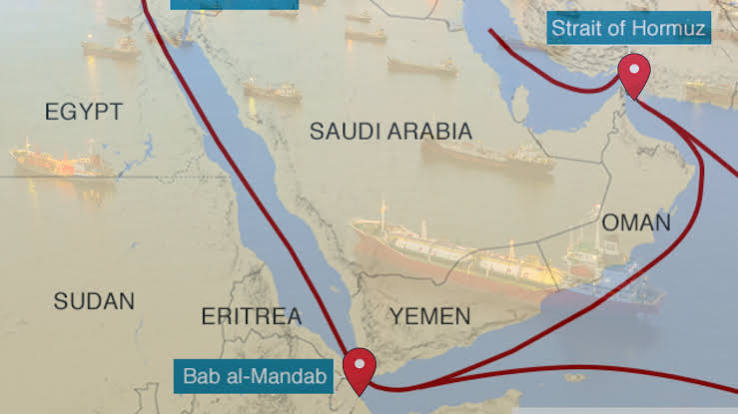
The Strait of Hormuz has repeatedly become the centre of military confrontation between Iran and the United States. The Bab-el-Mandeb Strait and the Red Sea have witnessed repeated attacks on commercial shipping by Yemen’s Houthi movement. Meanwhile, great-power naval deployments increasingly transform international waterways into militarised zones where commercial navigation depends less upon international law and more upon strategic calculations.
Neither Iran, nor the United States, nor any non-state armed organisation possesses sovereign ownership over these international waterways. Yet each, in varying degrees and through different methods, has demonstrated the capacity to interrupt global commerce.
This transformation represents an entirely new form of monopoly—not over land or natural resources—but over movement itself.
Nature Under Arrest
Unlike oil fields, mineral deposits, or forests, maritime straits were created by nature.
They are geological gifts shared by humanity.
When military coercion seeks to regulate access to these natural corridors, humanity confronts a disturbing reality.
Nature itself becomes hostage to geopolitical rivalry.
The monopoly no longer concerns ownership.
It concerns access.
It concerns permission.
It concerns the power to determine who may move, when they may move, and at what cost.
This is not merely a strategic contest.
It is the gradual privatisation of the global commons.
The Strait of Hormuz: The World’s Most Critical Energy Artery
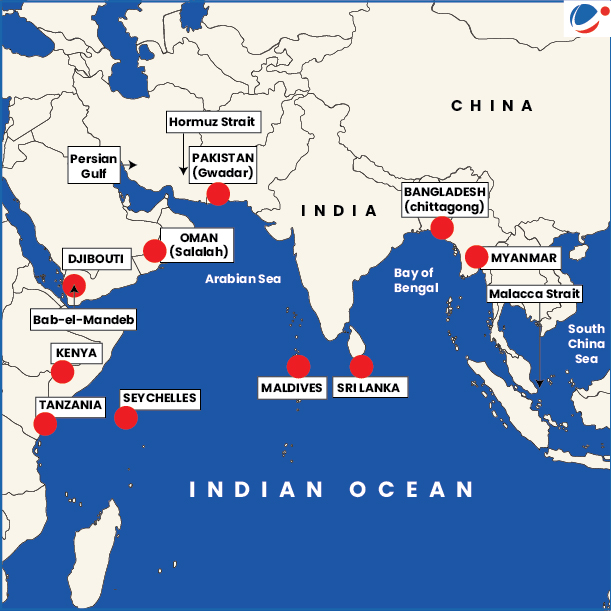
No maritime chokepoint illustrates this vulnerability more dramatically than the Strait of Hormuz. Approximately one-fifth of globally traded petroleum passes through this narrow waterway connecting the Persian Gulf with the Gulf of Oman. For India, the dependence is even more acute. A substantial share of India’s crude oil imports originates from Gulf producers—including Saudi Arabia, Iraq, Kuwait, the United Arab Emirates, and Qatar—with much of this traffic transiting Hormuz.
Even the perception of possible closure immediately produces:
* crude oil price volatility,
* increased freight charges,
* higher war-risk insurance premiums,
* exchange-rate pressure,
* inflationary expectations,
* widening current account deficits.
The economic consequences begin long before the first tanker is delayed. Markets react to uncertainty.
Bab-el-Mandeb and the Red Sea Crisis
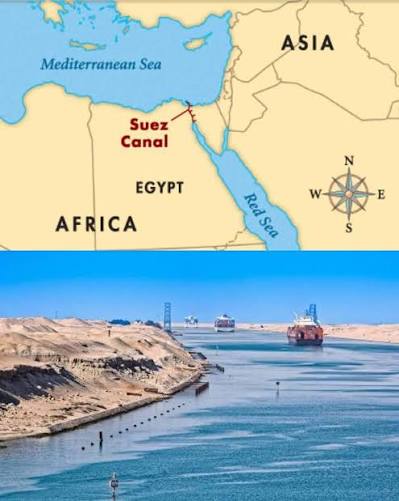
The Red Sea corridor presents an equally serious challenge. Repeated attacks on commercial shipping have compelled numerous shipping companies to abandon the Suez Canal route and instead navigate around the Cape of Good Hope.
The consequences are substantial:
* voyages become longer by nearly two weeks,
* fuel consumption increases dramatically,
* freight rates rise,
* insurance premiums escalate,
* container availability declines,
* export competitiveness weakens.
For export-dependent industries, the additional logistical costs translate directly into reduced global competitiveness.
India’s Structural Exposure
India’s economic geography renders it uniquely sensitive to maritime disruptions. More than eighty-five per cent of India’s crude oil requirements are imported. Its expanding manufacturing sector depends heavily upon imported energy, fertilisers, critical minerals, electronic components, and industrial machinery.
Similarly, Indian exports—including pharmaceuticals, engineering goods, textiles, chemicals, automobiles, and agricultural products—depend upon uninterrupted maritime connectivity.
Consequently, every disruption at Hormuz or Bab-el-Mandeb rapidly affects:
* domestic inflation,
* industrial production,
* energy security,
* trade finance,
* logistics,
* export earnings,
* fiscal management. Geopolitical instability abroad therefore becomes an economic challenge at home.
India’s Strategic Response
Recognising these structural vulnerabilities, India has gradually developed a comprehensive strategy aimed at reducing excessive dependence upon any single maritime corridor.
Diversification of Energy Sources
India has significantly expanded crude oil procurement from Russia while increasing purchases from the United States, Brazil, and Guyana. The objective is geographical diversification rather than exclusive dependence upon Gulf suppliers. Additionally, crude loaded from Fujairah on the Gulf of Oman bypasses the Strait of Hormuz altogether through UAE pipeline infrastructure.
Alternative Trade Corridors
India is simultaneously investing in multiple connectivity initiatives. The India-Middle East-Europe Economic Corridor (IMEC) seeks to combine maritime transport with rail connectivity across the Arabian Peninsula into Europe.
The International North-South Transport Corridor (INSTC) links India with Iran, the Caspian region, Russia, and Europe through a multimodal transport network centred on Chabahar Port.
The proposed Chennai–Vladivostok Eastern Maritime Corridor expands India’s access to Russia’s Far East while reducing dependence upon traditional western maritime routes.
Collectively, these initiatives represent strategic insurance against future maritime disruptions.
Domestic Maritime Infrastructure
India is also strengthening its own maritime ecosystem. The Vizhinjam International Deepwater Transshipment Port enables ultra-large container vessels to berth directly on Indian shores, reducing dependence upon Colombo and Singapore. The proposed Galathea Bay Port in Great Nicobar seeks to establish India’s strategic presence close to the Strait of Malacca, one of the world’s busiest shipping lanes.
Strategic Petroleum Reserves
India continues expanding underground Strategic Petroleum Reserves at Visakhapatnam, Mangaluru, and Padur. These reserves provide valuable cushioning against temporary supply disruptions and sudden geopolitical crises.
Maritime Security
The Indian Navy has substantially enhanced maritime surveillance and escort operations under initiatives such as Operation Sankalp, protecting Indian commercial shipping across the Gulf of Oman, Arabian Sea, and Gulf of Aden.
Naval diplomacy has become an indispensable component of economic security.
The Economic Cost of Maritime Coercion
The weaponisation of international waterways extends far beyond naval strategy.
It disrupts trade finance.
Letters of Credit remain unsettled longer.
Working capital becomes locked.
Shipping schedules become unpredictable.
Inventory costs increase.
Insurance premiums rise.
Ultimately, the burden is transferred to consumers through inflation.
The greatest victims are often neither the belligerents nor the major powers.
They are developing economies whose prosperity depends upon uninterrupted global commerce.
India exemplifies this reality.
Freedom of Navigation: A Collective Responsibility
Freedom of navigation is not merely a legal doctrine.
It is the foundation upon which modern globalisation rests.
Every nation benefits when maritime routes remain open.
Every nation suffers when they become theatres of strategic confrontation.
International waterways cannot become instruments of unilateral coercion, ideological warfare, or hegemonic competition.
Their uninterrupted operation constitutes a global public good.
Protecting that principle requires more than military presence.
It demands renewed commitment to international law, multilateral diplomacy, and respect for the shared maritime commons established under UNCLOS.
Conclusion: Releasing Nature from Geopolitical Captivity
The twenty-first century is witnessing a subtle transformation in the character of power.
Territory is no longer the only object of competition.
Control over movement has become equally consequential.
Whoever influences the world’s maritime chokepoints increasingly influences energy markets, global supply chains, inflation, and economic stability.
Yet the oceans are not commodities.
The straits are not sovereign possessions.
Nature created them long before states emerged, and civilisation has flourished because they remained open to all.
To monopolise these natural corridors is, in effect, to imprison nature itself.
The preservation of free navigation is therefore not merely a maritime concern.
It is a civilisational imperative.
For India—and indeed for every trading nation—the defence of international waterways is inseparable from the defence of economic sovereignty, strategic autonomy, and the rule of international law.
When Nature is placed under arrest, global prosperity becomes its first prisoner.

M. Shiva Prasad, IPS (Rtd.) is a dedicated law enforcement professional who served the combined Andhra Pradesh cadre before opting for the Telangana cadre. Though a native of Andhra Pradesh, he considers himself a true Hyderabadi with an abiding love for the Telugu people. Driven by sincerity, fearlessness, and a lifelong fight against inequality and injustice, his ultimate strengths remain his goodwill and deep affection for the public and the police force. Today, he continues his mission by writing snippets and articles true to his conscience.
Email: Shivareach@yahoo.com
Mobile: 98480 38774