Hindi as a Link Language, Telugu as Our Soul, English as Our Global Window
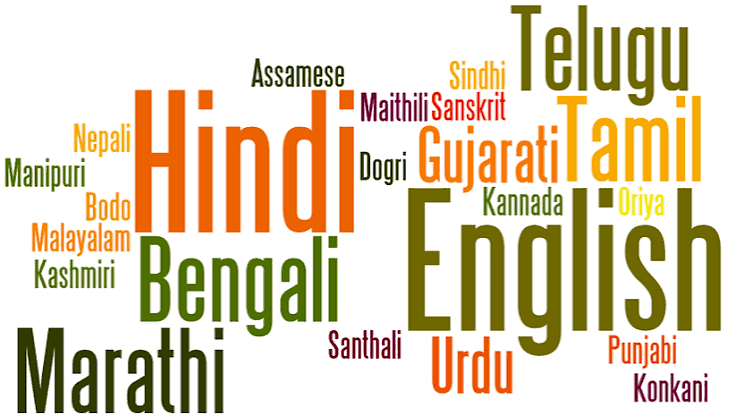
India’s greatest strength has never been uniformity. It has always been unity amidst extraordinary diversity. Few countries can claim the civilisational richness of nurturing hundreds of languages and thousands of dialects while remaining one constitutional republic. Our linguistic diversity is not a liability to be managed but a national asset to be cultivated.
Yet, language continues to be one of the most misunderstood subjects in public discourse. The promotion of Hindi is often portrayed as an attempt to undermine regional languages, while the defence of regional languages is sometimes interpreted as resistance to national integration. Such binaries are both intellectually unsound and socially unproductive.
A confident civilisation does not fear languages. It embraces them.
The debate must therefore move beyond politics and return to first principles. Language is fundamentally a medium of communication, knowledge and opportunity. It should unite citizens rather than divide them. The National Education Policy’s emphasis on multilingualism deserves to be appreciated in this spirit. The three-language approach is neither cultural surrender nor political compromise. It is a practical framework designed to prepare Indian students for an interconnected world.
Preserving Culture, Enhancing National Connectivity, and Bridging Global Frontiers
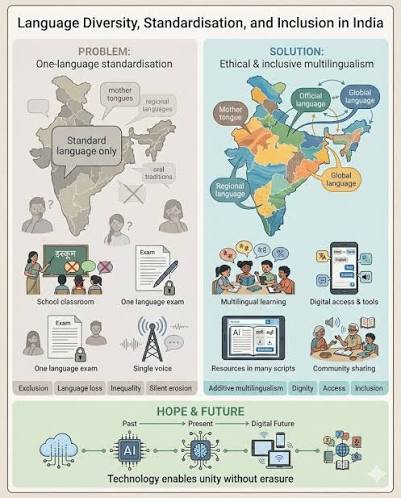
The first pillar is the mother tongue. Telugu is not merely a language; it is a civilisation, a repository of literature, philosophy, poetry, history and collective memory. Every Indian language deserves similar respect and institutional support.
The second pillar is Hindi, which functions as an important link language across large parts of India. In a nation where millions migrate for education, employment, public service, business and tourism, the ability to communicate with fellow citizens across State boundaries becomes a significant social and economic advantage. Learning Hindi should therefore be viewed not as an abandonment of regional identity but as an expansion of national communication.
The third pillar is English, India’s bridge to global science, technology, diplomacy, higher education, international commerce and the emerging world of artificial intelligence. English equips Indian youth to compete confidently on the global stage.
Together, Telugu, Hindi and English create a citizen who is rooted locally, connected nationally and competitive globally.
Preserving Roots While Expanding Horizons: Perspectives from Pawan Kalyan and P. V. Narasimha Rao
This understanding has increasingly found resonance across sections of society. Pawan Kalyan has repeatedly argued that learning Hindi should not be viewed through the prism of linguistic conflict. He has maintained that acquiring additional languages strengthens communication, broadens opportunities and contributes to national integration while preserving pride in one’s mother tongue. Whether one agrees with every aspect of his politics or not, his broader message—that languages should build bridges rather than walls—deserves thoughtful consideration.
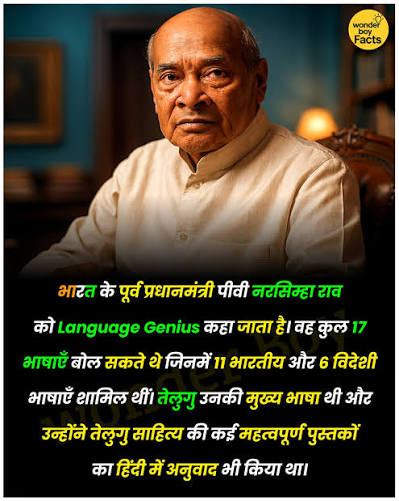
History offers an even more compelling example in P. V. Narasimha Rao. A proud son of Telugu soil, he mastered numerous Indian and foreign languages with remarkable scholarship. His fluency in Telugu, Hindi, English, Marathi, Sanskrit, Spanish and several other languages did not diminish his Telugu identity. Instead, it enhanced his intellectual stature and enabled him to lead India during one of its most consequential periods of economic reform. His life demonstrates that linguistic versatility strengthens leadership without weakening cultural roots.
A Personal Journey into the Transformative Power of Multilingualism
My own experience reinforces this conviction. Telugu is my mother tongue and the language of my emotions and cultural identity. I pursued a Master’s degree in English Literature and another Master’s degree in Hindi Literature. Rather than creating confusion, these languages complemented one another. They enriched my intellectual life, expanded my understanding of Indian civilisation and significantly contributed to my professional livelihood. Every language opened a new world of literature, ideas and human experience.
Learning languages, therefore, should be encouraged as a passion rather than imposed as a burden. At the same time, one cannot ignore contemporary realities. In today’s India, multilingual proficiency has become an educational necessity and an economic advantage. Every additional language enhances employability, strengthens mobility and expands opportunities.
Empowering the Future
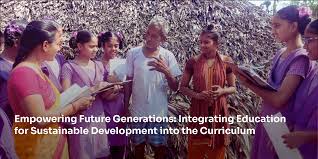
Scientific research increasingly supports this approach. Studies in linguistics and cognitive science suggest that multilingual individuals often display greater cognitive flexibility, stronger analytical abilities and enhanced adaptability. In an economy driven by knowledge, innovation and technology, multilingualism has become a strategic national resource. The objective of public policy should therefore be clear: strengthen every Indian language, preserve regional literary traditions, encourage multilingual education and equip every student with the communication skills required to thrive in India and across the world.
India does not need fewer languages. India needs more Indians who can speak to one another.
Hindi should be viewed as an important link language for national communication, never as a substitute for India’s magnificent regional languages. Telugu must flourish with pride. English must continue to connect India with the world. Together, they embody the true spirit of the three-language approach.
The future belongs to citizens who think deeply in their mother tongue, communicate confidently across their nation and engage fearlessly with the world. Multilingualism is not India’s challenge. It is India’s comparative advantage, its intellectual capital and one of the strongest foundations of its national building.


With a journalistic long journey, we bring you https://primepost.news, a dynamic platform committed to unraveling the intricate tapestry of Indian politics, particularly delving deep into the heart of Telangana and Andhra Pradesh. Our blog is not just a source of news; it’s a reservoir of insights, analysis, and thought-provoking reviews.