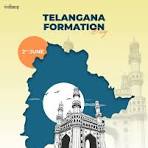
“After prolonged struggle, a new state is born.”
Part-I
Justice P A Choudary, an 88-year-old former Judge of the High Court of Andhra Pradesh, hailing from Guntur, a city in the coastal Andhra region, collected all his strength to go to the polling booth on 30 April to fulfill his responsibility as a voter. When his grandson asked him about his choice of party, it was reported that he said he would vote for the Car, symbol of Telangana Rashtra Samithi (TRS). He is reported to have said, “TRS fought for self-determination for the people of Telangana. The demand is perfectly democratic and constitutional. I support it on the principle of autonomy and self-rule.”
Generally, 99 per cent of the migrants from Andhra, in spite of residing in Telangana for generations, do not identify with Telangana and voted for parties that opposed Telangana, as indicated by the loss of TRS candidates in 21 of 24 seats in Greater Hyderabad. But the Constitutional lawyer Justice Choudary stood apart and appreciated the struggle for separate statehood for Telangana. He breathed his last on 17 May, 15 days before the ‘appointed day’ for the formation of Telangana, after TRS was voted to power with an absolute majority.
This is the dream of four crore people for more than 60 years being realised. Ten districts have been put together to form the 29th state of the Indian Union after a prolonged struggle. While 369 people fell to police bullets during the 1969 agitation, procrastination practiced by the rulers frustrated 1,200 persons to commit suicide between 9 December 2009 and January 2014.
Telangana is a saga of conflict between the Andhras ruled by the East India Company and Telanganites ruled by Nizams and Nawabs. Andhra and Telangana regions were never part of the same kingdom for more than two centuries preceding Independence. Parts of Machilipatnam and Guntur Districts (Andhra) were attached to Nizam’s Hyderabad State 200 years ago till the Nizam ceded them to the British. Even prior to that, the present 23 districts of AP were never together in any kingdom.
They were ‘united’, ignoring the cultural, linguistic, and economic divide, much against the recommendation of the first State Reorganisation Commission. This physical tying up has failed because of a lack of emotional integrity and a lack of brotherhood. But the de-merger was delayed for more than half a century. Though they speak the same language – Telugu – their accent, usage of expressions, culture, food habits, etc., are totally different. As apprehended by B. R. Ambedkar and others, language failed to be the cementing factor of the state. Its linguistic base has been loosened as differences over language were deepened. The experiment of linguistic state failed, and the first linguistic state, Andhra Pradesh, had to fail and fall in 2014.
Part of this territory was once ruled independently by Kakatiya, Satavahana, and Golconda kings, now integrated into a state on its own. Kakatiyas ruled Orugallu (present Warangal) as capital from 1083 to 1323 CE. Prataparudra was a valiant Kakatiya king with a courageous army; he defeated Alauddin Khilji, defending Orugallu fort in 1303. It was a disaster for Khilji at the Upparapalli battle. But in his second attempt in 1309, Khilji could secure a partial victory by capturing Siripur and Hanumakonda forts.
In another battle, Malik Kafur adopted cheap methods of murder and mayhem of innocent people around Warangal fort, which prompted Prataparudra to make a pact and offer an enormous amount of tribute. When there was a change of power in Delhi, Prataparudra wanted to be independent. He could repulse the army of Tughlaq’s son, Ulugh Khan. However, after a month, Ulugh Khan returned with a larger army and captured the Warangal fort. The end of the Prataparudra and Kakatiya dynasty came when he drowned in the Narmada while being taken to Delhi as a prisoner.
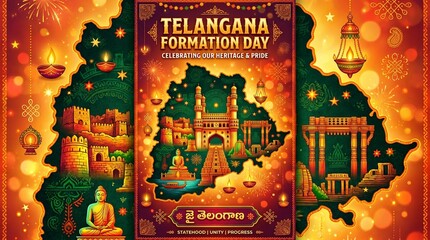
A large part of Telangana formed a core area of the Satavahana dynasty (221 BC to 218 AD), though it was ruled from Amaravati in the Krishna Valley. After the fall of Prataparudra, Telangana went under alien Muslim Rulers. It was called the Golconda state and then Hyderabad State. The Qutub Shahi Dynasty (1520-1687), followed by the Nizam Dynasty (1724-1948), ruled Telangana for a very long period. The historic gate of the Kakatiyas adorns the official logo of Telangana now.
The First States Reorganisation Commission, led by Justice Fazl Ali, did not recommend the formation of a Telugu linguistic state. Justice Fazl Ali suggested keeping Andhra and Hyderabad (Telangana) separate as they were at that time. While the Commission advised both states to exercise the option of integration some years hence, the Nehru government said that they could unite first and separate if they found it difficult to continue. Elements of split are inherent with the formal ‘integration’ of Telugu-speaking districts from Hyderabad and Andhra states.
The struggle for a separate state was because of false promises and betrayals, marginalisation and reducing people to a minority forever in their own state, treating them as second-rate citizens in their own capital, treacherous politics, clandestine diversion of resources, debased manipulations by bureaucrats with politicians for plundering state and employment sources in Telangana, violation of mulki (son of the soil) rules, and established bias in three estates – legislature, executive and even judiciary. Those who monopolised cinema, expression and media ridiculed the Telugu spoken by people of Telangana and suppressed its historical heroes like Komuram Bheem, etc. The literary giants of Andhras even denied the historical origin of the great devotional poet Pothana by creating baseless political controversy about his nativity in Warangal.
People wanted the restoration of their identity. The culture of Telangana, its language, and traditions survived despite the Muslim cultural and linguistic domination. While Telangana made progress under autocratic Muslim Rulers, it suffered suppression and neglect during Telugu governments, whether of Congress or Telugu Desam. The leadership in the Government, its offices, Police, Judiciary, and not the least, the media were filled by Andhras; they grabbed jobs, and diverted funds, rivers, power, coal, and other resources for their own development at the cost of Telangana. They have developed colonies where Andhra persons reside and allowed the old cities and districts to remain underdeveloped. The fight for independence within the Indian Union was without arms and beyond the ‘forts’ in the lobbies of the power and legislative houses. Agitators for Telangana fought huge amounts of money doled out by the anti-Telangana forces, faced clandestine strategies and conspiracies.
In fact, the Telugu people were already divided, even before the so-called integration. It is a fact that from NGOs to ministers, political parties to cultural organisations, almost in all walks of life, the Andhra and Telangana people are divided. Top officers, IAS babus, police, and others have two groups, if not associations. Engineers, doctors, lawyers, and other professionals have two sub-regional associations, unconnected to each other, though working under the same roof. Joint action committees are formed with representatives from different walks of life. The Andhras also came on the streets for ‘Samaikyandhra’ but they never included any Telangana person in their fold.
After Telangana Praja Samithi (TPS) failed in 1969 by merging with the Congress party, it took thirty years for another agitation to start. The strategic agitation spearheaded by the Telangana Rashtra Samithi was vibrant at times and lay low at others. Perhaps no sub-region in the current democratic world has faced so much resistance.
In a union, the people of a state have no choice but to go out of the union, and in a Federation like that of the United States of America, consent binds the states with the nation. America has many characteristics of a federation, with more than one Constitution. India is a combination of unitary and federal features. It is a Union because it keeps destructible states within an indestructible Union. Formation of Telangana is the latest evidence of India’s quasi-federal character, which is unique and well-suited to the country with its historic background of diversity of cultures and multiplicity of languages.
Both Telangana and Andhra Pradesh have great potential for growth if they could work together on river water sharing and make optimum use of resources. It is time for both brothers to struggle on the same page, though from separate territories, for the emancipation of humanity on both sides.
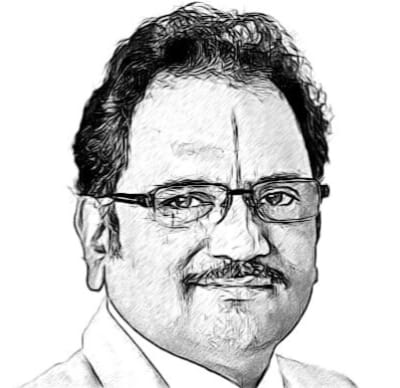
Law professor and eminent columnist
Madabhushi Sridhar Acharyulu, author of 63 books (in Telugu and English), Formerly Central Information Commissioner, Professor of NALSAR University, Bennett University (near Delhi), presently Professor and Advisor, Mahindra University, Hyderabad. Studied in Masoom Ali High School, AVV Junior College, CKM College, and Kakatiya University in Warangal. Madabhushi did LL.M., MCJ., and the highest law degree, LL.D. He won 4 Gold Medals at Kakatiya University and Osmania University.
Email: cicsridhar@gmail.com
Mobile: 8447651505