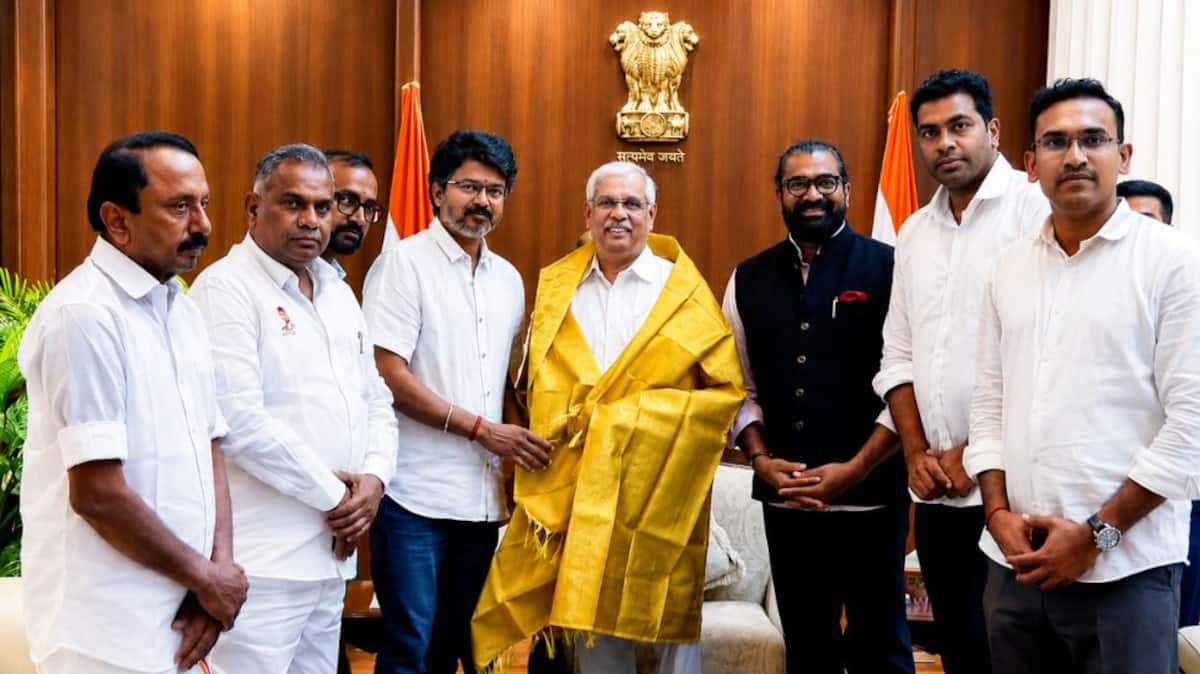
Deconstructing Vijay Victory in Tamilnadu
In Tamil Nadu, the Governor made the correct decision: those wishing to form a government must clarify their strength; individuals and their emotions are not the priority; the Constitution and Laws are paramount. Supreme Court advocate, former Advisor to the Governor of Karnataka, and Constitutional expert Vikas Bansode stated that the Governor’s decision not to invite the leader of the TVK party to take the oath as Chief Minister, until it was proven that they had the necessary majority support, was correct (as per news item from Telugu Newspaper on May 9, 2026). He explained that a Governor cannot invite someone to form a government if there is no clear majority support from members in the Assembly. In this matter, the Governor must act within constitutional limits.
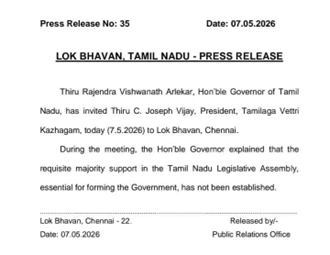
Bansode noted that while TVK has party MLAs, they reportedly fall short of the official majority by about 11 members. Therefore, the Governor’s invitation was delayed. Furthermore, he emphasized that not more than 48 hours should be given to prove a majority on the floor of the house.
Constitution, Laws, and Verdicts are Key
Vikas Bansode clarified that personal emotions, political popularity, or TV studio debates do not supersede the Constitution and laws. The Governor’s primary duty is to ensure a stable government. Decisions should be based on concrete evidence such as support letters or alliance agreements, rather than verbal claims. In the Bommai vs. Union of India case, the Supreme Court ruled that majority must be proven on the floor of the Assembly. The Governor must be convinced that the person has the support of a majority of members before inviting them to form a government.
Historical Precedents
The past Supreme Court rulings during times of uncertainty in government formation:
Bihar: The Supreme Court previously ruled that the Governor is right to refuse permission if a political party fails to show support for government formation.
Manipur (2017): Even though the Congress was the single largest party, the Governor invited a BJP-led coalition with the required numbers. The Supreme Court upheld that the majority is more important than being the single largest party.
Karnataka (2018): Initially, the BJP (single largest party) was given 15 days to prove its majority. The Supreme Court intervened, reducing the time to 24 hours. When they failed to prove the majority, the government fell.
Maharashtra (2019): After a pre-dawn swearing-in based on letters of support, the Supreme Court ordered an immediate floor test to determine the majority.
The Architecture of a Political Miracle:
Deconstructing Vijay’s Hypothetical Rise in a 2026 Hung Assembly
The chaotic theater of Indian politics has taught us one fundamental truth: numbers are pliable, but constitutional precedents are permanent. When the Bharatiya Janata Party (BJP) secured only 104 seats in the 224-member Karnataka Assembly in 2018, Governor Vajubhai Vala controversially granted B.S. Yediyurappa a 15-day window to engineer a majority, overriding a viable post-poll alliance between Congress and the Janata Dal (Secular). Though the Supreme Court cut that timeline short, forcing a resignation before the vote, the event birthed a provocative template.
Millions of people sharply criticized the contrast between the approach taken in Karnataka in 2018 and that later adopted in Tamil Nadu. They wondered what strategy or constitutional reasoning lay behind that decision. The Union Government, particularly the Union Home Ministry, also bears responsibility for protecting constitutional federalism in such situations.
If such a long leash could be offered in Bengaluru, could a similar blueprint unfold for Tamilaga Vettri Kazhagam (TVK) leader Vijay in a fractured Tamil Nadu Assembly? In a hypothetical scenario where the state is staring at a deeply divided mandate, what determines who grabs the crown? Is it masterstroke strategy, calculated constitutional interpretation, political illusion, or sheer cinematic magic?
The Meteoric Rise of a New Matinee Idol
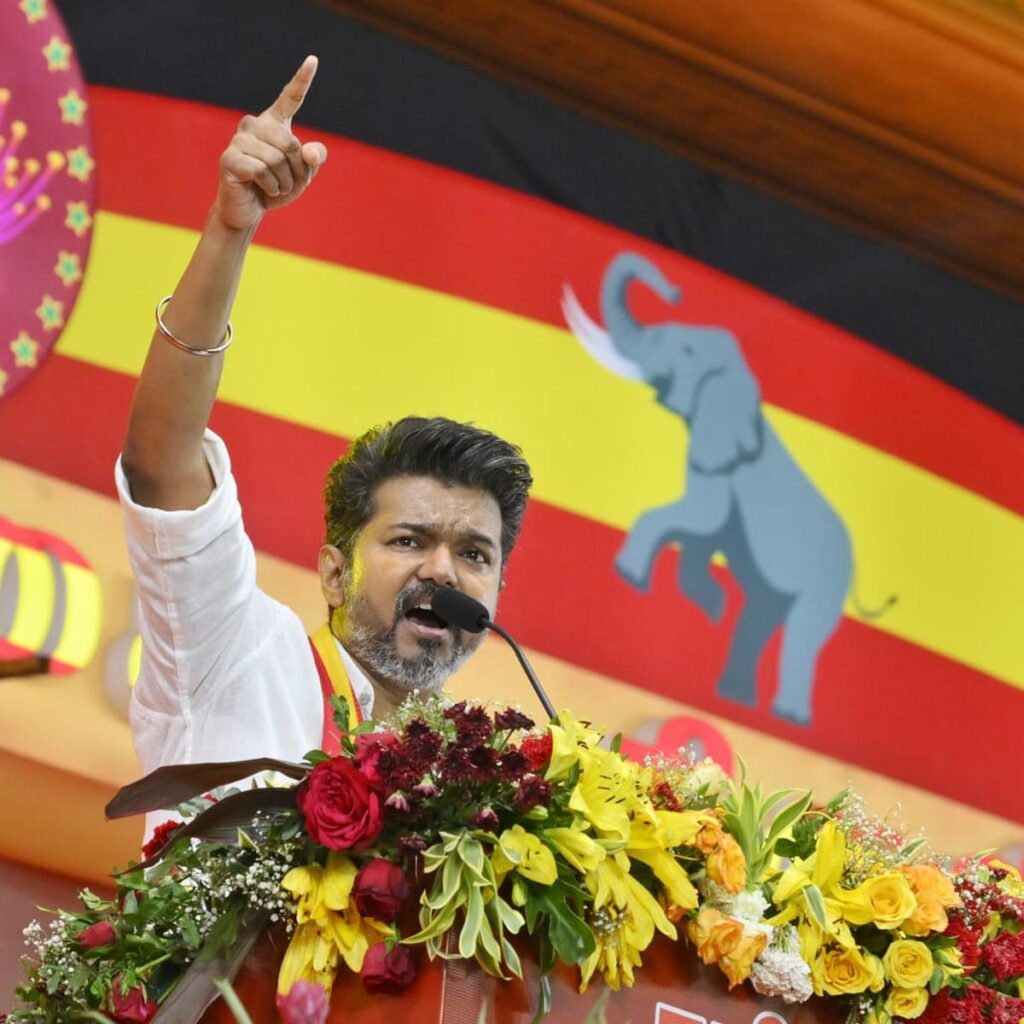
Vijay’s transition from a cinematic powerhouse to a frontline political contender has broken the conventional speed limits of Dravidian politics. As a young Scheduled Caste Christian leader, his political identity carries deep symbolic resonance: Breaking the Reservation Mold: Defying traditional identity politics, Vijay chose to contest and win from two unreserved general constituencies. Rapid Mainstream Acceptance: Within days of the election results, he transformed TVK from a nascent political startup into a formidable claimant for the Chief Minister’s office. Strategic Representation: For his supporters, his ascent represents a generational shift—a rare moment where a Dalit-Christian leader commands center stage in Tamil Nadu without relying on traditional Dravidian umbrellas.
During the height of this post-election instability, the acting Governor of Tamil Nadu, Rajendra Vishwanath Arlekar—holding temporary additional charge—maintained a calculated, unusual silence. Free from dramatic public posturing or polarizing declarations, the Raj Bhavan silently allowed the political gears to turn toward an eventually stable resolution.
Deconstructing the Myth of the “Single Largest Party”
When TVK initially staked its claim with the backing of roughly 108 legislators, critics pointed out that Vijay lacked an absolute majority. Vijay countered by demanding the right to prove his strength on the floor. This brought a classic constitutional debate back to life: does the “single largest party” hold an inherent right to form a government?
The short answer is no. The phrase “single largest party” is conspicuously absent from the text of the Constitution of India, nor is there any legally binding convention that forces a Governor to invite them first.
The Bommai Benchmark
In the landmark S. R. Bommai v. Union of India case, the Supreme Court radically redefined federalism and gubernatorial discretion. The judgment laid down ironclad principles that directly govern hung assemblies:
- The Assembly Floor is Supreme: Majority support cannot be assessed through headcount lists in Raj Bhavans or resort roll-calls; it must be tested exclusively on the floor of the House.
- No Partisan Preferences: Governors cannot act on personal political whims or align their decisions with partisan agendas.
- Limits on Article 356: The threat of President’s Rule cannot be wielded arbitrarily to dismantle or prevent elected governments.
- No Studio Mandates: Legitimate majorities are manufactured through constitutional processes, not in television studios or luxury hotels.
The Strategic Preferences of Government Formation
While the Constitution is silent, successive expert panels—most notably the Sarkaria Commission and the Punchhi Commission—have outlined a clear hierarchy of preferences for Governors navigating a fractured mandate.
| Preference Order | Type of Alignment | Constitutional Legitimacy |
| First Preference | Pre-poll alliance commanding a clear majority | Highest (Reflects direct voter mandate) |
| Second Preference | Single largest party claiming stake with outside support | High (Requires immediate floor validation) |
| Third Preference | Post-poll coalition where partners actively join the Cabinet | Moderate (Formed to ensure stable numbers) |
| Fourth Preference | Post-poll coalition where partners offer external support | Conditional (Highly vulnerable to shifting alignments) |
Though these guidelines lack the force of codified law, they heavily guide gubernatorial ethics. In this instance, constitutional strategist Vikas Bansode reportedly advised that the Governor’s primary duty is not just tracking down the biggest single entity, but actively facilitating a regime that promises long-term structural stability.
This explains why a Governor functioning under a BJP-led Central Government acted with unexpected institutional restraint, deviating from past controversies. In places like Goa and Manipur (2017), governors skipped the single largest party (Congress) to invite BJP-led coalitions that demonstrated stable post-poll numbers. Conversely, rushed swearing-ins in Karnataka (2018) and Maharashtra (2019) ended in public embarrassment and abrupt resignations within days.
The Chessmasters: How the Numbers Shifted
Vijay’s transition from a vulnerable claimant with 108 seats to an unassailable leader was a masterclass in quiet political realignment. The operation moved through three distinct phases:
| Phase 1: Claim staked. | Phase 2. Governor approved. | Phase 3: Floor test was successful. |
| 144 MLAs (Final Majority) | 120 MLAs Allowed to Vote | 144 MLAs (Final Majority) |
- The Initial Staking (108 MLAs): On May 5th, Vijay approached Raj Bhavan with a base of 108 legislators. The crucial momentum shift came when 5 Congress MLAs broke ranks to back him. Remarkably, they did this while their party formally remained a part of the DMK-led INDIA alliance—moving like silent grandmasters on a multi-dimensional chessboard.
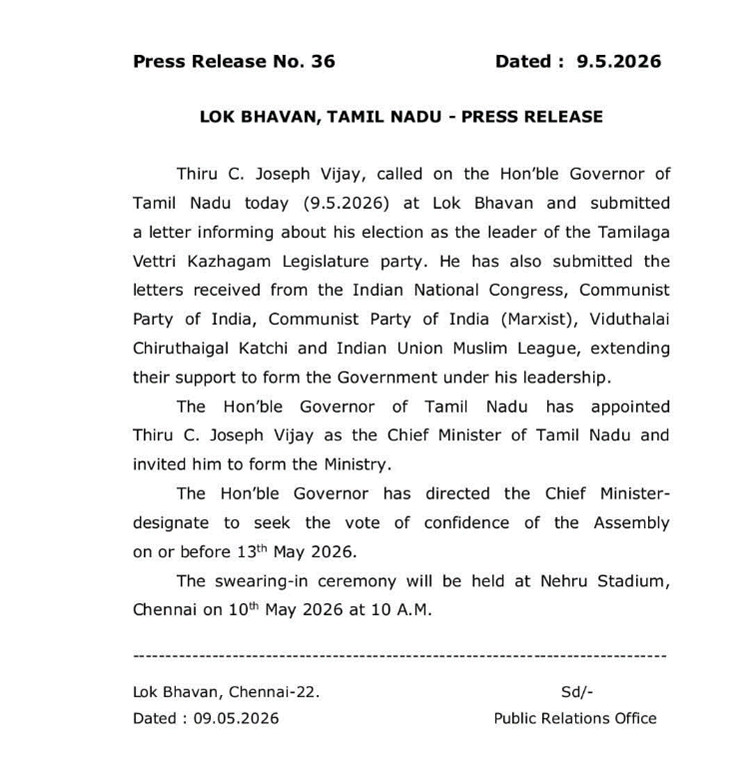
- The Governor’s Validation (120 MLAs): Backed by the Bansode stability doctrine, the Governor permitted a floor test once Vijay’s consolidated file reached 120 MLAs.
- The Coronation (144 MLAs): During the actual voting process on the floor of the House, the numbers swelled dramatically to 144, transforming a fragile minority into an absolute, commanding majority.
Behind the Curtain: Strategy or Illusion?
Vijay’s rise evokes memories of iconic actor-politicians like M.G. Ramachandran, J. Jayalalithaa, and N.T. Rama Rao. Yet, his structural consolidation raises deep, lingering questions about what truly transpired behind the scenes.
If the twin titans of Dravidian politics—the DMK and the AIADMK—wanted to stop TVK, they possessed the combined numbers to do so. Why did they falter?
- The DMK’s Calculated Retreat: Former Chief Minister M.K. Stalin publicly announced that the DMK would not destabilize a TVK government for at least six months. During the final vote, his party staged a strategic walkout rather than voting Vijay down.
- The AIADMK’s Internal Fractures: The AIADMK, traditionally aligned with the BJP, suffered sudden internal rifts at the exact moment of the vote, effectively paralyzing their opposition and indirectly strengthening Vijay’s hand.
Ultimately, this sequence of events enters the realm of political philosophy. Was Vijay the ultimate architect of his own destiny, a lucky beneficiary of a fractured era, or an unsuspecting protagonist in a larger, intricate script written within the quiet corridors of Raj Bhavan?
While the public witnessed a spectacular, cinematic climb to the apex of power, the real puppeteers steering the strings may choose to remain forever invisible.
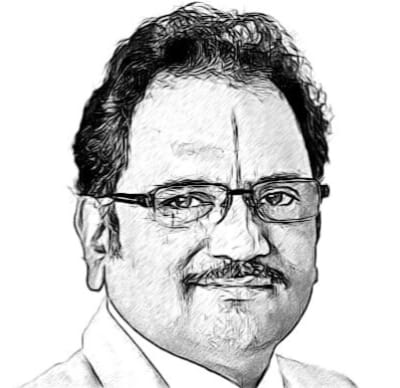
Law professor and eminent columnist
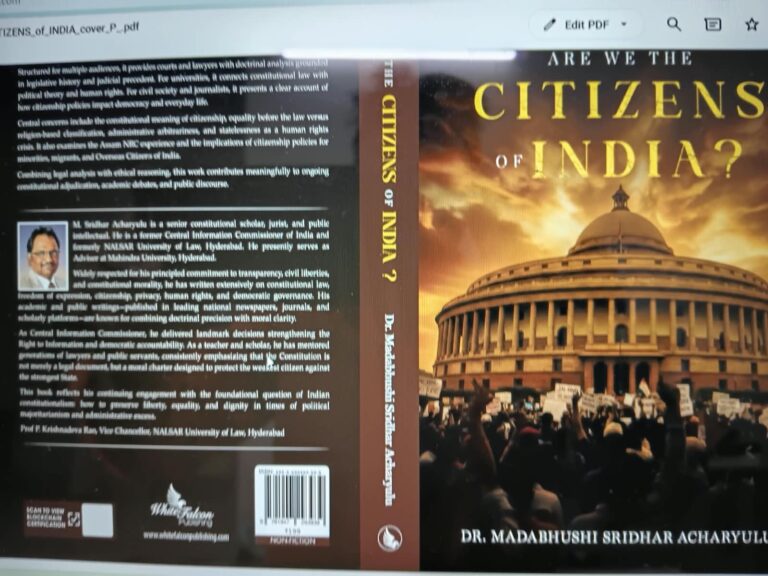
Madabhushi Sridhar Acharyulu, author of 63 books (in Telugu and English), Formerly Central Information Commissioner, Professor of NALSAR University, Bennett University (near Delhi), presently Professor and Advisor, Mahindra University, Hyderabad. Studied in Masoom Ali High School, AVV Junior College, CKM College, and Kakatiya University in Warangal. Madabhushi did LL.M., MCJ., and the highest law degree, LL.D. He won 4 Gold Medals at Kakatiya University and Osmania University.
Email: cicsridhar@gmail.com
Mobile: 8447651505
In such a case I have seen Governor used to invite single party who has highest number of seats shortfall of single digited number of seats and asking party leader to prove absolute majority within a short period. Failing to that he will step down. I remember even in P. V. Narsimha Rao issue also he was offered to form the Government though he was in short fall of seats (single digited number). Later he proved absolute majority within short period. It all depends as per Governor’s choice.