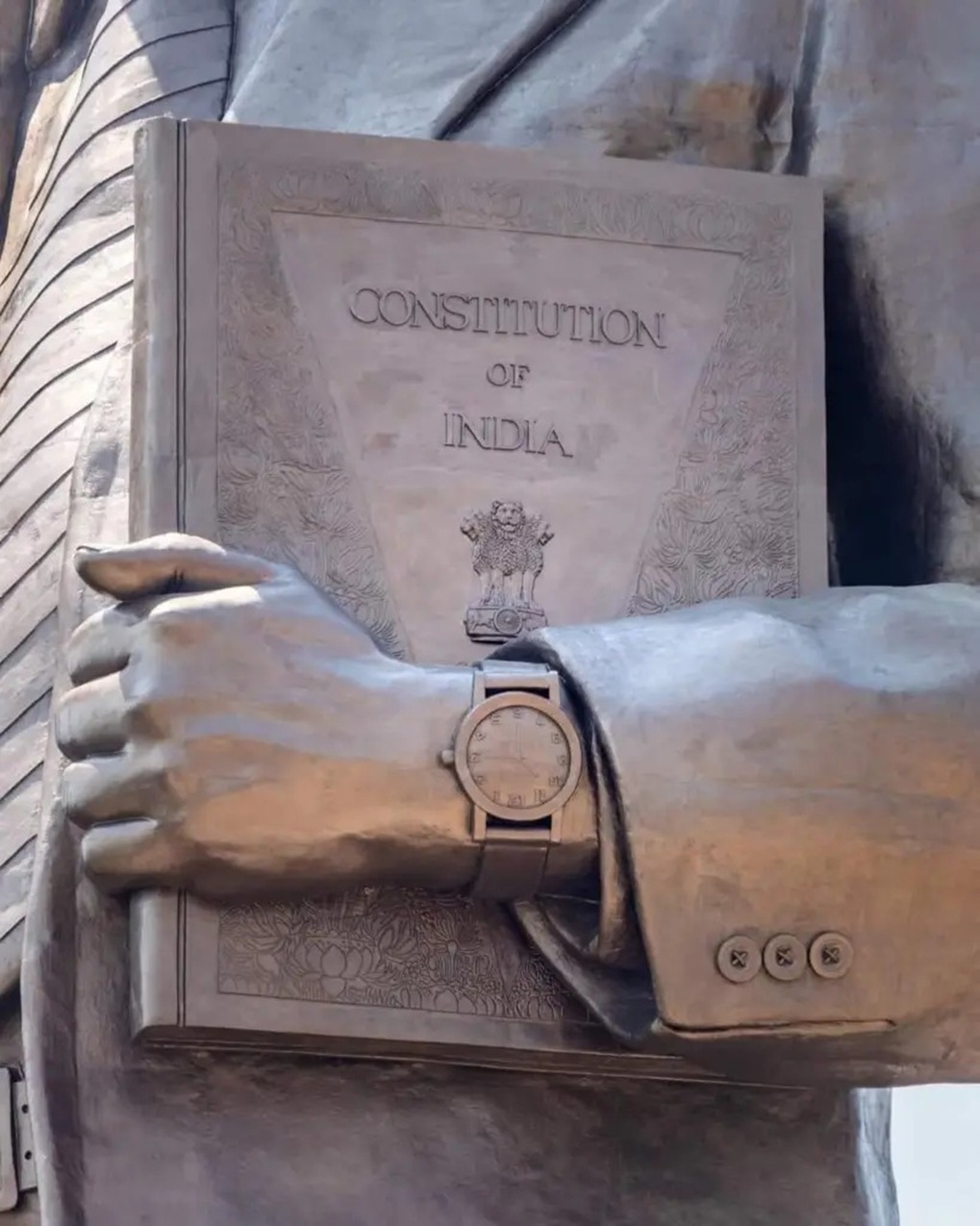
- Ambedkar created a living social contract
The seemingly simple question, ” Who wrote the Constitution of India? opens the door to a far deeper constitutional inquiry. At first glance, one might be tempted to search for a single “author,” much like one would for a book or a literary work. But such a comparison is fundamentally misplaced. A Constitution is not authored in the conventional sense; it is constructed, debated, negotiated, and ultimately adopted as a collective expression of a nation’s will.
In that sense, no individual can claim ownership of the Constitution of India. It does not belong to a person; it belongs to the people. Indeed, the very opening words, We, the People of India,” assert that sovereignty rests with the citizens across generations: those who participated in its making, those who live under it today, and those yet to come. The Constitution is thus not merely a legal document; it is a living social contract.
Yet, while this broad philosophical answer captures the spirit of constitutionalism, it risks obscuring the historical reality of how the document was actually framed. For, although the Constitution is a collective creation, its making was guided, shaped, and structured by identifiable individuals and institutions whose contributions deserve careful recognition.
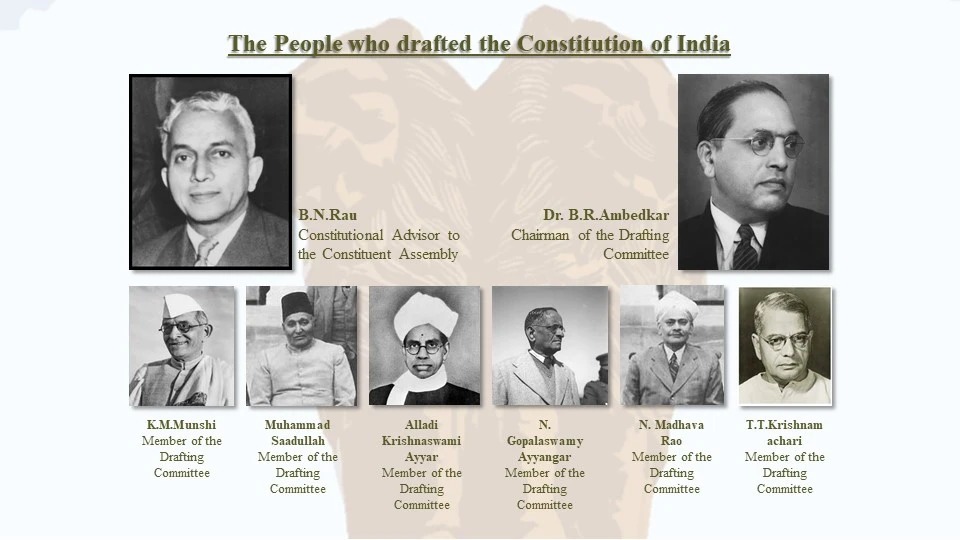
Decisive and transformative
At the forefront of this monumental exercise stands Dr. B. R. Ambedkar. As Chairman of the Drafting Committee, Ambedkar played a role that was both decisive and transformative. To describe him merely as an “author” would be to understate his contribution. He was, in every meaningful sense, the Chief Architect of the Constitution—one who brought coherence to complexity, clarity to competing ideas, and a deep commitment to justice as the guiding principle of the document.
Contribution
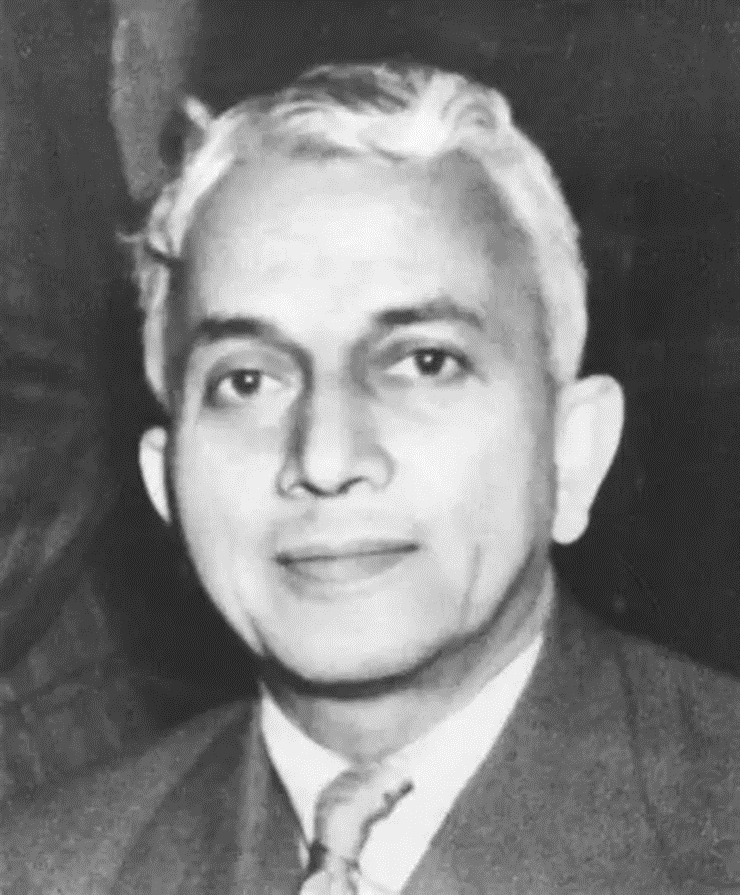
The process of constitution-making, however, began before the Drafting Committee took shape. B. N. Rau, an eminent jurist and civil servant, prepared the initial draft of the Constitution. Drawing upon comparative constitutional models from across the world, Rau laid the intellectual foundation upon which the Drafting Committee would build. His work exemplified the global outlook of Indian constitution-makers, who were not hesitant to learn from other democracies while tailoring solutions to Indian realities.
Equally significant was the contribution of Surendra Nath Mukherjee, whose mastery over legislative drafting ensured that the Constitution achieved precision in language and clarity in legal expression. If Rau provided the blueprint and Ambedkar the architecture, Mukherjee gave the structure its technical finish.
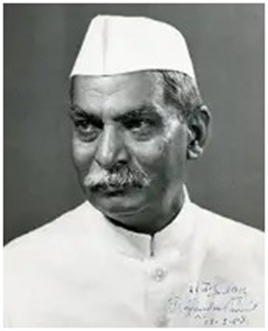
The Constituent Assembly itself functioned as the deliberative core of this enterprise. Presided over by Dr. Rajendra Prasad, the Assembly consisted of 284 members who ultimately signed the Constitution. These members represented diverse regions, communities, and political perspectives. Through rigorous debates spread over nearly three years—specifically, 2 years, 11 months, and 18 days—the Assembly examined every clause, proposed amendments, and shaped the final document.
The Constituent Assembly sat for 141 days of debate
The scale and intensity of this exercise were extraordinary. The Assembly sat for 141 days of debate, reflecting an unparalleled commitment to democratic deliberation. Importantly, the Constitution drew heavily from the Government of India Act, 1935, adapting its administrative framework while infusing it with democratic legitimacy and fundamental rights. This blending of continuity and change enabled India to transition smoothly from colonial governance to a sovereign republic.
The Constitution that emerged from this process is often described as the world’s lengthiest written Constitution. It lays down the framework of governance, defines the powers and functions of institutions, and enshrines Fundamental Rights and Directive Principles. It establishes India as a sovereign, socialist, secular, and democratic republic—committed to justice, liberty, equality, and fraternity.
A “lawyer’s paradise”
Yet, its comprehensiveness has also attracted criticism. The noted constitutional expert Sir Ivor Jennings famously described it as a “lawyer’s paradise,” suggesting that its complexity could invite excessive legal interpretation. While this critique underscores the Constitution’s detailed nature, it also reflects the framers’ intent to address India’s vast diversity and intricate social realities through a carefully structured legal framework.
The organisational structure of the Constituent Assembly further illustrates the collective nature of constitution-making. Multiple committees were constituted to examine specific aspects: the Union Powers Committee and Union Constitution Committee under Jawaharlal Nehru; the Provincial Constitution Committee and Advisory Committee on Fundamental Rights under Vallabhbhai Patel; and various sub-committees dealing with minorities, tribal areas, and fundamental rights. Each committee contributed to shaping different dimensions of the Constitution.
The seven great
The Drafting Committee itself consisted of seven members, including luminaries such as Alladi Krishnaswami Ayyar, K. M. Munshi, N. Gopalaswami Ayyangar, Mohammad Saadulla, B. L. Mitter (later replaced), and D. P. Khaitan. Their collective expertise in law, administration, and public affairs enriched the drafting process.
However, the realities of the time meant that not all members could participate equally. As T. T. Krishnamachari candidly acknowledged, several members were absent due to resignation, death, ill health, or other responsibilities. This left the principal burden of drafting on Ambedkar. Krishnamachari’s statement in the Assembly remains a crucial historical testimony to Ambedkar’s extraordinary contribution.
The Constitution was adopted on 26 November 1949 and came into force on 26 January 1950, marking India’s transformation into a republic. The adoption of 26 November is now commemorated as Constitution Day, reflecting the nation’s commitment to constitutional values.
Collective wisdom
A Constitution is not a literary manuscript that can be attributed to a single pen. It is a living document, born out of intense debate, ideological contest, historical experience, and collective wisdom. In that profound sense, the Constitution of India belongs to the people—those who lived through its making, those who sustain it today, and those who will inherit it tomorrow. It is, in essence, a civilizational covenant.
Yet, acknowledging this collective ownership must not blur historical clarity. Among the galaxy of distinguished contributors, one figure stands pre-eminent: Dr. B. R. Ambedkar. As Chairman of the Drafting Committee, Ambedkar performed a role that went far beyond coordination or compilation. He gave structure to scattered ideas, coherence to competing visions, and a moral foundation to the constitutional framework. His intellectual discipline, legal acumen, and deep commitment to social justice transformed the Constitution into a document of enduring strength and transformative potential.
Ambedkar’s contribution, however, did not exist in isolation. The groundwork laid by B. N. Rau and the technical brilliance of Surendra Nath Mukherjee, along with the deliberative wisdom of the Constituent Assembly under Dr. Rajendra Prasad, were indispensable to the outcome.
Ambedkar himself, in his closing address to the Constituent Assembly on 25 November 1949, offered a warning that remains timeless:
“However good a Constitution may be, it is sure to turn out bad because those who are called to work it, happen to be a bad lot. However bad a Constitution may be, it may turn out to be good if those who are called to work it, happen to be a good lot.”
This profound observation reframes the debate. The success of the Constitution lies not merely in its drafting, but in its working, by institutions, by leaders, and above all, by citizens guided by constitutional morality.
Therefore, the answer must be layered, not linear. The Constitution of India is a collective creation, shaped by many minds and voices, and ultimately owned by the people of India. Yet, its architecture—its design, structure, and enduring vision—bears the unmistakable imprint of one individual.
Dr. B. R. Ambedkar was not merely a contributor, nor an author in the ordinary sense. He was not just a draftsman. He was the Chief Architect of the Constitution of India.
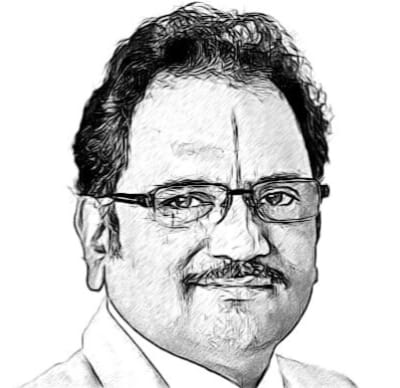
Law professor and eminent columnist
Madabhushi Sridhar Acharyulu, author of 63 books (in Telugu and English), Formerly Central Information Commissioner, Professor of NALSAR University, Bennett University (near Delhi), presently Professor and Advisor, Mahindra University, Hyderabad. Studied in Masoom Ali High School, AVV Junior College, CKM College, and Kakatiya University in Warangal. Madabhushi did LL.M., MCJ., and the highest law degree, LL.D. He won 4 Gold Medals at Kakatiya University and Osmania University.
Email: cicsridhar@gmail.com
Mobile: 8447651505