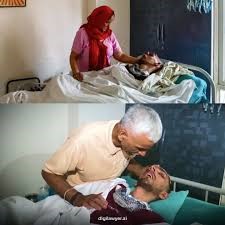
In a quiet room at the All India Institute of Medical Sciences (AIIMS) on Tuesday, Harish Rana passed away, bringing a peaceful conclusion to a 13-year struggle and marking a historic first for India. Harish became the first person in the country to be granted passive euthanasia under a court-mandated protocol, ending a landmark case that has forever changed the landscape of Indian law and medical ethics. His passing at AIIMS New Delhi signifies more than just the end of a long medical battle; it represents the moment India’s legal theory on the “right to die with dignity” finally met compassionate, real-world practice.

The conclusion of the Harish Rana case has sent ripples through the Indian legal system, effectively expanding the meaning of Article 21 of the Constitution. While this article has always guaranteed the “Right to Life and Personal Liberty,” the Supreme Court’s intervention has clarified that this right is not just about the struggle to stay alive, but also about the right to a dignified and painless end when recovery is medically impossible. For Harish, a former engineering student who spent 13 years in a persistent vegetative state after a tragic fall in 2013, the law finally recognized that “life” is more than just a beating heart maintained by machines.
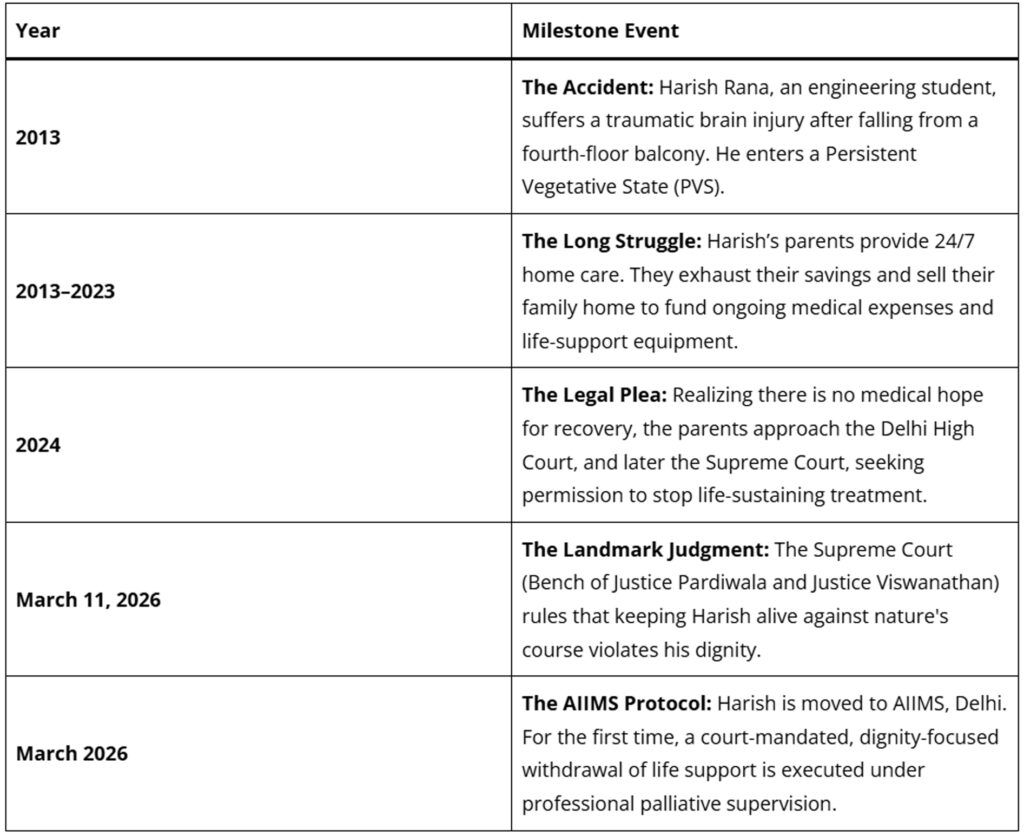
For over a decade, Harish’s parents provided tireless care, even selling their home to cover mounting medical bills. Eventually, they approached the courts with a heartbreaking plea: that keeping their son alive through artificial means, with zero hope of recovery, was only prolonging his suffering. In a landmark judgment delivered on March 11, 2026, the Supreme Court bench, led by Justice J.B. Pardiwala and Justice K.V. Viswanathan, ruled in favor of the family, marking the first time India’s passive euthanasia guidelines were put into actual practice.
The true legal breakthrough lies in how the court addressed Clinically Assisted Nutrition and Hydration (CANH). The court made a critical distinction by classifying feeding tubes as “medical treatment” rather than basic nursing care. This allowed the principles of passive euthanasia to apply, permitting the withdrawal of interventions that are no longer beneficial to a patient. This shift moves the legal focus from “keeping a body functioning at any cost” to “respecting the soul’s peace,” acknowledging that the right to life inherently includes the right to die with dignity.
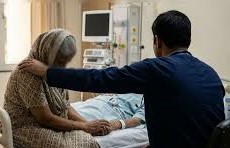
The court-mandated protocol was designed to be deeply humane. Rather than an abrupt “switching off” of machines, Harish was moved to the palliative care department at AIIMS, Delhi. Under a supervised, dignity-focused protocol, a team of specialists ensured he felt no pain or distress through a gradual withdrawal of life support combined with palliative sedation. The court emphasized that this was not an “act of abandonment” but an act of profound compassion for a soul trapped in a static body.
By successfully implementing this protocol, the Harish Rana case has provided a practical roadmap for future cases involving irreversible medical conditions. It has bridged the gap between theoretical legal rights and real-world medical practice in India. While the judgment brought a sad end to a long struggle, it has been hailed for bringing peace to a grieving family and setting a compassionate precedent for thousands of others facing similar ethical dilemmas.
The Harish Rana Case: A Legal and Medical Timeline (2013–2026)
The journey from a tragic accident to a history-making Supreme Court judgment spanned thirteen years. Here is the sequence of events that redefined the “Right to Life” in India:
Senior Journalist
Anand Gantela is a seasoned media professional with nearly three decades of experience across the spectrum of Indian journalism. Having worked extensively in both print and broadcast media, he has held key positions at renowned outlets such as Prajashakthi, Andhra Bhoomi, Mudra, Media India, Siti Cable, Mana Telugu, and Maa TV. From ground-level reporting to managing news bureaus and overseeing bulletin production, Anand has witnessed the evolution of news firsthand. His wealth of experience reflects a deep understanding of the dynamic and ever- evolving landscape of news reporting.
Email: gantela.anand@gmail.com
Mobile: 7893549889