The Case for alleged Partisan Misconduct Against the CEC
In a historic move, opposition parties from the INDIA bloc submitted a formal notice on March 13, 2026, seeking the removal of Chief Election Commissioner (CEC) Gyanesh Kumar. According to parliamentary sources and recent reports, 193 Members of Parliament signed the notice (slightly different from the 197 cited in some early reports), comprising 130 MP’s from the Lok Sabha and 63 MP’s from the Rajya Sabha.
Key Details of the Motion
The 10-page notice was spearheaded by the Trinamool Congress (TMC) and supported by other major parties, including the Congress, Samajwadi Party, and AAP. The motion lists seven charges against the CEC, including partisan and discriminatory conduct. Allegations of blocking probes are that the poll body has favoured the ruling party.
Voter Disenfranchisement
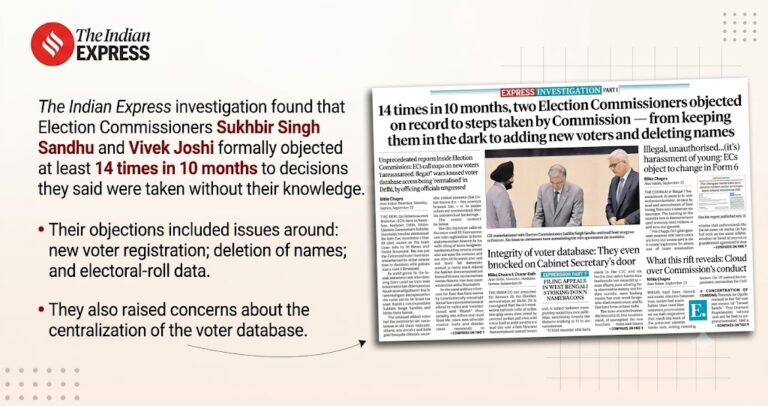
Criticism regarding the “Special Intensive Revision” (SIR) of electoral rolls, which the opposition claims led to the mass deletion of legitimate voters, particularly in West Bengal and Bihar. Allegations are on blocking probes into electoral fraud. Under Article 324(5) of the Constitution, a CEC can only be removed in the same manner as a Supreme Court judge. The rules require at least 100 signatures in the Lok Sabha or 50 in the Rajya Sabha. The opposition has exceeded both.
The Speaker of the Lok Sabha and the Chairman of the Rajya Sabha must now decide whether to admit the motion. If admitted, a three-member judicial committee will be formed to investigate the charges. This is the first time in India’s history that a formal notice for the removal of a Chief Election Commissioner has been submitted in Parliament. The move comes amid heightened political tension just as assembly elections in states like West Bengal and Kerala are approaching.
The Two-Step Mathematical Hurdle
To pass the motion, it must satisfy both of the following conditions simultaneously in each House. The motion must be supported by more than 50% of the total membership of the House. For example, in the Lok Sabha (543 seats), at least 272 members must vote in favour, regardless of how many are actually present that day. The motion must also be supported by at least two-thirds (66.6%) of the members present and voting.
Why is this so difficult?
This high threshold acts as a safeguard. If a House has 543 members but only 300 show up to vote, a “two-thirds majority” of those present would be 200. However, since 200 is less than the 272 required for an absolute majority, the motion would fail. Both criteria must be met in the same session of Parliament.
Requirement Initiation
Signed by 100 MPs (Lok Sabha) or 50 MPs (Rajya Sabha) is required for taking the initiative. The Speaker or Chairman has the discretion to admit or reject the notice. A three-member committee (SC Judge, HC Chief Justice, and Jurist) investigates the charges. Voting must pass by the special majority described above in both the Houses. The President of India issues the formal order of removal.
Historically, while several removal motions have been initiated against judges in India, none have successfully completed the entire process to result in a removal, often because the “Special Majority” is so hard to achieve or the individual The constitutional requirements for the removal of a Chief Election Commissioner (CEC) are purposefully stringent to ensure the independence of the Election Commission. As per Article 324(5), the CEC can only be removed in the same manner as a Judge of the Supreme Court.
The “Special Majority” required to pass this motion is a two-step mathematical hurdle that must be cleared in both the Lok Sabha and the Rajya Sabha. The motion must also be supported by at least two-thirds (66.6%) of the members present and voting. “The INDIA bloc’s motion will serve the purpose of exposing the lack of neutrality of the CEC.”
Editor, Prime Post
Ravindra Seshu Amaravadi, is a senior journalist with 38 years of experience in Telugu, English news papers and electronic media. He worked in Udayam as a sub-editor and reporter. Later, he was associated with Andhra Pradesh Times, Gemini news, Deccan Chronicle, HMTV and The Hans India. Earlier, he was involved in the research work of All India Kisan Sabha on suicides of cotton farmers. In Deccan Chronicle, he exposed the problems of subabul and chilli farmers and malpractices that took place in various government departments.
Email: ravindraseshu7@gmail.com
Mobile: 9063718675