The Grace of Acceptance
1. The Arrival
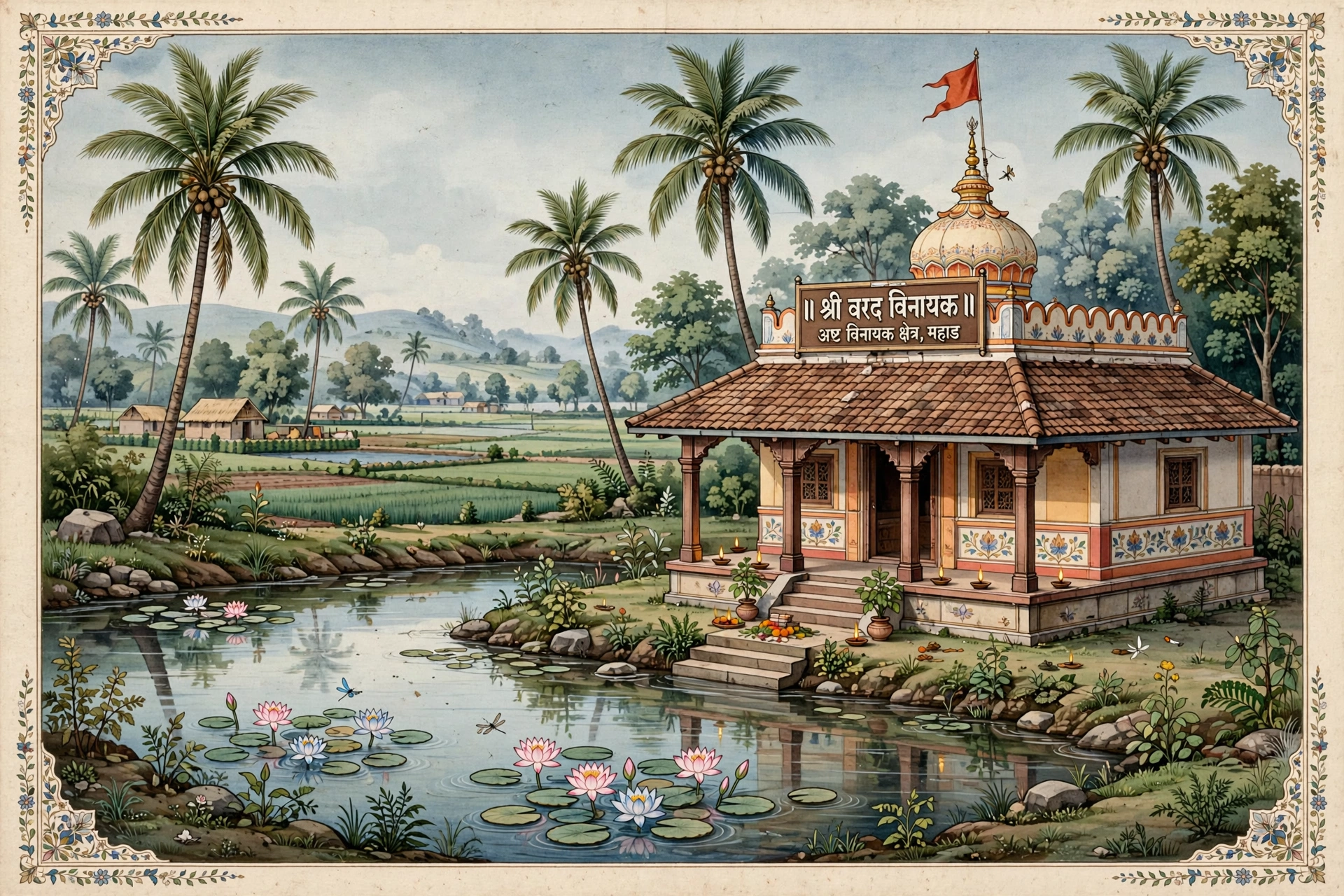
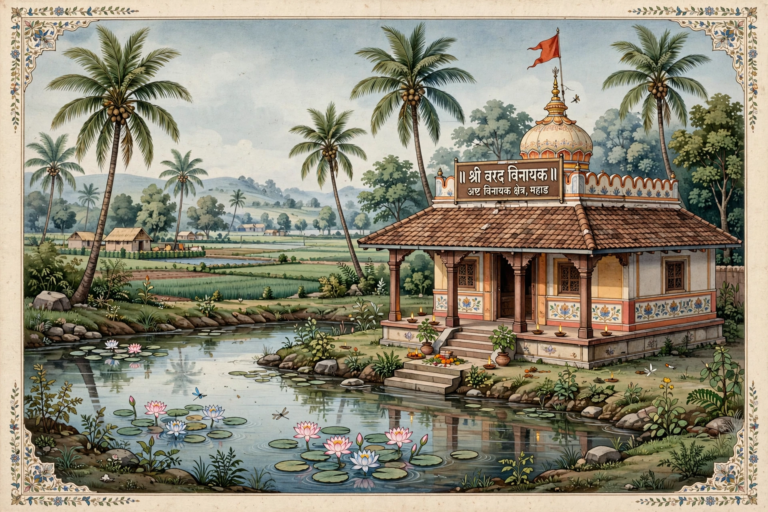
The journey now leads to a quiet village off the Mumbai-Pune highway, wrapped in the rolling greens of the Raigad district. Mahad does not announce itself with grand gateways or tourist crowds. You walk down a narrow path flanked by coconut trees, cottages, and open fields. The temple sits beside a pristine, ancient pond filled with water lilies. The structure feels incredibly intimate, resembling a simple old tiled house rather than a fortress.
As you step onto the stone courtyard, the soft sound of water lapping against the edge of the pond sets the pace. The air is cool, carrying the scent of damp earth and fresh tulsi leaves. A kingfisher darts across the water. There is no rush here. The temple does not impress you with scale. It disarms you with simplicity.
This is the first Ashtavinayak shrine where you feel you could live. Where the god feels like a neighbour. And that is the point. Because the lesson of Mahad is not about escaping the world. It is about accepting it, exactly as it is.
2. The Ancient Legend
The lore of Mahad centers on a prince named Rukmangada. Through a complex twist of cosmic events and mistaken identity, a great sage cursed the prince with a terrible physical affliction. His skin broke out in painful sores. His beauty vanished. His courtiers turned away. Stripped of his royal identity, his health, and his place in the world, Rukmangada retreated into these deep forests.
He did not let bitterness consume him. He did not curse the sage, or the gods, or his fate. Instead, he sat by this very pond and turned his mind completely toward Ganesha. He did not pray for revenge. He did not pray for his old life back. He prayed for peace with the life he had.
After years of deep contemplation, the Lord appeared before him to grant a boon. Rukmangada asked for his health to be restored, but he also asked for something more: that this spot become a perpetual source of blessings for anyone seeking relief from life’s sudden tragedies.
Ganesha agreed, offering the boon of his permanent presence here as Varadvinayak, the giver of blessings and ultimate boons. Varada means “the giver of boons.” But the deeper meaning is this: the greatest boon is the capacity to accept what cannot be changed.
3. The Uniqueness of the Form
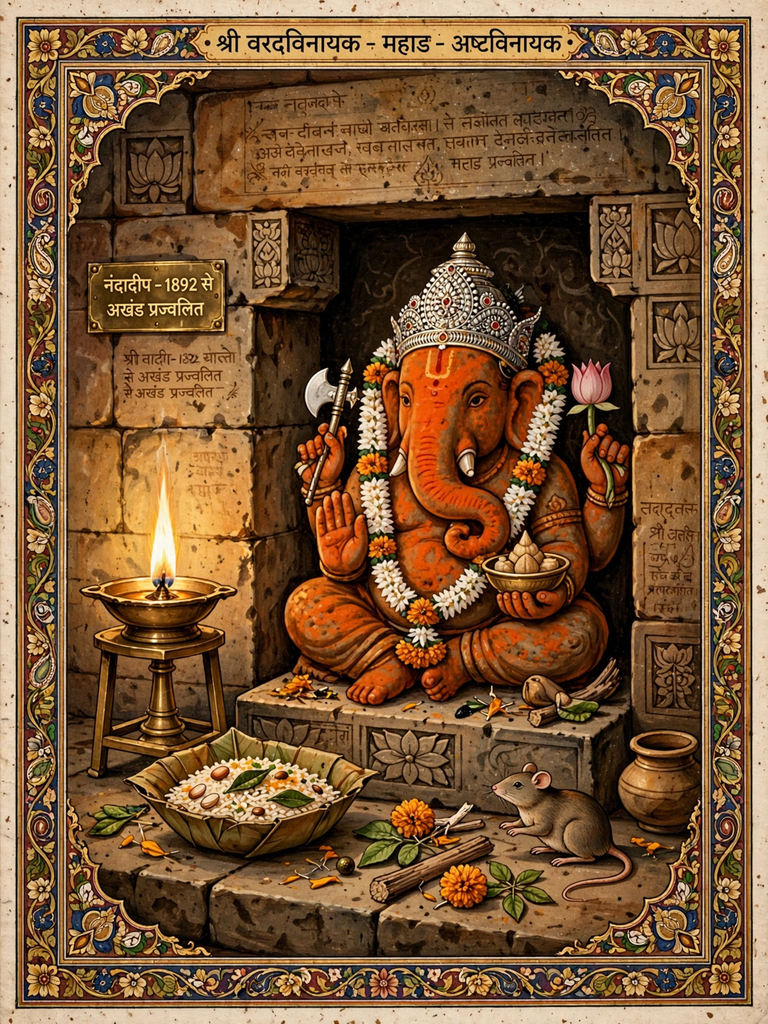
The inner sanctum at Mahad holds a very unique tradition. Unlike most other temples where the ancient deity is kept out of reach behind silver doors, here the seeker can enter the core chamber and sit directly beside the stone. The Swayambhu form is modest and sits facing the east. His trunk turns to the left, maintaining the gentle, nurturing approachability we see in the early stages of the circuit.
A unique feature of this shrine is an oil lamp that has been kept continuously burning since the year 1892. The steady, golden flame reflects off the saffron-coated stone, creating a constant field of warm light that fills the small room. It has survived world wars, monsoons, and power cuts. It is called the Nanda Deep. The unextinguished lamp.
The lamp is not miraculous because it never went out. It is miraculous because people kept lighting it. Acceptance is like that. It is not a one-time event. It is a flame you tend, daily, quietly, without applause.
Outside, the pond is called the Pushkarini. Pilgrims believe a dip in its waters heals skin afflictions — a direct echo of Rukmangada’s story. But the real healing is not in the water. It is in the act of immersion. Of letting go.
4. The Inward Lesson
Moregaon gave us our clear purpose. Siddhatek built our capability. Pali gave us the courage to shield ourselves from external hostility and to surrender when we are tied to the tree. But even with all these milestones achieved, life eventually presents us with situations we cannot control, fix, or fight.
The affliction of Rukmangada is a metaphor for the sudden, unfair setbacks that strip us of our status, our plans, or our expectations. A diagnosis. A betrayal. A market crash. A child who does not turn out how you hoped. These are not problems to be solved. They are realities to be met.
Varadvinayak represents the stage of total acceptance. He teaches us that true strength does not lie in continuous resistance. Sometimes, the highest form of maturity is to surrender our demand for why things happened and accept the reality before us. This is not defeat. It is the opening of a space where healing can begin.
We waste immense internal energy fighting realities that have already occurred. We demand that the past change its course. We replay the conversation. We Google the symptom. We ask “why me?” for the thousandth time. But Varadvinayak invites us to pause the exhausting struggle.
Acceptance is not approval. Rukmangada did not say “I like these sores.” He said “I will not let these sores stop me from praying.” Acceptance is saying: This is what is. Now, what is wise?
The ancient, unextinguished oil lamp reminds us that even in the darkest phases of life, a steady, quiet awareness inside us remains completely untouched by external storms. You may lose your job, your health, your reputation. But you do not lose the witness. The Nanda Deep in you never goes out. Your job is to sit beside it.
5. The Taste of the Temple
The Naivedya offered at Mahad is remarkably simple. It consists of Poha, flaked rice mixed with grated coconut and light spices. It is the food of the common household, light, unpretentious, and deeply grounding.
There is no elaborate preparation or heavy sweetness. No ghee-laden laddu like at Pali. No roasted sattu like at Siddhatek. Poha is what you eat on an ordinary Tuesday morning. It tastes of the ordinary day, reminding us that grace is found not in grand, extraordinary events, but in learning to accept and find nourishment in the simple reality of the present moment.
The coconut is white — purity. The poha is soft — gentleness. The tempering is mild — no drama. When you eat it after darshan, sitting by the pond, you understand: healing is not a miracle. It is a breakfast. It is showing up for the simple, day after day, until the bitterness softens.
6. The Closing Reflection
We often waste immense internal energy fighting realities that have already occurred. We demand that the past change its course. But Varadvinayak invites us to pause the exhausting struggle. Acceptance is the threshold of true transformation.
Take a moment today to look at the heaviest burden you are carrying. Don’t try to fix it. Don’t try to reframe it. Just name it. “I am carrying…” What happens when you stop fighting it and simply sit with it in quiet acceptance, like Rukmangada by the pond?
The moment you accept the reality; the barrier turns into a bridge. The pond does not ask you to be pure before you enter. It makes you pure because you entered.
The Nanda Deep has been burning since 1892. It will still be burning after we are gone. Your job is not to keep the whole world lit. Your job is to sit beside your own small flame, and keep it from going out.
From here, the path climbs to Lenyadri, where acceptance deepens into silence. But first, eat the poha. Listen to the water. And let what is, be.
Author Biography: – R Srinivasa Murthy, the author, is a corporate leader, an independent writer, and a student of Hindhu Philosophy. He Identifies as a Demystic, committed to removing unnecessary mysticism from traditions to offer practical systems for the next generation. His upcoming book, Logic of And: Sanatana Dharma as a Toolkit for the Contemporary Seeker, aims to bridge ancient wisdom with modern life to foster an inclusive, living civilisation.

With a journalistic long journey, we bring you https://primepost.news, a dynamic platform committed to unraveling the intricate tapestry of Indian politics, particularly delving deep into the heart of Telangana and Andhra Pradesh. Our blog is not just a source of news; it’s a reservoir of insights, analysis, and thought-provoking reviews.
Beautifully written, Sir! 🙏 The message of Varadvinayak—acceptance, inner strength, and finding peace in what we cannot change—is truly profound. The Nanda Deep beautifully reminds us to keep our inner light burning through every phase of life. Ganpati Bappa Morya! 🙏🌺
Superb sir😍😍
As a Author and philosopher,You are doing a Tremendous activity.
I bow my head about your Divineship sir🙏🙏👍😍🌞🕊️