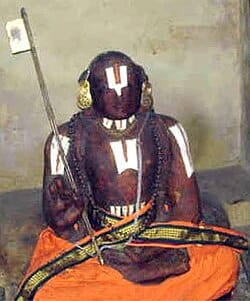
Bhagavan Sri Ramanujacharya stands as one of the foremost among the three great Acharyas (teachers) of Indian philosophy. He is the propounder of Vishishtadvaita (Qualified Non-dualism), a profound philosopher, a theistic rationalist, and a yogi. Ascending temple towers, he openly revealed the sacred secrets of the Narayana mantra, guiding countless souls toward the radiant path of divine knowledge. He was a universal teacher who sought to dismantle the barriers of caste, creed, and gender, aspiring for all beings to attain the Supreme. He was a teacher who unlocked the secrets of sacred mantras, an awakener, and a guide to liberation. The spiritual traditions illuminated by Adi Shankaracharya through Advaita, by Ramanuja through Vishishtadvaita, and by Madhvacharya through Dvaita represent three luminous paths for spiritual life. Among these, the philosophy of Sri Ramanuja holds a unique and distinguished place.
Sri Ramanuja Jayanti (Vaisakha Panchami)
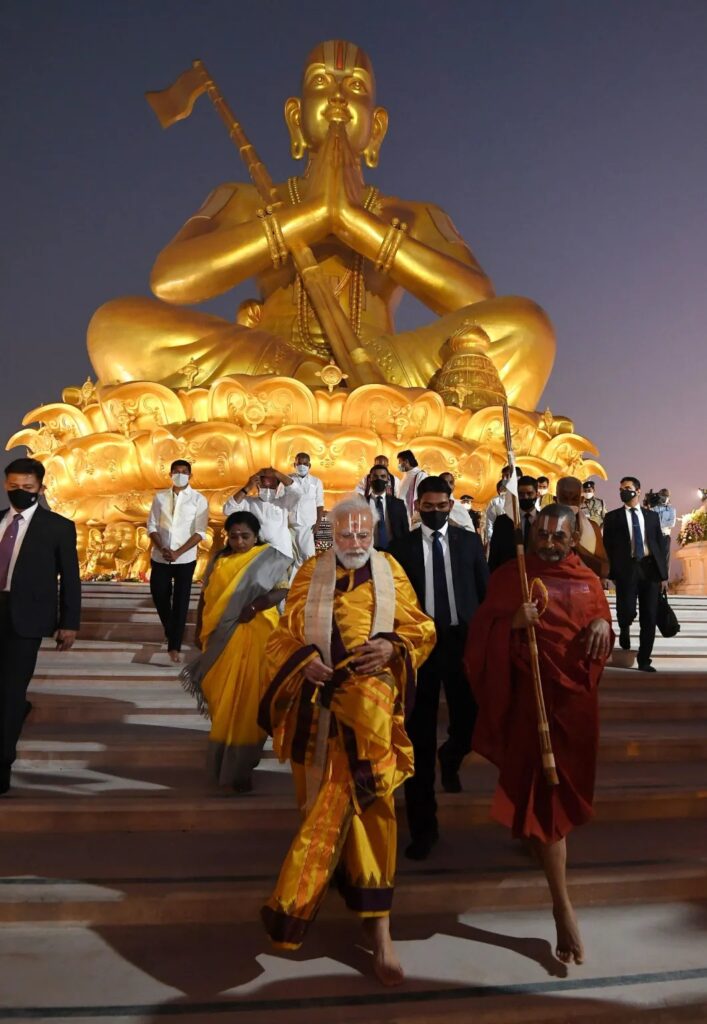
Sri Ramanujacharya was born in Sriperumbudur (historically known as Bhutapuri) in Tamil Nadu to the pious couple Keshavacharya and Kantimati, in the Tamil year Pingala. Interestingly, he also attained paramapada (divine abode) in another Pingala year. Just as King Dasharatha performed the Putrakameshti Yajna to be blessed with Lord Rama, Keshavacharya and Kantimati too are believed to have performed the same ritual to be blessed with this divine child. According to Ayurveda, the full span of human life is 120 years. In traditional Tamil and Telugu calendars, a year-name repeats once every 60 years; thus, 120 years completes two such cycles. Sri Ramanujacharya, born in 1017 CE and living until 1137 CE, is regarded as having lived a complete life span. He firmly believed in and practiced the principle that “knowledge belongs to all.” He was a preacher of Vishishtadvaita who made the paths of devotion (bhakti) and knowledge (jnana) accessible to everyone.
Recovering Deities from Muslim Rulers
During periods when foreign rulers attacked India, desecrating temples and abducting sacred idols, both Adi Shankara and Ramanuja used their intellectual brilliance and debating skills to restore these temples and recover many lost deities. To understand the essence of the sacred eight-syllable (Ashtakshari) mantra, Ramanuja undertook immense hardship. He walked hundreds of miles repeatedly, observing fasts and enduring trials, traveling eighteen times from Srirangam to Tirukoshtiyur to earn his teacher’s grace. His perseverance and determination stand as an extraordinary example of spiritual dedication. Sri Ramanuja did not believe that one is a Vaishnava merely by birth. Instead, he taught that one who fixes their mind on Lord Vishnu and practices universal equality is the true Vaishnava. Traveling across the country, he engaged in philosophical debates, scriptural discourses, and intellectual discussions, achieving great victories.
Vishnu in Tirumala
One of his most remarkable debates was at Tirumala, where some Shaivites claimed the deity was Shiva. Through rigorous argument, Ramanuja established that the deity was indeed Narayana, reaffirming Tirumala as a Vaishnava shrine.
“Nine Gems of Ramanuja” Literary Contributions Ramanuja was an accomplished scholar fluent in Sanskrit, Tamil, and Manipravalam (a blend of both). His major works include: Sri Bhashya(commentary on Brahma Sutras) Commentary on the Bhagavad Gita from the Vishishtadvaita perspective Vedartha Sangraha(interpretation of the Upanishads) He also composed three celebrated prose works: Sharanagati GadyaSri Ranga GadyaVaikuntha Gadya Other works include Vedanta Sara, Vedanta Deepa, and Nitya Grantha. These nine works are collectively known as the “Nine Gems of Ramanuja,” earning him the title Sri Bhashyakara.
12 Alvars, including Goddess Andal
He brought the works of the twelve Alvars (Vaishnava saints), collectively known as Nalayira Divya Prabandham, to the masses. He also widely propagated the devotional hymns of Goddess Andal, especially Tiruppavai. Among the twelve Alvars, eight were non-Brahmins and one was a woman—clear evidence that Vaishnavism transcended caste boundaries. Ramanuja institutionalized the practice of feeding all devotees equally in temples, irrespective of caste or creed. This communal dining tradition was known as Tadiya Aradhana or Samaradhana. He organized large-scale food distribution systems called “Ramanuja Kutami,” which continue in Vaishnava temples even today.
Travels and Social Contributions
Ramanuja traveled extensively, from Thiruvananthapuram in the south to Dwarka in the west, from Kashmir and Nepal in the north up to Muktinath, and to Puri Jagannath in the east—spreading Vaishnava philosophy and establishing a spiritual tradition. At Tondanur, he constructed a massive 2200-acre temple tank known as “Tonnur Kere,” located about 20 km from Melkote. For over a thousand years, it has provided drinking water to nearly seventy villages. In another remarkable episode, Ramanuja discovered a crown at Tirunarayanapuram and searched for the matching idol. Lord Narayana appeared to him in a dream, revealing that the idol was in the custody of a Delhi Sultan. Ramanuja traveled there, negotiated its return, and brought the deity back. It is said that the Sultan’s daughter, who had developed deep devotion for the deity, followed him and was respectfully honored by Ramanuja as “Bibi Nachiyar.” Historical accounts also state that when a Chola king removed the Govindaraja idol from Chidambaram out of sectarian bias, Ramanuja brought the idol to Tirupati and established the Govindaraja temple there.
Devotion of Disciples
His disciple Kuresa (Koorathazhwan) offered this profound prayer: “Forever devoted to the twin lotus feet of Achyuta, considering all else as mere straw, I surrender at the feet of my guru, the ocean of compassion, Ramanuja.” Sri Ramanujacharya’s path remains eternally relevant, a path of compassion, equality, knowledge, and devotion, meant for all humanity to follow.
Law professor and eminent columnist
Madabhushi Sridhar Acharyulu, author of 63 books (in Telugu and English), Formerly Central Information Commissioner, Professor of NALSAR University, Bennett University (near Delhi), presently Professor and Advisor, Mahindra University, Hyderabad. Studied in Masoom Ali High School, AVV Junior College, CKM College, and Kakatiya University in Warangal. Madabhushi did LL.M., MCJ., and the highest law degree, LL.D. He won 4 Gold Medals at Kakatiya University and Osmania University.
Email: cicsridhar@gmail.com
Mobile: 8447651505