Electoral Reversal, MAGA’s Succession Crisis
The Geopolitics of American Unilateralism
The American midterm elections of November 2026 have delivered a stunning rebuke to President Donald Trump. The Republican Party has lost control of both the House of Representatives and the Senate, with Democrats making significant inroads into traditionally Republican strongholds, including Texas and Kansas. The outcome is more than an electoral setback; it is a referendum on Trump’s second-term governance, economic nationalism and increasingly unilateral foreign policy. The 120th Congress, commencing January 2027, will usher in divided government, legislative confrontation and institutional resistance to presidential overreach.
The economics of discontent proved decisive. Inflation, housing costs, healthcare expenditure and energy prices have eroded household purchasing power. Trump’s protectionist tariff regime, intended to revive domestic manufacturing and assert American economic supremacy, has generated trade uncertainty, supply-chain disruptions and inflationary pressures. Economic nationalism cannot indefinitely compensate for declining living standards. The Iran conflict has further aggravated public disquiet over military expenditure and its domestic economic consequences.
Ideological Consolidation and Electoral Realities
The MAGA succession dilemma is equally consequential. Constitutionally barred from seeking another presidential term in 2028, Trump faces the challenge of political succession. Vice-President JD Vance is a potential inheritor of the movement, but ideological allegiance does not automatically translate into electoral legitimacy. Reconciling populist nationalism with economic pragmatism will be his principal challenge. Stephen Miller’s elevation as White House Chief of Staff following the defeat suggests ideological consolidation rather than moderation.
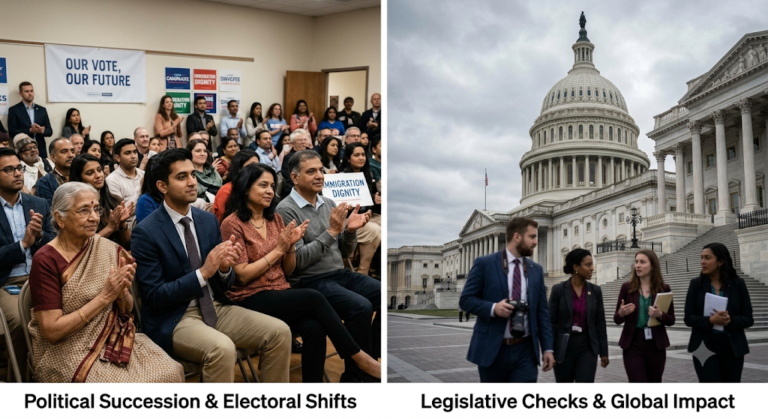
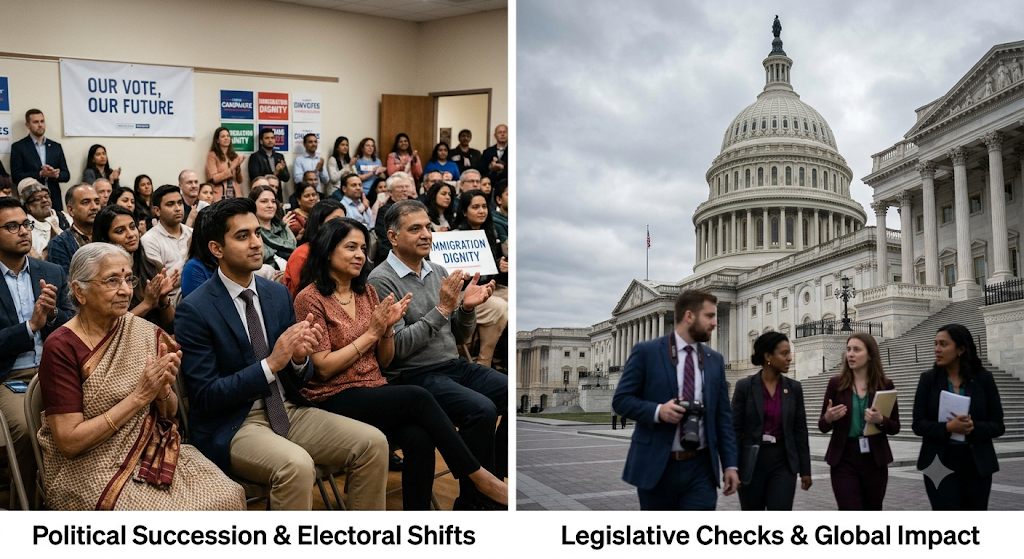
Indian-American alienation exposes another Republican vulnerability. H-1B visa restrictions, immigration uncertainty, employment concerns and anti-immigrant rhetoric have weakened Republican appeal among sections of a community deeply integrated into America’s technology and professional sectors. Democratic victories by Suhas Subramanyam and other Indian-American candidates, alongside Vivek Ramaswamy’s defeat in Ohio, underline the community’s growing political significance. The Republican contradiction is evident: an administration aspiring to technological supremacy cannot disregard the international talent pool that sustains its innovation economy.
Foreign Policy Reckoning and Tech Governance
Iran, Israel and geopolitical overreach have compounded the administration’s difficulties. The military confrontation with Tehran has heightened regional instability, threatened energy supplies and exposed the strategic vulnerability of the Strait of Hormuz. Washington’s alignment with Israel must be assessed against the wider imperatives of regional stability, the Palestinian question and evolving Israeli domestic politics. Military superiority cannot guarantee a sustainable political settlement. A Democratic Congress can use appropriations and oversight powers to scrutinise military commitments and constrain executive discretion.
Artificial intelligence and employment disruption constitute an emerging political fault line. Corporate investment in automation, semiconductor infrastructure and hyperscale data centres promises productivity gains but accelerates workforce displacement and corporate layoffs. These projects also consume enormous quantities of electricity and water, raising environmental and resource-allocation concerns. Underground infrastructure does not eliminate ecological costs. AI governance must therefore encompass algorithmic accountability, employment transition, data protection and environmental safeguards.
Legislative Gridlock and Indian Strategic Interests
The Democratic-controlled Congress is expected to intensify investigations into immigration enforcement, tariff policy, corporate influence, environmental deregulation and executive conduct. Although Trump retains presidential veto powers, his legislative agenda will encounter formidable resistance. Greater reliance on executive orders and administrative rulemaking could deepen institutional confrontation and policy paralysis.
The global economic implications extend far beyond Washington. International equities initially rallied on expectations of greater policy restraint, although geopolitical uncertainty, trade fragmentation and energy insecurity remain significant risks. For India, the consequences are multidimensional. Immigration restrictions threaten skilled migration and IT services; tariff uncertainty affects export competitiveness; and the Iran conflict exposes energy security, shipping routes and currency stability to external shocks. Washington remains indispensable to India’s Indo-Pacific strategy, particularly in balancing China’s expanding influence. New Delhi must consequently sustain bipartisan engagement, diversify energy partnerships and preserve strategic autonomy.
The significance of these elections transcends partisan fortunes. Trump may continue to project political confidence, and Republicans may celebrate their ideological credentials, but the loss of both congressional chambers exposes the limitations of personalised executive authority. His inability to seek another presidential term also places the future of MAGA and Vance’s political ambitions under scrutiny. The electorate has not merely altered congressional arithmetic; it has reasserted the distinction between electoral triumphalism and institutional legitimacy. Presidential authority cannot substitute for democratic consent, just as military supremacy cannot guarantee geopolitical stability.
Conclusion ——-
Trump’s defeat is not merely a Republican setback but a democratic warning against presidential overreach, economic coercion and geopolitical adventurism. The ultimate measure of American leadership will be its willingness to replace unilateralism with multilateral engagement, transactional diplomacy with strategic cooperation, and political spectacle with responsible statecraft.

M. Shiva Prasad, IPS (Rtd.) is a dedicated law enforcement professional who served the combined Andhra Pradesh cadre before opting for the Telangana cadre. Though a native of Andhra Pradesh, he considers himself a true Hyderabadi with an abiding love for the Telugu people. Driven by sincerity, fearlessness, and a lifelong fight against inequality and injustice, his ultimate strengths remain his goodwill and deep affection for the public and the police force. Today, he continues his mission by writing snippets and articles true to his conscience.
Email: Shivareach@yahoo.com
Mobile: 98480 38774