The Threshold
Do you remember the night your mother was afraid?
A phone call that came too late. A knock at the door when no one was expected. A report from the doctor that she read twice, and then a third time, before saying anything.
You remember her face. Not what she said. What her face did.
It went still. Quieter than you had ever seen her. And in that stillness, something in the room changed. The fear was still there. But it was no longer in charge. Your mother had taken over.
You watched her pick up the phone. You watched her make the call. You watched her ask the questions that needed asking, in a voice that did not shake, even though her hands did.
She was afraid. She did not show it.
You did not understand it then. You understand it a little more now.
That was courage. Not the loud kind. The kind where the hands shake, and the voice does not.
The Turn
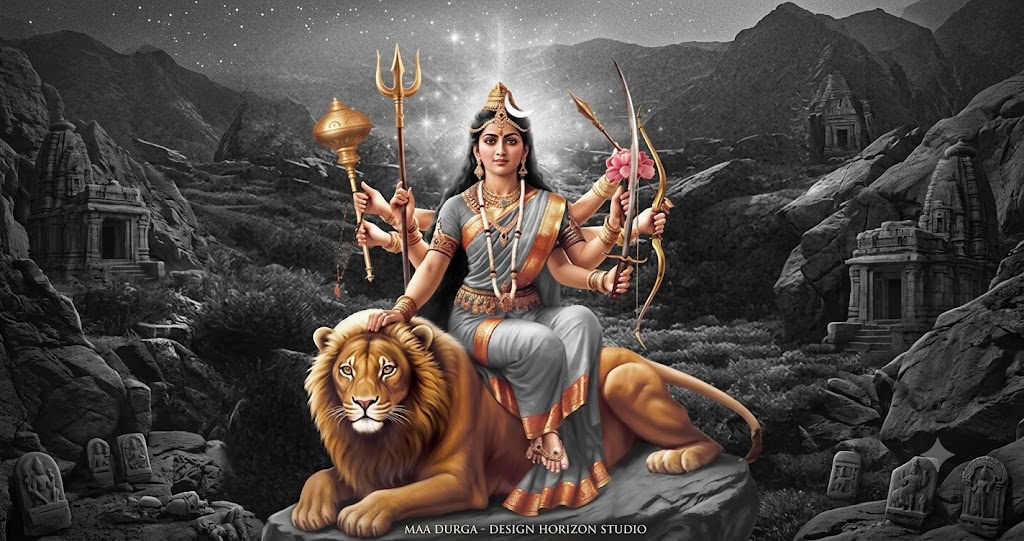
On the third night of Navaratri, the Mother comes as Chandraghanta.
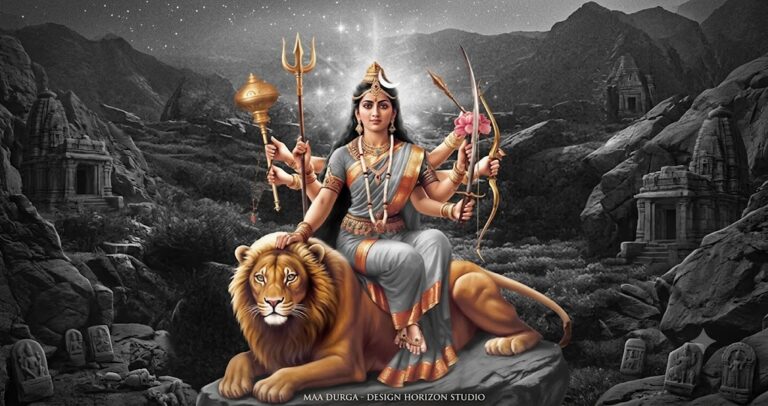
Chandra means moon. Ghanta means bell. She wears the crescent moon on her forehead, shaped like a bell. And on this night, she is ready for battle.
But look at her face.
She has ten arms, and every one of them carries a weapon. She rides a lion. And yet her face is calm. Golden. Almost smiling. Her expression is quiet. Her hands are full.
That is what you saw on your mother’s face that night. Fear, and something steadier underneath it.
This is the third night. Shailaputri taught us to stand. Brahmacharini taught us to walk. Tonight, the Mother teaches us how to face what frightens us, without raising our voice.
Meeting the Mother
Her name is Chandraghanta. She is Parvati, newly married, no longer the girl doing penance in the forest, but the wife stepping fully into her power.
After her marriage to Shiva, she took the crescent moon and shaped it into a bell upon her forehead. It is a bridal ornament. And it is also a warning.
The sound of that bell, the old stories say, is enough to unsettle powerful demons before a single weapon is raised. Her readiness alone does the work. Very little violence is required once an opponent understands that she will not hesitate.
The battle is often over before it begins. Not because she has won. Because the other side has already understood that she cannot be moved.
That is what your mother did that night. She stayed quiet. She stayed still. She simply became the person the moment required, and the room recalibrated around her calm.
And she says one thing, to you, today.
“I do not need to be loud to be certain. I have already decided. That is enough.”
What She Carries
Look at what she holds. Everything is a teaching.
The crescent moon. Cool, reflective light. Her power is guided by clarity, the kind that only comes when the mind is not clouded by fear.
You have seen this moonlight on your mother’s face. The night she stayed calm while everyone else panicked. The night she said very little, and somehow the whole house settled.
She is the Manipura. The solar plexus. The fire at the centre of the body, where courage is stored. The place that steadies when everything else is shaking.
The bell. It has a single purpose. To be heard before it is needed. What needs to retreat, retreats. Nothing else has to happen.
It is the sound of a boundary being stated. Once. Clearly. Without repetition.
Your mother had a bell too. Not a real bell, but you knew when it had rung. The one time she said enough. The one time she said no. She said it once. That was enough.
Her ten arms. They signal preparation. A readiness for whatever direction trouble might come from, so that no threat catches her unaware.
Your mother had many arms too. She was a wife, a mother, a daughter, an employee, a cook, a nurse, a peacemaker. She held all of them at once, and somehow none of them fell. You did not see how she did it. She never explained. She simply did.
The lion. Wild and untamed by nature. And yet it carries her without struggle. It suggests that even our fiercest instincts, when they are aligned with something worth protecting, stop fighting us and start carrying us.
What She Teaches
Three lessons. Each one quiet. None of them soft in the way we usually mean that word.
Grace and strength were never opposites.
Kindness and strength can live in the same person. That choice was invented. Someone taught you that you had to pick one. You do not.
Your mother was both. She was gentle, and she was unmovable. She kissed your forehead, and she ended the matter. You learned, watching her, that softness and strength can live in the same woman.
Readiness is not the same as fear.
You can prepare for difficulty without living inside it. Chandraghanta is armed for battle and completely at rest. That combination is available to you, too.
Your mother was ready for things that never happened. She had thought about them. Planned for them. Prepared for them. She was not anxious. She was responsible. And then she set it down, and lived her life.
Protect what is tender, without becoming hard.
Her fierceness exists in service of something soft. Her home. Her people. The ones she loves. Courage that forgets what it is protecting eventually turns on the very thing it was meant to guard.
Your mother stayed soft. Even in the years when hardening would have been easier. She stayed soft. She stayed fierce. And she did not confuse the two.
The Offering
For those who follow the daily traditions, Chandraghanta is honoured with the colour grey. The grey of a sky gathering itself before a storm. Calm on the surface. Immense underneath.
Her offering is milk, or kheer. Sweetness offered without asking for anything back. Offer it with the thought, Mother, I offer you my readiness, and ask you to keep it gentle.
Place a small bell near your altar today. Or a picture of a crescent moon. A quiet echo of the ornament she wears into battle.
If you wish, whisper her name. Om Chandraghantayai Namah. Or simply, Chandraghanta, make me steady, not loud.
A Quiet Moment
If you light a lamp today, do not ask her to take the fear away. Ask her to walk beside you through it.
Sit quietly. Let her look at you. Feel her hand on your head, and on your heart.
You do not need to explain anything. You do not need to ask for anything. Being seen is enough.
She smiles. Faintly. The bell on her forehead catching the light without making a sound.
And in that quiet, you understand. The quietest voice in the room is the one no one argues with.
Walking with Her Today
Where is your mother’s steadiness needed in you today?
Have the conversation you have been avoiding. And keep your voice gentle while you have it. Say the difficult thing once. Clearly. In your normal voice. That is enough.
Notice, at least once today, the difference between feeling anxious and feeling alert. Anxiety spirals. Alertness simply watches. When you catch yourself spiralling, ask yourself gently, What am I actually protecting right now?
Do one small brave thing that no one will applaud. Send the email. Make the call. Set the boundary. Let it be quiet. Chandraghanta’s courage was never for an audience.
When you feel yourself needing to raise your voice to be taken seriously, pause. Breathe. Lower it instead.
Silence, when it is chosen, is the loudest answer.
Let the noise settle. Let the panic settle.
Beneath all of it, you are still here. Steady. Held in her blessings.
That is the courage she carried. That is the courage you carry too.
The Return
And now, back to your mother.
Think of that night again. The phone call. The stillness on her face. The hands that trembled while her voice did not.
You did not understand it then. You thought she was not afraid. You thought brave people simply did not feel fear.
But she was afraid. She was terrified. She simply did not let the fear decide anything.
She did the thing that Chandraghanta does. She became steady, not because she felt steady, but because the moment asked her to. And the moment was met.
You have that same capacity in you. You have had it all along. You simply have not needed it yet.
That is the third night.
Not a goddess on a lion. A woman in a hospital corridor, making a phone call.
The same love, in two forms.
Jai Chandraghanta.
Author Biography: – R Srinivasa Murthy, the author, is a corporate leader, an independent writer, and a student of Hindhu Philosophy. He Identifies as a Demystic, committed to removing unnecessary mysticism from traditions to offer practical systems for the next generation. His upcoming book, Logic of And: Sanatana Dharma as a Toolkit for the Contemporary Seeker, aims to bridge ancient wisdom with modern life to foster an inclusive, living civilisation.

With a journalistic long journey, we bring you https://primepost.news, a dynamic platform committed to unraveling the intricate tapestry of Indian politics, particularly delving deep into the heart of Telangana and Andhra Pradesh. Our blog is not just a source of news; it’s a reservoir of insights, analysis, and thought-provoking reviews.
Superb sir
Daily I knew about one mother upto Navratri festival.
Fantastic Explanation sir😍😍😍😍👍🤩🤩🤩🙏
Let’s Look at our mother at home. She has been showing the same quite courage to take for us and family
Calmness – learning for the day