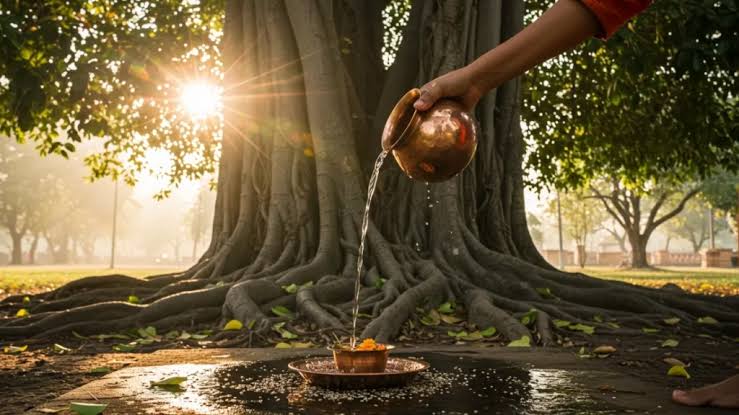
Pitru Paksha, a handful of water, and the names we must not forget
oday (27th September), something quiet begins in many Indian homes.
No lights. No crackers. No new clothes. No celebratory sweet boxes passed across the threshold.
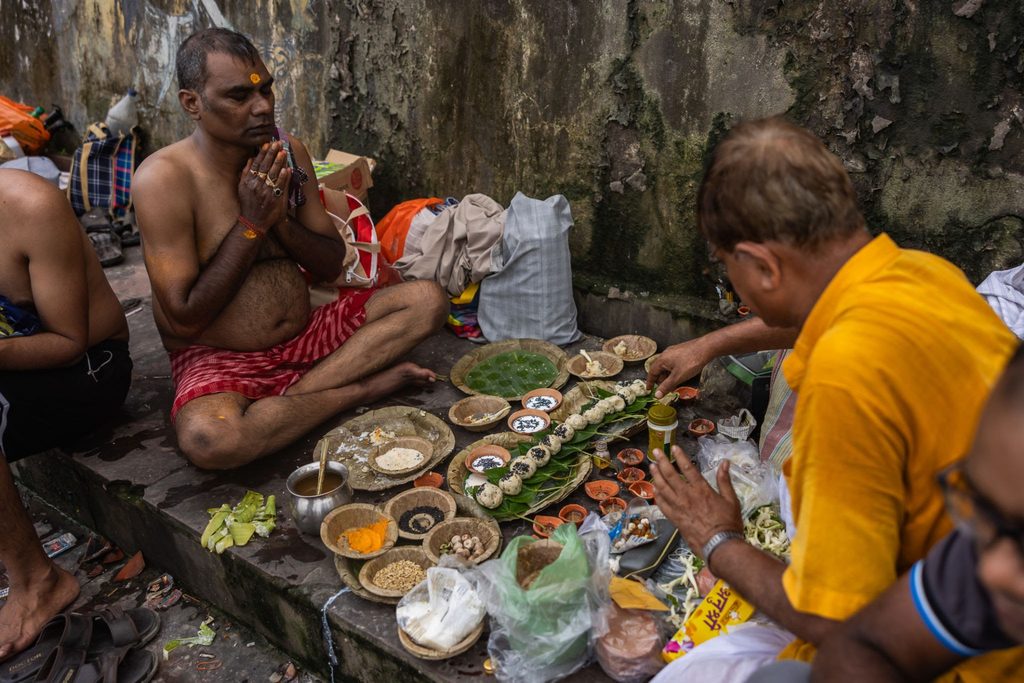
Instead, the day opens with a deliberate hush. The brass vessel polished the previous evening sits waiting on a small woven mat. A bowl of black sesame seeds rests beside a single blade of darbha grass. And a person sitting barefoot on the floor, saying names out loud into the quiet morning air.
In Lucknow, it is Pitaji. In Chennai, Appa. In Kolkata, Baba. In Ahmedabad, Bapuji. In Hyderabad, Nanna.
Different words across a vast land. The same ache. The same quiet return to where we began.
This is Pitru Paksha. The fortnight when we set aside our daily ambitions to remember those who came before us. It begins today and ends on Mahalaya Amavasya.
A simple act
The ritual is called tarpana. It comes from the Sanskrit root trup, which means “to satisfy” or “to quench a thirst.”
We cup our palms together. We let water flow out slowly between the thumb and the first finger, right where the palm meets the wrist. With each offering, we say a name.
That is all. It takes only a few minutes.
But something subtle shifts in those few minutes.
For many of us, it is the only day in the whole year we say our great-grandfather’s name. Some of us do not even know it. We have to call an aunt in Pune or an uncle in Mysuru to ask. And when they tell us, there is often a long, thoughtful pause on the line. Then a story comes spilling out. “He walked ten miles to school barefoot, you know.” “She always sang old classical ragas while she stirred the lentils.”
That phone call across state lines is also a tarpana. It quenches a forgotten story’s thirst to be heard again.
Why water?
Because water is the first and purest gift of life. It is a newborn’s first need. A dying person’s last request. You cannot refuse water even to an enemy standing at your door. In our climate and our culture, water is not just a compound; it is grace made liquid.
So we give our ancestors the one thing no living being can do without. It is our way of stripping away all complexity and saying, “You gave us life. Here is a little of it back.”
In the full tradition, tarpana is offered in three distinct streams. First for the divine principles that govern the cosmos, then for the seers and teachers who preserved knowledge, and finally for our personal line of ancestors. It is a subtle reminder that our personal family history sits nestled inside a much larger cosmic fabric. We do not exist in isolation.
Nobody is forgotten
On the last day, Mahalaya Amavasya, something deeply compassionate happens. We do not stop with our own direct lineage.
We offer water for everyone.
For the grandparents whose death dates nobody wrote down in the family diary. For the unmarried uncle who left no children behind to say his name. For the young aunt who died before anyone really got to know her.
For the soldier who fell on a cold, distant border far from his village. For the farmer who went quietly in a bad harvest year. For the migrant worker who poured the concrete for the flyover we drive on every day, and whose name no city record ever kept.
For the childhood friend we lost touch with and only heard about years later. For the schoolteacher who shaped our character and never found out what became of us. For the old neighbour who always stood by the gate and asked how our exams went.
For those who perished in floods, in earthquakes, in sudden accidents, in lonely hospital wards with no family holding their hand.
Even for total strangers. Even for those who were never ours.
There is an old, timeless prayer recited on this final day:
Ye bandhava abandhava va, ye anya-janmani bandhavah,
Te triptim akhilam yantu, ye chasmat-toya-kankshinah.
In simple words, it says: “To those who were my family, and those who were not. To those who may have been my kin in another lifetime. To every soul waiting for a drop of water from my hand. May all of you be fully satisfied and at peace.”
Think about the ethical genius of that for a moment.
We sit down with our own private grief and our own personal losses. And yet the tradition gently turns our face outwards towards the rest of the world. It whispers: you are not the only one missing someone. And there are millions of souls out there with no one left on earth to remember them.
So we tilt our palms again. We pour a little extra water. For them.
Nobody is forgotten on this day. Not by us.
The first year
If you have lost a parent, you know the gravity of this moment.
The first time you sit down to offer water for them, your hand trembles slightly. Their name gets stuck in your throat like a stone. Just last year, they were the one sitting on the grass mat. You were the one standing behind them, holding the brass pitcher, watching idly.
Now the mat is yours. It is your turn to face east. And slowly, amidst the ache, a quiet realization dawns. One day, my child will sit right here. One day, someone will tilt their palm and say my name into the water. It is not a morbid thought. Not really. It feels remarkably like being held. You realize you are not an isolated island floating in time. You are a single link in an unbroken chain of people who loved, struggled, made mistakes, built homes, and kept going. You are not the beginning. And you are definitely not the end.
What we inherit
Having spent many years as an accountant, I know that every balance sheet opens with an opening balance. You did not earn it. It was simply handed down to you from the previous closing entry.
Our human lives operate on the exact same principle.
The language we think and dream in. The subtle flavor profile of the food cooked in our home. The automatic way we fold our hands when passing a place of quiet worship. The stubborn resilience that unexpectedly shows up when everything goes wrong on a Tuesday afternoon. None of it began with us. Someone carried those values through difficult times, through wars, plagues, and poverty, just to hand them to us intact. Pitru Paksha is our annual pause to acknowledge that debt and say thank you.
If you don’t know the mantras
That is perfectly fine. Truly.
Do not let the complexity of formal rituals keep you away. Sit quietly on a morning during these fifteen days. Say the names you know with clarity. Ask your elders for the ones you do not know yet. Give a cool cup of water to a tired delivery worker or a street sweeper. Feed a stray animal or birds on your balcony. Sit with your children for ten minutes and tell them just one story about their grandparents. The ancient mantras are breathtakingly structured. But sincere love is the real substance of the offering.
The emperor who was thirsty
Let me leave you with a story from Agra, in the intense heat of summer in 1658.
Shah Jahan, the grand emperor who built the Taj Mahal, was imprisoned inside the Agra Fort by his own ambitious son, Aurangzeb. In a bid to force submission, the son restricted the old emperor’s water supply.
The builder of monuments was dying of thirst.
The historical account notes that he wrote a short note to his captor son. Yesterday, he wrote, I commanded a vast empire and armies. Today I beg for a single vessel of water. And then came the poignant lines that scholars have preserved for over three centuries, penned in Persian:
Ai pisar tu ajab musulmani,
Ba pidar-e-zinda ab tarsani.
Afarin bad hinduwan sad bar,
Mi-dahand pidar-e-murda ra dayam ab.
In simple words: “O son, what a strange believer you are. You make your living father long for a single drop of water. A hundred praises to the Hindus, who continuously pour water even for their departed parents.”
Reflect on that scene. A broken ruler, betrayed by his own flesh and blood, found a moment of bitter solace in observing his subjects pour water for ancestors who had been gone for decades.
Very few cultural traditions in the world have taken the intangible feeling of memory and turned it into such a concrete, sacred, and daily duty. Ours has done so for thousands of years, one handful of water at a time.
That is the true heart of this fortnight.
Tarpana is not merely an exercise for the dead. It is a profound moral education for the living.
The tradition reminds us of a fundamental truth, remembering those who have gone before us loses its meaning if we fail to honour those who are still walking alongside us today. The true completion of any ritual of gratitude is not just the water poured into the river, but the warmth extended across the domestic threshold.
So, once you have completed the ritual. And then walk away from the vessel, step into the house, and sit with your father or mother if you are fortunate enough to still have them near you. Hold their hands. Listen to their repetitive stories without interrupting. Pour them a fresh glass of water, too.
Honour the memory of those who left, but do not forget to cherish those who stay.
They will not be here forever.
Author Biography: – R Srinivasa Murthy, the author, is a corporate leader, an independent writer, and a student of Hindhu Philosophy. He Identifies as a Demystic, committed to removing unnecessary mysticism from traditions to offer practical systems for the next generation. His upcoming book, Logic of And: Sanatana Dharma as a Toolkit for the Contemporary Seeker, aims to bridge ancient wisdom with modern life to foster an inclusive, living civilisation.

With a journalistic long journey, we bring you https://primepost.news, a dynamic platform committed to unraveling the intricate tapestry of Indian politics, particularly delving deep into the heart of Telangana and Andhra Pradesh. Our blog is not just a source of news; it’s a reservoir of insights, analysis, and thought-provoking reviews.

A deeply meaningful reflection, Sir. 🙏 The simple act of offering water beautifully expresses gratitude, remembrance, and respect for those who came before us. Tarpana reminds us that remembering our ancestors is not just a ritual—it is a way of keeping gratitude and compassion alive across generations. 🙏
Sir, Nice article during Mahalayapaksha. Remembering gone souls and offering them Tarpana in solitude creates a sacred space where remembrance, gratitude, and the blessings of our ancestors become one.
Shahjahan, remembering our tradition during his ill fateful days is one thing how our ancient traditions are built.
Earlier i didn’t know all these spiritual things sir.
Superb sir and fantastic briefing sir.
Thanks 🙏👍😍😍🎉🕊️🕊️🕊️🕊️
Thank you so much, Sir. 🙏
I feel lucky to have heard some of these stories from you while travelling, even before they were penned down. 🖊️
Very thoughtful and beautifully connected. Coincidentally, just yesterday my wife and I were discussing with Aunty and my sister what we could do from our side during these days🙏
My take away from this as below:
“जो चले गए, उन्हें जल से तृप्त करो;
जो साथ हैं, उन्हें प्रेम से तृप्त करो।
क्योंकि पितरों का सम्मान केवल स्मरण में नहीं,
बल्कि उनके दिए जीवन के प्रति कृतज्ञता में है।” 🙏🏻🪔
“Offer water to those who have gone before us;
offer love to those who are still with us.
For honouring our ancestors is not merely about remembering them,
but about being grateful for the life they gave us.” 🙏🏻🪔
❤️ Let’s cherish our parents and family while they are with us. Give them our time, love and care—not just memories after they are gone.
Life is precious. Family is priceless. 🙏🏻❤️
Thanks for reading through and sharing your thoughts
Fantastic sir , it is the right time to know this subject , today onwords pitru pak sham started .
Thanks for updating sanatana darma time to time .
Thanks for sharing your thoughts