Policing Between Power and Public Trust
The police uniform is not merely an emblem of authority; it is the visible face of the State at street level. Its true dignity lies not in the power to command, but in the constitutional responsibility to protect, investigate and enforce the law without fear or favour.
Indian policing, however, remains marked by a fundamental dichotomy. Law and order is a State subject, yet policing operates within a complex hierarchy of political executive, bureaucracy, judiciary and public expectations. The ideal of professional policing can therefore collide with political patronage, social hierarchy, caste and class interests, and the unequal distribution of institutional influence. These are structural problems, not merely individual failings.
The contradiction becomes sharper when social justice is proclaimed while informal hierarchies continue to influence access, representation and institutional behaviour. Policing must neither become an instrument of political convenience nor retreat into an insulated bureaucracy. Its legitimacy rests upon operational autonomy within constitutional accountability.
Publicity cannot substitute for policing.
Modern policing needs visibility, but excessive publicity can distort priorities. Arrests, raids, encounters, recoveries and spectacular operations readily become public narratives; painstaking investigation, preventive intelligence, case-diary preparation and courtroom performance rarely do. Yet the latter constitute the durable architecture of a criminal case.
A professional police force should therefore measure itself less by publicity and more by evidence, investigation, prevention, prosecution and public confidence.
The real police skill begins where the spectacle ends.
A competent investigator must know the law, facts, forensic science, procedure and human behaviour. He must be able to construct a case from the FIR to the case diary, from the crime scene to the charge-sheet, and from investigation to trial.
Case-diary writing is not clerical routine. It is the intellectual record of investigation: chronology, evidence, witness examination, contradictions, recoveries, forensic findings, procedural compliance and the reasoning connecting fact to inference. In an increasingly sophisticated adversarial system, an investigator must possess sufficient legal and analytical competence to withstand searching cross-examination and the scrutiny of experienced counsel and courts.
The police officer must therefore be part investigator, part legal scholar, part field administrator and part social anthropologist.
India’s police-training architecture increasingly recognises this need. BPR&D’s current programmes include scientific investigation, specialised investigators, cybercrime, crime-scene investigation and strategies for efficient investigation and trial.
Knowledge is the new weapon of policing.
The policeman of yesterday depended principally upon physical presence, local intelligence and experience. The policeman of today must understand digital evidence, cybercrime, forensic science, financial trails, organised crime, narcotics networks and new criminal procedure. BPR&D’s mandate itself places emphasis on science, technology, research and continuous skill upgradation.
The comparison with mature policing systems is therefore instructive: wherever policing becomes professional, training, specialisation, investigation and institutional accountability acquire greater importance than personal proximity to political power. The Indian answer need not imitate another jurisdiction; it must adapt proven principles to India’s constitutional, social and demographic complexity.
The remedy is institutional, not rhetorical.
Policing requires:
operational autonomy; political neutrality; transparent accountability; separation of investigation from routine law-and-order burdens where practicable; scientific investigation; continuous legal education; stronger forensic capacity; professional case-diary writing; protection from arbitrary interference; and objective performance assessment.
BPR&D’s own data illustrate the scale of the training challenge: 4,55,901 police personnel were trained during 2023–24, across different ranks and organisations. Training, however, must become a continuing intellectual discipline rather than an episodic departmental exercise.
Ultimately, the police uniform represents a paradox.
It embodies State power, yet must remain subordinate to the law.
It demands authority, yet requires restraint.
It confronts criminals, yet must preserve the rights of citizens.
It serves government, yet its ultimate loyalty must be to the Constitution.
The finest policeman is therefore not the one who merely commands fear, nor the one who generates publicity.
He is the officer whose investigation survives scrutiny, whose case diary withstands the courtroom, whose judgment remains independent under pressure, whose knowledge keeps pace with crime, and whose uniform commands respect because it represents justice rather than privilege.
That is the spirit of policing.
That is the truth of the uniform.
And that is why I love my uniform
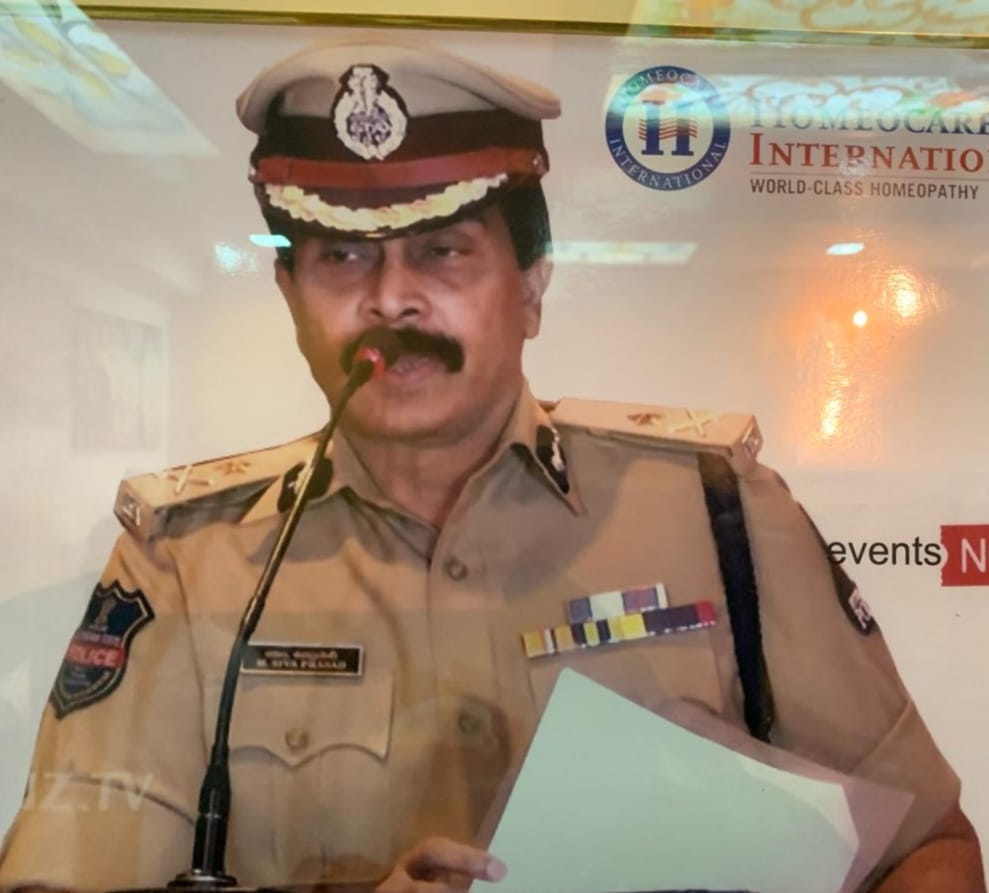
M. Shiva Prasad, IPS (Rtd.) is a dedicated law enforcement professional who served the combined Andhra Pradesh cadre before opting for the Telangana cadre. Though a native of Andhra Pradesh, he considers himself a true Hyderabadi with an abiding love for the Telugu people. Driven by sincerity, fearlessness, and a lifelong fight against inequality and injustice, his ultimate strengths remain his goodwill and deep affection for the public and the police force. Today, he continues his mission by writing snippets and articles true to his conscience.
Email: Shivareach@yahoo.com
Mobile: 98480 38774