Part Two
Acharya’s contribution was not confined to newspapers. He helped organise young people to attend meetings addressed by national and regional leaders, including Mahatma Gandhi, Acharya Bansali and Vinoba Bhave, according to the account. He also participated as a volunteer at public meetings. Khadi became another expression of his commitment. The account records that Acharya campaigned for Khadi and continued to wear it.
The organisation of youth was particularly important in a period when physical courage and collective discipline were needed for community protection. Acharya helped organise sports and physical activities, including wrestling, kabaddi and other competitions.
What might appear to be ordinary sporting activity acquired a different significance in the political circumstances of the time. Physical training created discipline, confidence and a capacity for collective action.
Pratapa Rudra Dal and the culture of physical resistance
In 1946, 1947 and 1948, Acharya organised the Pratapa Rudra Dal and other youth groups, according to the account. Wrestling competitions, kabaddi, ball badminton, volleyball and exercises were conducted through these organisations and gymnasiums. The purpose was not merely recreation. Physical culture was regarded as one means of developing courage and self-defence among young people.
Acharya worked with people such as Koosam Vaikuntam and A. Rama Rao, and a training camp was established at Sunder Bhavan in Hyderabad under V. Veerabhadra Rao. The account also refers to Dr. Anaram Ramarao, one of those associated with the training, later received military training at the centre of Dr. B. S. Moonje at Nagpur. These activities show another dimension of the Hyderabad liberation struggle: alongside political mobilisation and journalism, there was an effort to create organised youth networks capable of protecting communities during a period of violence.
The rescue of Mustyala Shankar Rao
One of the episodes that brought Acharya directly into danger concerned his colleague and fellow freedom fighter Mustyala Shankar Rao. According to the account, Razakars kidnapped Shankar Rao and subjected him to brutal treatment. Acharya became involved in efforts to secure his release, eventually helping to move him out of Razakar custody and into police custody, from where his release was subsequently secured. The success of this effort had consequences.
The Razakars came to suspect that Acharya had played an important role in Shankar Rao’s release. His house was attacked several times. Acharya and his associates had therefore to build what may be described as an informal early-warning and defence network. Information about impending attacks was collected and communicated in advance. This enabled Acharya to move from one place to another before an attack could take place. The struggle was not only about confronting danger. It was also about learning how to survive it.
Several narrow escapes from death
The episodes recorded about Acharya include at least two incidents in which his life was apparently in immediate danger. On one occasion, while distributing agitation literature concealed inside newspapers, he was confronted by a Razakar near the shop of Kandagatlа Kanakaiah. When Acharya refused to hand over the newspaper, the Razakar threw him down and was preparing to attack him with a spear. The intervention of businessmen in the street saved his life.
The significance of this incident lies not only in Acharya’s personal courage but also in the courage of those ordinary citizens who intervened. Resistance was sometimes expressed not through organised political action but through a community refusing to allow a person to be killed in front of them. On another occasion near Intezarganj Police Naka in Warangal, a Nizam’s military officer on a motorcycle allegedly knocked Acharya down and attempted to assault him. Irukulla Srisailam, a local businessman, intervened and helped save him.
Such episodes explain why Acharya’s work cannot be understood merely as newspaper distribution. The circulation of information itself had become a dangerous political act.
Shehar Badar and the Kothakonda camps
At a certain stage, some active leaders were subjected to “Shehar Badar” orders — effectively requiring them to remain outside the town. When such restrictions affected the movement’s organisers, youth camps were organised at Kothakonda Jathra under the leadership of Pendyala Ramanuja Rao, according to the account.
Acharya participated as a volunteer and messenger. He helped bring together youth and maintain communication between those outside the town and workers inside Warangal. Again, his role was essentially that of a connector: between leaders and activists, between border camps and the town, and between information and the people who needed it.
Watching Mamunoor Airport
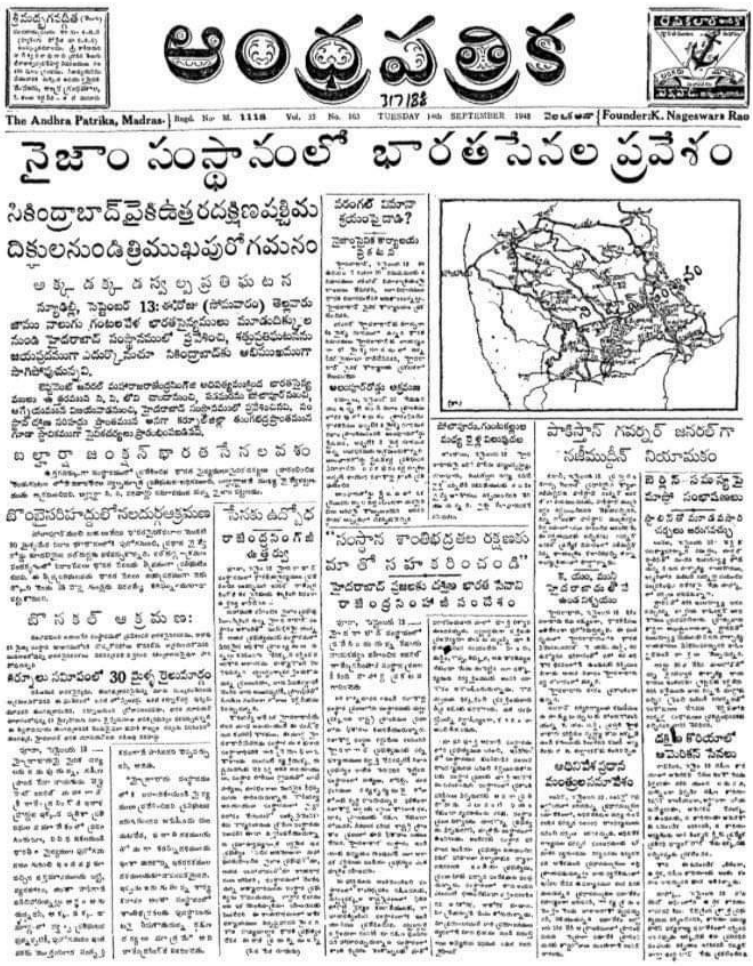
Among the most unusual accounts is Acharya’s activity around Mamunoor Airport. The account refers to information concerning the movement of arms and ammunition by air and says that Acharya and his associates kept watch near the airport with binoculars. The information was then communicated to the Vande Mataram brothers and, through them, to K. M. Munshi, the Government of India’s representative in Hyderabad.
This was intelligence-gathering of a rudimentary but highly risky kind. Young men with binoculars observing aircraft movements could easily attract suspicion. The episode illustrates the extent to which the liberation movement depended upon individuals who gathered information outside formal political structures. Years later, one of the participants in this activity, Dr. Anaram Ramarao, visited the Janadharma office in Warangal. The meeting became an emotional recollection of those days.
Acharya recognised Ramarao immediately. Their conversation returned to Mamunoor Airport and the days when they had watched aircraft movements with binoculars. The memory was not merely nostalgic. It was a reminder of how ordinary young men had once undertaken activities in which discovery could have had fatal consequences.
Night watches in Papaiahpet
The danger to civilians did not end with daytime activity. During periods of intense Razakar attacks, Acharya, along with S. Mallesham and Aduval Venkata Narsaiah, kept night vigils in the Papaiahpet area of Warangal. They carried lathis and lanterns and patrolled the locality until dawn. Their objective was not only physical protection. They also sought to give confidence to civilians who were frightened by the violence around them.
Empty houses too had to be watched. This aspect of Acharya’s work is particularly revealing. The liberation struggle was experienced by ordinary residents as a question of whether they could sleep safely in their homes. Night patrols therefore became a form of community protection.
The family had to leave Warangal
As the danger increased, Acharya’s family eventually had to leave Warangal. The recollections passed down within the family describe relatives moving from place to place without certainty about where they would stay or how they would meet their immediate needs. The experience was one shared by many families during periods of violence and political uncertainty.
The family members had to travel and seek shelter, sometimes relying upon the kindness of others. These experiences are important because the story of a freedom fighter is not only the story of the individual who remained in the field. It is also the story of the family that bore the consequences of that decision.
While Acharya remained involved in the struggle, his family lived with the uncertainty created by his activities.
Law professor and eminent columnist
Madabhushi Sridhar Acharyulu, author of 63 books (in Telugu and English), Formerly Central Information Commissioner, Professor of NALSAR University, Bennett University (near Delhi), presently Professor and Advisor, Mahindra University, Hyderabad. Studied in Masoom Ali High School, AVV Junior College, CKM College, and Kakatiya University in Warangal. Madabhushi did LL.M., MCJ., and the highest law degree, LL.D. He won 4 Gold Medals at Kakatiya University and Osmania University.
Email: cicsridhar@gmail.com
Mobile: 8447651505