As the “chilling effect”: Invisibly ban a book from being printed or distributed
The Supreme Court of India established a powerful standard for freedom of expression in S. Rangarajan v. P. Jagjivan Ram judgement. The court ruled that anticipated public anger or protest is not a valid reason to ban or suppress a work. The judges famously stated that expression cannot be held hostage to a “hostile audience,” and the state’s duty is to protect freedom, not bow to intolerance.
For decades, India banned imports of this book under a 1988 customs notification (see The Salman Rushdie Satanic Verses Precedent). However, in a landmark move, the Delhi High Court effectively dismantled the ban because the government could not produce the original notification order. The court ruled that citizens cannot be bound by a phantom ban they are not permitted to see, reinforcing that administrative opacity cannot restrict a citizen’s right to read.
Undeclared pre-censorship is far harder to fight because it happens behind closed corporate doors. Publishers often choose to pulp or withdraw books quietly to protect their business interests from political or legal harassment.
Similarly, the Pulping of The Hindus: An Alternative History (2014) also can be quoted. Scholar Wendy Doniger’s book faced a civil lawsuit from a right-wing group claiming it hurt religious sentiments. Instead of fighting the case in court, the publisher, Penguin India, chose to settle out of court, withdraw all copies, and pulp the remaining stock. This caused mass outrage in the literary world, as it showed a major publisher giving in to legal intimidation before a court had even ruled the book unlawful.
When veteran politician Jaswant Singh wrote a book praising Pakistan’s founder Mohammad Ali Jinnah, he was expelled from his political party (the BJP), and the state government of Gujarat officially banned the book (See the Withdrawal of Jinnah: India-Partition, Independence (2009). Even though the Gujarat High Court later struck down the ban, the political backlash created a massive “chilling effect” where bookstore owners across the state voluntarily refused to stock it out of fear of vandalism.
Difference between Banning vs. Pre-Censorship
| Feature | Official Book Banning | Undeclared Pre-Censorship / Self-Censorship |
| Who enforces it? | The State (via laws, court orders, or customs notifications). | The Publisher or Author (via internal corporate decisions). |
| Visibility | Public and transparent. A gazette notification or law is issued. | Invisible and hidden. Happens during editing or legal reviews. |
| Recourse | High. Can be challenged, argued, and overturned in a court of law. | Low. Citizens cannot easily take a publisher to court for choosing not to print a book. |
| Primary Driver | Political ideology, public order, or state security. | Fear of consequences (tax raids, lawsuits, financial ruin, or boycotts). |
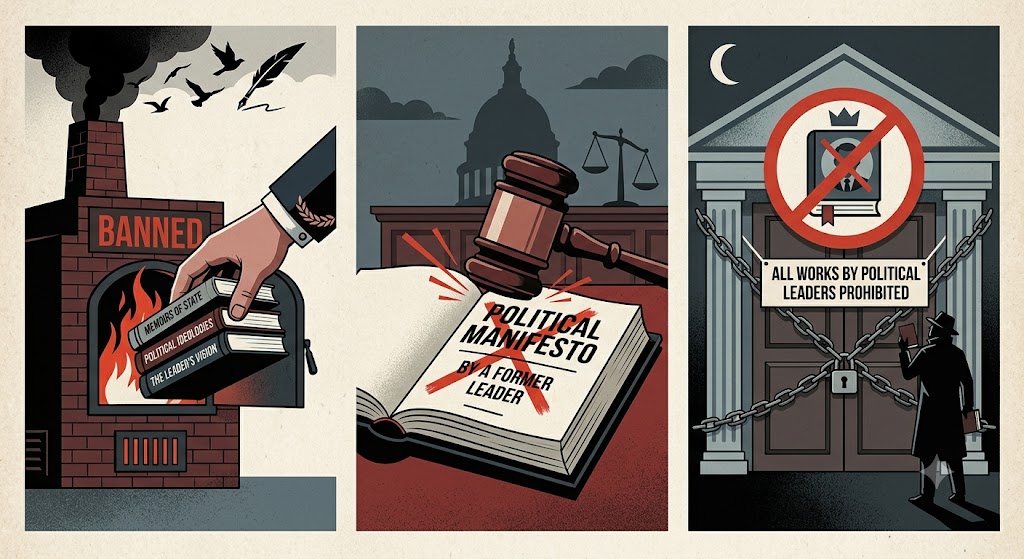
The freedom of reading guarantees an individual’s unhindered right to access and explore diverse ideas, whereas explicit book banning uses formal state power to legally outlaw a publication, and undeclared pre-censorship relies on invisible, pre-emptive self-regulation by publishers to suppress controversial content before it ever reaches the public.
Understanding these three dynamics exposes how the control of information operates across a spectrum, from open democratic access to overt legal prohibition and, finally, to subtle corporate or political intimidation.
As Readers, don’t We have the Right to Read?
The freedom to read is the foundational pillar of intellectual liberty and democratic discourse. It asserts that citizens have the autonomy to seek out, consume, and evaluate information, historical accounts, and political opinions without interference. [
It rests on the belief that individuals can critically assess ideas for themselves and that the remedy for offensive or controversial speech is more speech, not enforced ignorance.
In democracies, this is tied to constitutional guarantees like Article 19(1)(a) of the Indian Constitution or the First Amendment in the United States, which protect both the right to express and the corresponding right to receive information.
Violation of Constitutional Right
Book banning is an overt, official action taken by a governing authority or institution to remove, restrict, or criminalize the distribution of a specific text. It is transparently punitive or restrictive. Whether through official state bans, library removals, or legal proscriptions, the targeted text is clearly identified and publicly targeted.
While often justified by authorities using arguments of public morality, security, or age-appropriateness, an explicit ban leaves a paper trail. It can be legally contested, debated in courts, or resisted publicly because the prohibition is out in the open.
The “chilling effect”
Undeclared pre-censorship, often referred to as the “chilling effect”, occurs invisibly before a book is even printed or distributed. It happens when publishers, editors, or authors pre-emptively alter, tone down, or cancel a project out of an unexpressed fear of political retaliation, legal harassment, or economic fallout. There is no official government order or public notification of a ban because the book is modified or smothered at its inception.
This form of control is insidious because it leaves no evidence of a direct state mandate. Publishers may deny political pressure, citing standard “legal risk management,” making it exceptionally difficult for the public to fight a restriction they cannot explicitly see or prove.
Story of book of Sonia
Sonia could not become the Prime Minister; she is an important opposition leader. She has every right to write a book and distribute it to readers. It was a story of law plus politics about her progress toward leading the nation. One may not agree with her thinking, sayings, and politics of Congress under her. But she has the right to speak, write, and publish a book, subject to reasonable restrictions provided under the Constitution of India, which is a democratic right all over the world.
It is the story of a book. Whether under pressure from political power or the fear of publication, an alternative publication is absolutely right and appropriate. Congress leader Sonia Gandhi’s memoir, “Belonging: A Journey of Love”, is reported that it will be published by Harper Collins on November 10. For some reason, the book was earlier set to be released by Penguin Random House India; the publisher withdrew from the project following an editorial dispute with the author’s team.
Naturally, the decision had triggered a political controversy, with Congress leaders alleging pressure over parts of the manuscript. It’s about her life and political growth. Her book is expected to offer a personal account of Sonia Gandhi’s life, including her childhood in Italy, her marriage into the Nehru-Gandhi family, and her experiences following the assassination of former Prime Minister Rajiv Gandhi and her succession of Rahul.
It is reasonable that the memoir is also expected to discuss her eventual entry into active politics and her journey within one of the important parties- the Congress, whether in power or in opposition. The book will definitely attract considerable political attention even before its international release, largely because of the dispute surrounding its earlier publication arrangement. It is reported that Penguin Random House India had earlier signed on to publish the memoir when its US-based imprint, Alfred A. Knopf, had announced the project. However, Penguin India eventually changed its mind and refused to go ahead with the publication. Penguin Random House India denied that it dropped the book due to external political pressure. They issued a statement clarifying that fact-checking and recommending editorial changes are standard practices meant to protect books from litigation, adding that they remained “willing and keen” to publish within those parameters. Thus, the controversy surrounding Sonia Gandhi’s memoir has ignited a fierce national debate and became popular before it was published. Sonia Gandhi flatly refused to amend the text, maintaining that the book represents her personal account and perspective, and she would not permit her narrative to be distorted. The Congress Party and free-speech advocates heavily criticized the decision, calling it a “murder of democracy”. Critics may argue that PRHI lacked the spine to stand by its author and succumbed to an unspoken atmosphere of fear, where corporate entities pre-emptively self-censor to avoid angering the ruling dispensation, facing tax raids, or enduring legal retaliation.
The decision led to allegations from Congress leaders that the publisher had faced government pressure over references to the ruling party and the Rashtriya Swayamsevak Sangh (RSS), and with conterversial China’s occupation of Indian territory during the BJP government.
BJP has its own right to have its opinion
The BJP has its own right to have its opinion. It rejected the allegations and questioned the nature and contents of the memoir. On record, Penguin Random House India denied claims that it was pressured by the government to alter the manuscript. The publisher said the book had gone through its standard editorial process, during which various issues were discussed with representatives of Sonia Gandhi. It was explained that, to Penguin, some proposed changes were accepted by the author’s side, while in other cases the publisher accepted the author’s position.
That controversy is about freedom of expression and political self-censorship. Why are Indian citizens losing the right to read? Are these controversial books being pulled out of fear of the government?
The publisher’s legal and editorial teams reportedly flagged passages concerning four main areas:
- Critical reflections on his leadership and specific policy decisions of the central government.
- Views on the Rashtriya Swayamsevak Sangh’s deep-rooted influence on national affairs and India’s social fabric.
- Content detailing the sensitive communal situation in the country.
- Commentary regarding Chinese incursions and the deadly 2020 Galwan Valley clash.

Law professor and eminent columnist
Madabhushi Sridhar Acharyulu, author of 63 books (in Telugu and English), Formerly Central Information Commissioner, Professor of NALSAR University, Bennett University (near Delhi), presently Professor and Advisor, Mahindra University, Hyderabad. Studied in Masoom Ali High School, AVV Junior College, CKM College, and Kakatiya University in Warangal. Madabhushi did LL.M., MCJ., and the highest law degree, LL.D. He won 4 Gold Medals at Kakatiya University and Osmania University.
Email: cicsridhar@gmail.com
Mobile: 8447651505