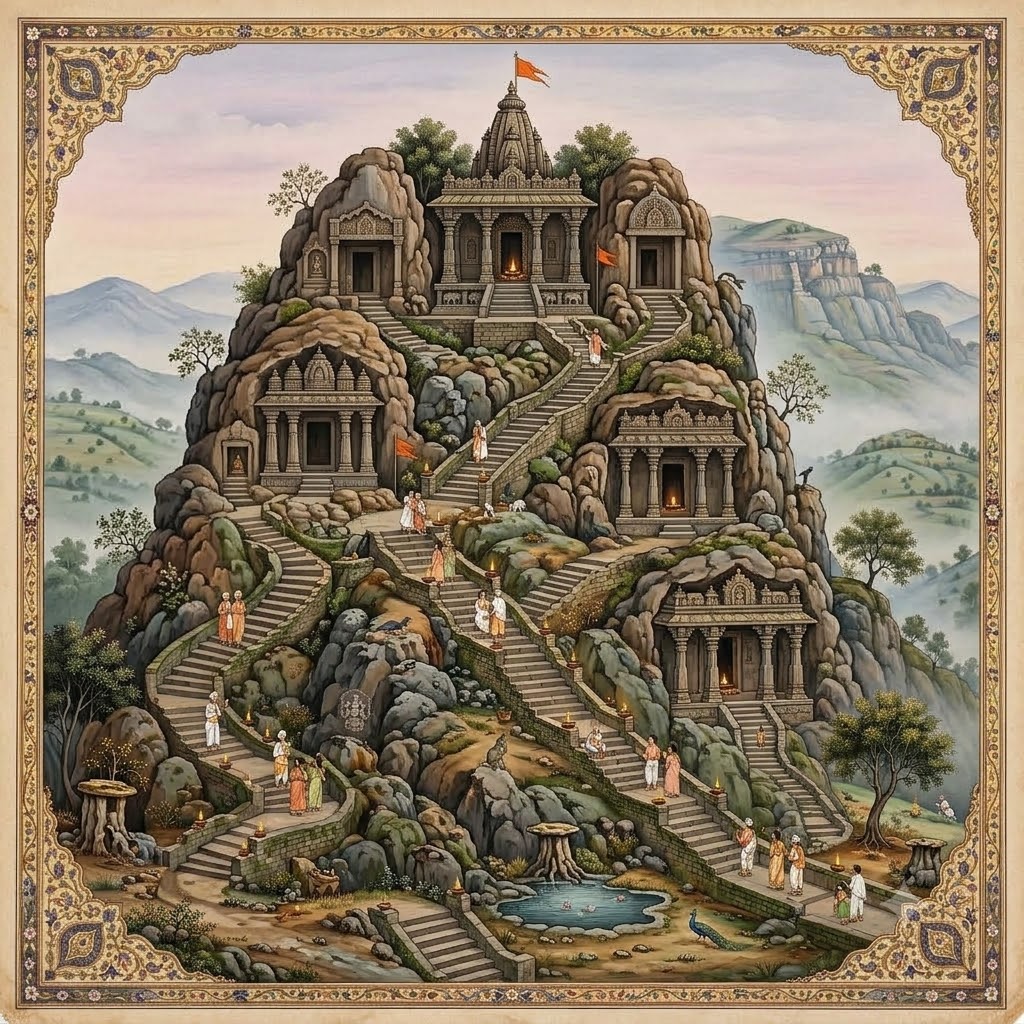
The Cave of Silence
1. The Arrival
The journey to Lenyadri is unlike any other in the Ashta Vinayak circuit. It takes you away from the riverbanks and village paths into the rugged terrain of the Western Ghats. The landscape shifts dramatically. The greenery gives way to rocky outcrops, dry scrub, and the ancient, weathered faces of hills that have stood for millennia.
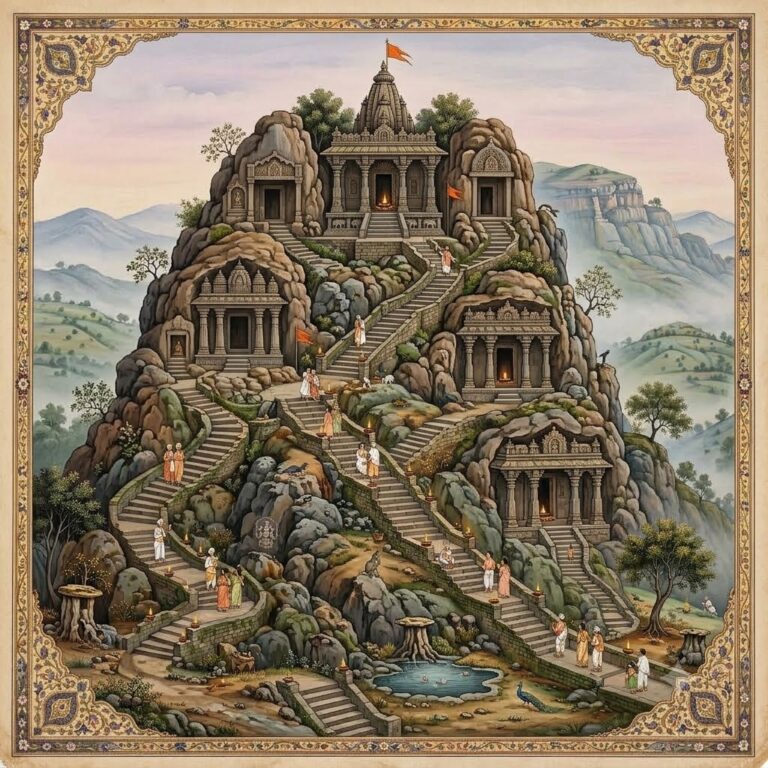
Lenyadri is not a village shrine. It is a cave temple, carved into the side of a mountain, part of a complex of Buddhist rock-cut caves that date back over two thousand years. To reach the sanctum, you must climb three hundred steps, each one a small act of renunciation. The climb is steep, and the sun beats down on the exposed rock. But with each step, the noise of the world falls away.
By the time you reach the top, you are breathless, not just from the effort, but from the silence that envelops you. The vast hall of the cave is cool, dim, and echoing with the sound of dripping water. You have arrived at the cave of the Son of the Mountain. This is where words end and listening begins.
2. The Ancient Legend
The story of Lenyadri is intimately connected to the birth of Ganesha himself. The Puranas tell us that Parvati, desiring a child, created Ganesha from the sandalwood paste on her own body. But there is another tradition, deeply rooted in the Sahyadri hills, that speaks of a different origin.
It is said that Parvati, in her aspect as Girija, the daughter of the Mountain, performed intense penance in these very caves to please Shiva. She sought him as her consort, and her devotion was so powerful that it shook the heavens. Shiva, moved by her unwavering focus, appeared before her and granted her wish. In time, they were united, and their union gave birth to Ganesha.
Lenyadri is believed to be the very place where Parvati meditated, where the seed of the elephant-headed god was conceived in the deepest silence of the mountain. For this reason, Ganesha is worshipped here as Girijatmaj, the Son of Girija, the Son of the Mountain.
The cave is not just a shrine. It is a womb, a space of primordial stillness where the divine takes form. It is where action is born from stillness, where the greatest power emerges from the deepest quiet.
3. The Uniqueness of the Form
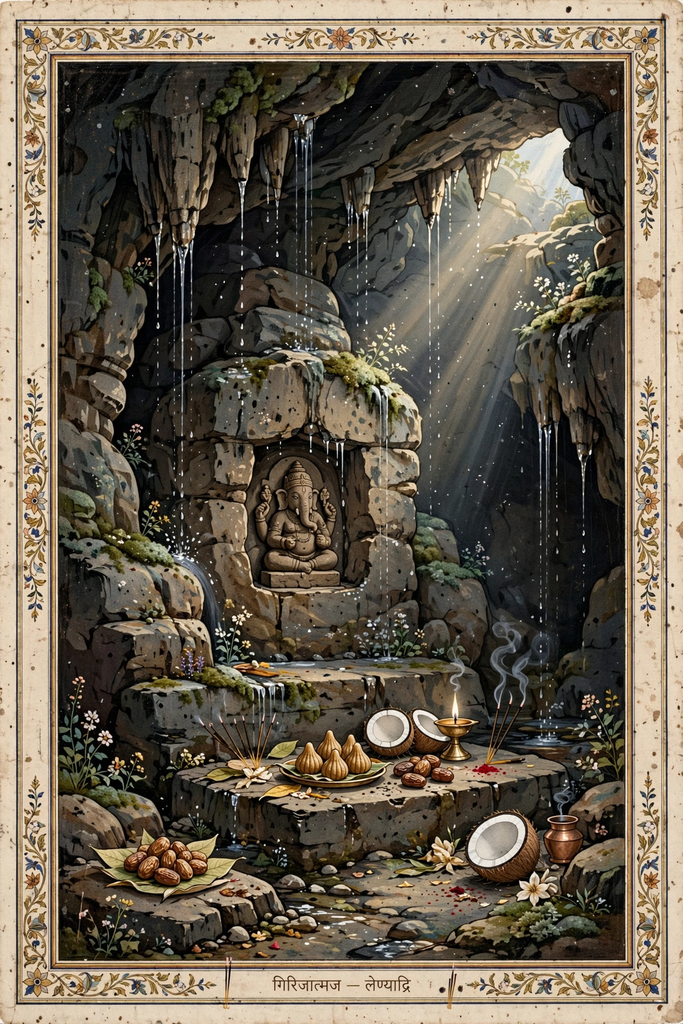
The murti at Lenyadri is unlike any other in the circuit. It is not a Swayambhu, a self-manifested stone, like the others. It is a carved idol, sculpted from the living rock of the cave itself. It is small, barely two feet in height, and sits on a low platform in the inner sanctum. His trunk turns to the left, the Vamamukhi form, symbolising his gentle and accessible nature.
But it is the setting that makes this form so extraordinary. The cave is a vast hall, part of a Buddhist monastic complex that once housed monks who sought solitude and enlightenment. The sound of dripping water echoes through the chambers. The light is dim, filtered through the carved entrance. The air is cool and still, carrying the faint scent of ancient stone and the lingering fragrance of incense.
The Moregaon Ganesha here is not the grand, adorned deity of the other temples. He is simple, almost austere. He wears no elaborate crown, no heavy ornaments. He sits in the quiet darkness, as he has for centuries, waiting for seekers who are willing to climb the steps and sit with him in silence. This is not a god of ceremony. This is a god of stillness.
4. The Inward Lesson
Moregaon taught us clarity of intent. Siddhatek taught us discipline and capability. Pali taught us the courage of surrender. Mahad taught us the grace of acceptance. Lenyadri teaches us the power of silence.
The cave is a powerful metaphor. It represents the inner space, the depths of our own being, where the noise of the world cannot reach. In our daily lives, we are constantly bombarded by sounds, by distractions, by the endless chatter of our own minds. We are rarely still. We are rarely silent. We are rarely alone.
Lenyadri invites us to step into the cave of our own hearts. It asks us to climb the steep steps of effort, to leave behind the noise of our busy lives, and to sit in the quiet darkness of our own being. It is in that silence that we meet the divine.
Parvati did not find Shiva in the midst of celebration or in the comfort of her palace. She found him through penance, through stillness, through the deep practice of turning inward. Lenyadri teaches us that the most profound transformations happen in silence. The seed of wisdom is not planted in the noise of our daily routines. It is planted in the quiet soil of our own hearts.
When we sit in silence, we stop performing. We stop striving. We stop clinging. We simply allow ourselves to be. And in that simple being, we discover that we are not alone. The mountain is holding us. The silence is speaking. The divine is present.
In our age of constant input — notifications, podcasts, meetings, scrolling — Lenyadri is radical. It says: the answer you seek is not in more information. It is in less noise. Climb the 300 steps. Sit in the cave. And listen to what has been waiting beneath the chatter.
5. The Taste of the Temple
The offering at Lenyadri is unique and deeply symbolic. It is a simple dish of Khajur Modak, a sweet made from dried dates and coconut. Unlike the rich, golden Besan Laddu of Pali or the crisp Karanji of Theur, this is a humble offering, reflecting the austere nature of the cave.
The dates represent the sweetness that comes from the harsh, dry landscape. They grow in desert conditions, yet hold concentrated nourishment. It is a reminder that even in the most difficult conditions, even in the driest of seasons, there is nourishment to be found. The modak is not elaborate. It is simple, honest, and deeply satisfying. There is no refined sugar, no heavy ghee. Just the natural sweetness of fruit and the grounding richness of coconut. It is the taste of silence, the sweetness that comes from stillness. It is the taste of sustenance without stimulation.
When you eat it after climbing 300 steps, in the cool of the cave, it does not excite you. It settles you. And that is the point.
6. The Closing Reflection
We live in a world that values noise. We are taught to speak, to perform, to produce, to post. But Lenyadri whispers a different truth. It tells us that the deepest wisdom is born in silence.
Take a moment today. Find a quiet corner. Turn off your phone. Close your eyes. Take a few deep breaths. Let the noise of the world fade away. Let the chatter of your mind settle. Sit in the stillness for just a few minutes. You do not need to do anything. You do not need to think anything. You simply need to be.
In that silence, you may hear something you have not heard in a long time. The voice of your own heart. The whisper of your own soul. The presence of the One who has been waiting for you in the cave.
The mountain does not speak. But if you sit long enough, you will hear it. The dripping water is its mantra. The cool stone is its blessing. Girijatmaj does not give you answers. He gives you the silence in which your own answers can finally arise.
From here, we descend to Ozar, where silence becomes devotion and obstacles dissolve. But carry the cave with you. In your commute, in your meetings, in the pause between emails — find the inner Lenyadri. And be still.
Author Biography: – R Srinivasa Murthy, the author, is a corporate leader, an independent writer, and a student of Hindhu Philosophy. He Identifies as a Demystic, committed to removing unnecessary mysticism from traditions to offer practical systems for the next generation. His upcoming book, Logic of And: Sanatana Dharma as a Toolkit for the Contemporary Seeker, aims to bridge ancient wisdom with modern life to foster an inclusive, living civilisation.

With a journalistic long journey, we bring you https://primepost.news, a dynamic platform committed to unraveling the intricate tapestry of Indian politics, particularly delving deep into the heart of Telangana and Andhra Pradesh. Our blog is not just a source of news; it’s a reservoir of insights, analysis, and thought-provoking reviews.


Beautifully written, Sir. 🙏 A very divine and informative article about Girijatmaj Ganpati. May Lord Ganesha bless you and your family with happiness, good health, peace, and prosperity. Ganpati Bappa Morya! 🙏🌺