The Courage of Surrender
1. The Arrival
The journey to Pali takes you away from the coastal plains and into the gentle folds of the Sahyadri hills. The village lies cradled between the towering presence of Sarasgad Fort and the quiet flow of the Amba River. This is not the rugged openness of Siddhatek, nor the fortress-like solitude of Moregaon. Pali feels different. It feels lived in, warm, and deeply human.
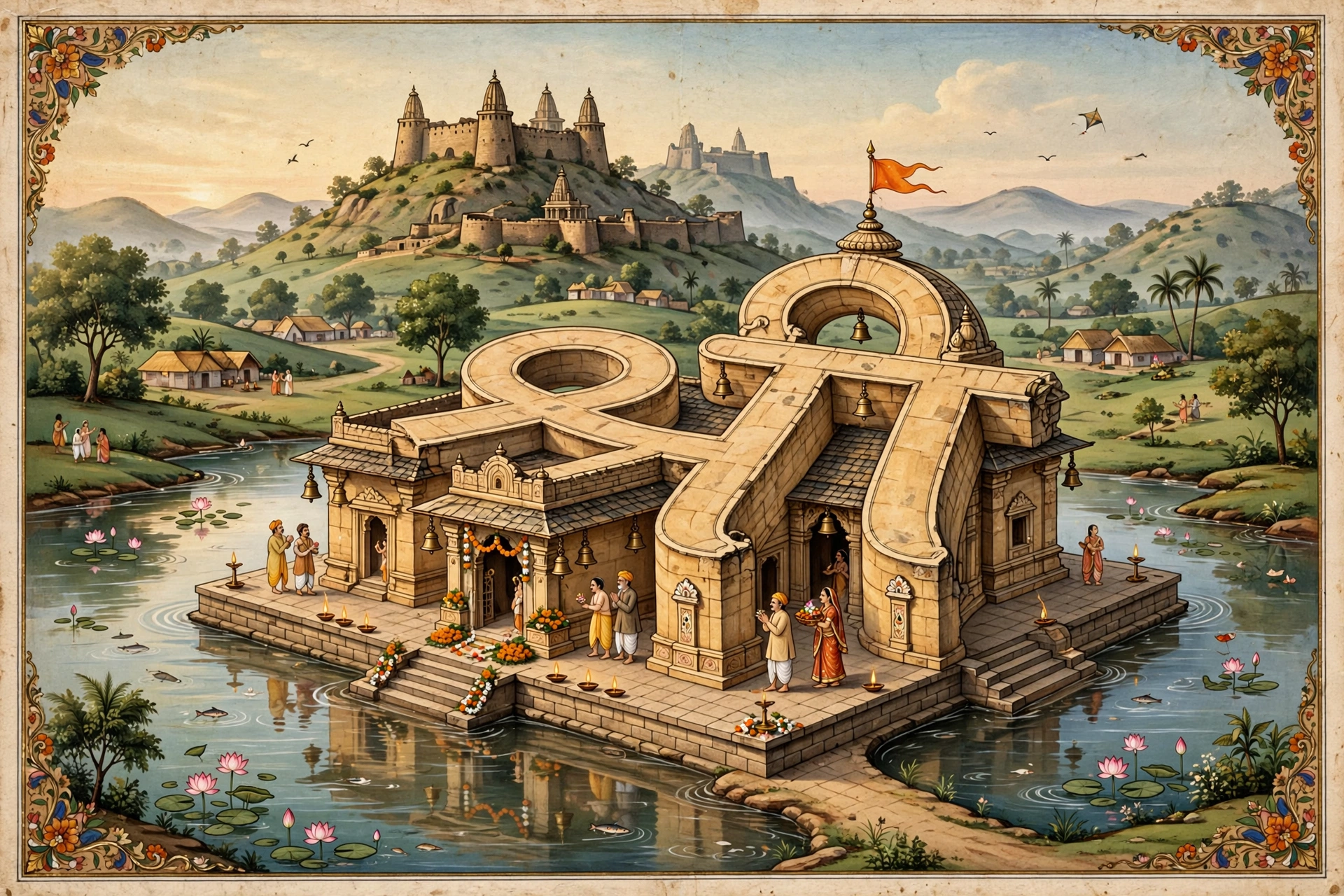
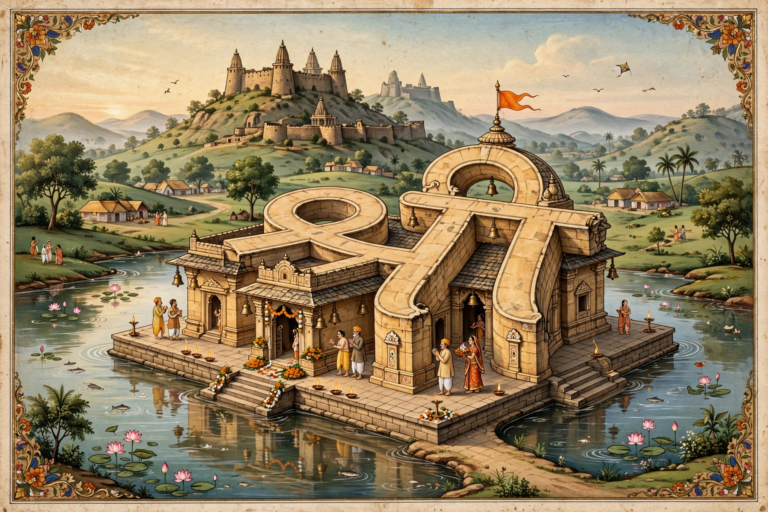
As you approach the Ballaleshwar temple, you notice its unusual shape. It is built in the form of the sacred letter ‘Shri’, a symbol of prosperity and auspiciousness. The temple complex encircles two serene lakes, their waters reflecting the sky and the ancient stone walls. Children play near the steps. An old woman feeds the fish. The air carries the scent of damp earth and the distant echo of temple bells.
You have arrived at a place where devotion meets ordinary life, where a god chose to stay not for cosmic reasons, but for the love of a boy.
2. The Ancient Legend
The story of Ballaleshwar is unlike any other in the Ashta Vinayak circuit. It is the only temple named not for the god, but for a devotee. That alone tells you something profound: here, the seeker matters as much as the sought.
In the village of Pali, which was once known as Pallipur, lived a merchant named Kalyan and his wife Indumati. They had a son named Ballal, who was a deeply devoted worshipper of Ganesha. Ballal would often gather his friends and take them into the forest, where they would place a large stone, decorate it as an idol of Ganesha, and lose themselves in prayer and ritual. Their devotion was so intense that they would forget the passage of time and return home late.
The parents of the other children grew frustrated. They complained to Kalyan, blaming Ballal for leading their children astray. Kalyan, already unhappy with his son’s neglect of worldly responsibilities, flew into a rage. He stormed into the forest, destroyed the makeshift shrine, and threw the stone idol to the ground. In his fury, he beat Ballal mercilessly, tied him to a tree, and left him there, declaring that his god would have to set him free.
Bound and in great pain, Ballal did not despair. He did not curse his father. He did not curse his fate. He continued to chant the name of his beloved Ganesha with unwavering faith. The ropes cut into his wrists. The ants found him. Night fell. Still, he chanted.
Moved by the boy’s extraordinary devotion, Lord Ganesha appeared before him, not as a grand deity, but as a simple Brahmin sage. He freed Ballal from his bindings and blessed him with divine grace. Overcome with joy, Ballal pleaded with the Lord to remain in Pali forever, to make his presence known to all who sought him. Granting his devotee’s wish, Ganesha took residence in Pali and was thereafter worshipped as Ballaleshwar. The Lord of Ballal.
3. The Uniqueness of the Form
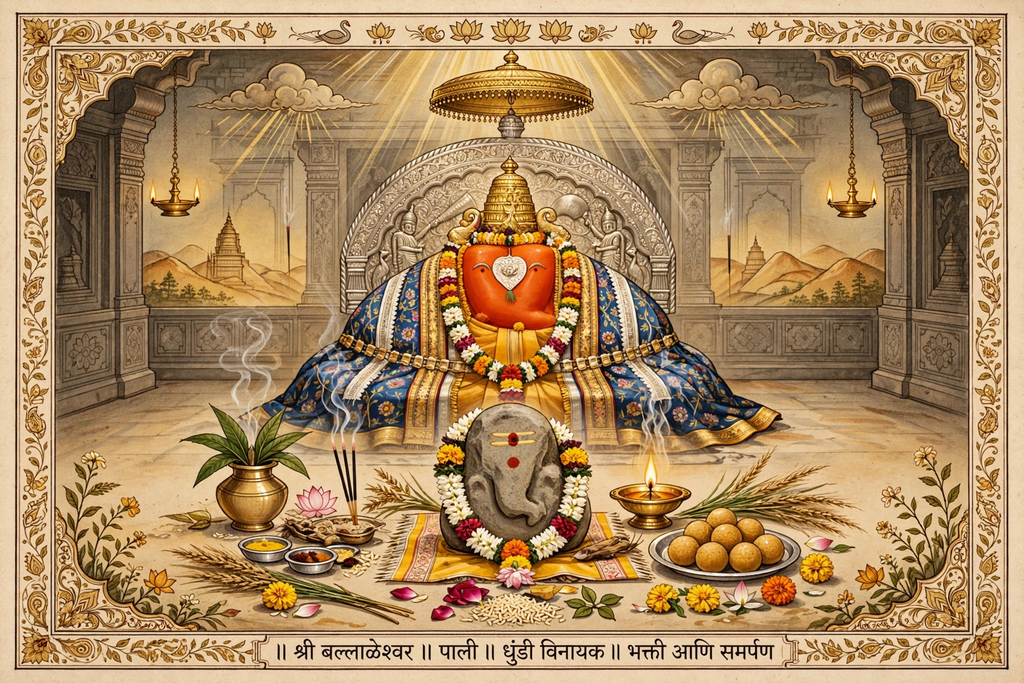
The murti of Ballaleshwar sits on a stone throne in the inner sanctum, facing east. Like the Lord at Moregaon, his trunk is turned to the left, a symbol of the lunar, receptive, and nurturing energy that blesses his devotees with prosperity and well-being.
The idol is carved from black stone and stands about three feet tall. His eyes and navel are set with sparkling diamonds, which catch the flickering light of the oil lamps and gleam like distant stars in the darkness of the inner chamber. A large stone mouse, Ganesha’s vehicle, sits before him, holding a modak in its forepaws. Behind the idol, a silver backdrop depicts Riddhi and Siddhi, the goddesses of prosperity and spiritual power, waving chamaras.
But one of the most fascinating details of this temple is the practice that precedes the main darshan. Devotees are expected to first visit Dhundi Vinayak, a smaller, west-facing idol located behind the main temple. This is believed to be the very stone that Ballal and his friends worshipped, the one that was thrown away by his father. It is a humble acknowledgement of the temple’s sacred origins and a reminder that even what is broken and discarded can hold profound spiritual power.
The temple’s ‘Shri’ shape is no accident. You enter through the curves of grace, and you exit through the same. The entire structure is a blessing you walk through.
4. The Inward Lesson
Moregaon taught us clarity of intent. Siddhatek taught us discipline and capability. Pali teaches us the courage of surrender.
The story of Ballal is not simply a tale of divine intervention. It is a mirror held up to our own lives. How often do we face rejection for our passions? How often are we punished for following our hearts? How often does the world, represented by an angry father, bind us to a tree of doubt and fear?
Ballal’s response is the lesson. He did not fight his father. He did not curse his fate. He did not abandon his faith. He simply continued to hold on to his truth. His surrender was not weakness. It was a profound act of trust. He trusted that his devotion was not in vain, that the god he loved would not abandon him.
We all have our moments of being tied to a tree. We feel trapped by our circumstances, by the expectations of others, by our own fears. We are told we are too idealistic, too impractical, too devoted to something that doesn’t pay. The world ties us up with “be realistic” and leaves us in the forest.
Ballaleshwar teaches us that the first step to freedom is not to break the ropes through sheer force, but to surrender to a power greater than ourselves. It is the courage to say, “I cannot do this alone. I trust that help will come.” And when we have that courage, the ropes that bind us begin to loosen.
This is not passive. Ballal kept chanting. Surrender is not giving up. It is giving over. It is saying: “I will do my part — the chanting, the showing up, the loving — and I trust the universe to do its part — the untying, the healing, the opening.”
At Moregaon we learn to name our intent. At Siddhatek we build the skill. At Pali we learn that even with intent and skill, we will face moments where only grace can untie us.
5. The Taste of the Temple
At most Ganesha temples, the offering is the beloved modak, a sweet dumpling that is the Lord’s favourite. But at Ballaleshwar, the prasad is different. Here, the offering is Besan Laddu, a rich, golden sweet made from roasted chickpea flour and ghee.
Unlike the simple Khichdi of Moregaon or the practical Sattu of Siddhatek, this is a sweet that speaks of celebration, of the joy of being saved, of a relationship between a god and a boy. The laddu is dense and nourishing, a reminder that when we surrender with true faith, the reward is not just freedom, but sweetness.
Besan is earthy. Ghee is richness. Together, they are roasted until the kitchen smells like a festival. This is not the food of preparation. This is the food of homecoming. It is the taste of grace received after the trial is passed. It is the taste of a father — not the angry one who tied the ropes, but the divine one who untied them.
6. The Closing Reflection
We are not all called to be sages or warriors. Some of us are simply called to be like Ballal: to love deeply, to trust completely, and to hold on to our faith even when the world turns against us.
In our daily lives, we face obstacles. We face rejection. We face moments when we feel bound and abandoned. But Ballaleshwar reminds us that our suffering is not the end of the story. It is often the beginning. It is the moment when we are forced to look inward, to find the strength that does not come from our own muscles, but from something greater.
Take a moment today. Think of the tree you are tied to. What is it? Fear? Resentment? Self-doubt? The voice of a parent, a boss, a culture that says “your devotion is a waste”? Now, do not fight it. Simply turn inward. Offer your struggle to the Lord of Ballal.
Trust that the ropes will loosen, that the grace will come, that the sweetness will follow.
When you find the courage to surrender, you have already begun to be free. The two lakes still reflect the sky. Sarasgad still stands guard. And in the sanctum, a boy’s love still holds God in place.
From here, we walk to Mahad, where surrender deepens into acceptance. But for now, taste the laddu. Remember the stone. And know that devotion, even when broken, is never wasted.
Author Biography: – R Srinivasa Murthy, the author, is a corporate leader, an independent writer, and a student of Hindhu Philosophy. He Identifies as a Demystic, committed to removing unnecessary mysticism from traditions to offer practical systems for the next generation. His upcoming book, Logic of And: Sanatana Dharma as a Toolkit for the Contemporary Seeker, aims to bridge ancient wisdom with modern life to foster an inclusive, living civilisation.

With a journalistic long journey, we bring you https://primepost.news, a dynamic platform committed to unraveling the intricate tapestry of Indian politics, particularly delving deep into the heart of Telangana and Andhra Pradesh. Our blog is not just a source of news; it’s a reservoir of insights, analysis, and thought-provoking reviews.

Super wow, Sir! 👏 Truly a powerful and inspiring article. Your way of connecting devotion, faith and life lessons is remarkable. A wonderful piece of writing! 🙏🌺 Ganpati Bappa Morya!
Superb sir
Fantastic briefing and knowing the Details in Deep.
Thanks sir😍👍🙏👏😍