The Systemic Collapse of Public Education in India
How Schools Lost Their Classrooms and Education Lost Its Purpose
It is one of the profound ironies of India’s public education system that a student may spend years in a classroom nominally supervised by one of the country’s finest academic minds and yet receive almost no formal education. The contradiction is not merely personal; it is institutional. It reveals a structural malaise in which administrative prestige, bureaucratic routine, and symbolic accomplishment have gradually displaced the primary purpose of a school—to teach.
My own experience in a Municipal High School remains an enduring illustration of this paradox. Our headmaster was no ordinary educator. He was celebrated as an exceptional mathematician and was selected by the government to author the official Tenth Class Mathematics textbook prescribed for thousands of students across the state. His intellectual reputation was unquestionable. Yet throughout my years in school, he never entered our classroom to teach the mathematics periods officially assigned to him. Every day, those precious instructional hours disappeared into administrative inspections, corridor supervision, office files, meetings, registers, and institutional management. The textbook writer never taught the textbook.
This is not an indictment of an individual. It is an indictment of a system that has transformed schools into administrative establishments where educational leadership is increasingly measured by paperwork rather than pedagogy. When the state’s finest teachers are consumed by bureaucracy instead of classrooms, students become the invisible casualties of institutional priorities.
The tragedy extends far beyond one municipal school. It reflects a disturbing national pattern in which expertise has become detached from instruction. Across India—and particularly in the Telugu-speaking states of Andhra Pradesh and Telangana—the public education system increasingly exhibits a dangerous disconnect between educational policy and classroom reality. Schools continue to function; education often does not.
The Anatomy of Abandonment: When Excellence Is Forced to Grow Alone
In the absence of structured classroom instruction, students are compelled to construct their own educational pathways. Some survive through extraordinary determination. Others depend upon educated parents who can compensate for institutional deficiencies by teaching lessons at home. Still others rely upon classmates, private tuition, or self-study. These coping mechanisms conceal rather than solve the underlying failure.
When a child displays unusual academic promise under such circumstances, society is quick to celebrate innate brilliance. Yet what frequently lies beneath this outward success is profound insecurity. Students who learn without teachers often carry an invisible burden of uncertainty. Every examination becomes an experiment in self-reliance rather than an assessment of guided learning. Achievement, instead of being the product of effective schooling, becomes an individual struggle against systemic neglect.
This creates one of the gravest educational inequalities in modern India. A child born into a family capable of providing academic guidance possesses a decisive advantage over another whose parents lack formal education. Consequently, the quality of education increasingly depends not upon the school but upon the household. The constitutional promise of equal educational opportunity is thus quietly undermined within the walls of government institutions themselves.
Schools Without Education: The Structural Crisis in Andhra Pradesh and Telangana
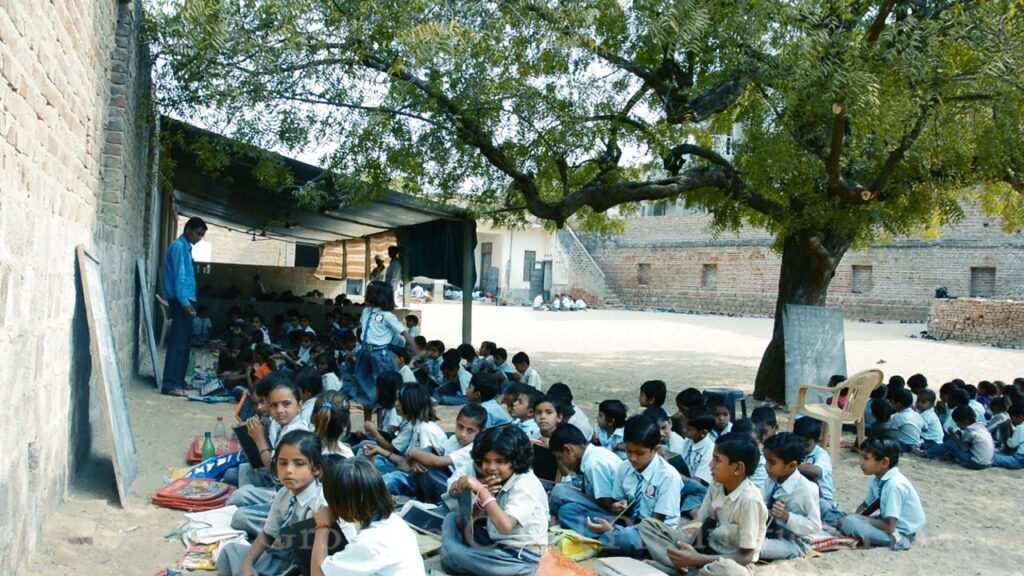
The experience of countless government schools across Andhra Pradesh and Telangana illustrates that the crisis is not primarily one of infrastructure but of instructional delivery. Buildings have multiplied, enrolment drives have expanded, digital classrooms have been announced, and welfare schemes have proliferated. Yet the essential transaction between teacher and student remains alarmingly fragile.
Empirical evidence reinforces this concern.
The Annual Status of Education Report (ASER) has consistently demonstrated that although enrolment in primary education approaches universality, foundational learning remains deeply deficient. Less than half of Class V students in rural government schools can comfortably read a Class II text or solve elementary division problems. Years spent inside classrooms have not necessarily translated into meaningful learning.
This educational deficit explains the remarkable migration toward low-cost private schools. Even economically disadvantaged families willingly sacrifice a significant share of their income not because private institutions invariably offer superior education, but because they promise something increasingly uncertain within many government schools: regular teacher presence, classroom discipline, academic continuity, and predictable instructional routines.
Public expenditure presents another contradiction. India continues to spend approximately four per cent of its Gross Domestic Product on education, substantially below the long-standing recommendation of six per cent reaffirmed by the National Education Policy (NEP) 2020. Even within existing allocations, a disproportionate emphasis frequently falls upon infrastructure, buildings, equipment, administrative expansion, and welfare distribution, while comparatively less attention is devoted to teacher development, classroom supervision, pedagogical quality, and measurable instructional outcomes.
Education consequently becomes visible in budgets but invisible inside classrooms.
From Rote Learning to Institutional Failure
Where teaching becomes inconsistent, memorisation inevitably replaces understanding.
Students prepare not to comprehend but to reproduce. Examinations reward mechanical recall rather than intellectual curiosity. Marks become substitutes for knowledge, certificates replace competence, and degrees increasingly fail to reflect genuine educational attainment.
Such a system inevitably produces graduates possessing formal qualifications but lacking analytical reasoning, communication skills, scientific temper, and practical problem-solving ability. Universities inherit underprepared students. Employers encounter unemployable graduates. Governments confront rising educated unemployment despite expanding educational access. The consequences extend beyond the labour market. A generation educated without conceptual foundations becomes vulnerable to misinformation, ideological manipulation, technological displacement, and declining civic reasoning. Educational weakness gradually transforms into economic weakness, administrative weakness, and democratic weakness.
The recurring controversies surrounding examination irregularities, recruitment paper leaks, coaching dependency, and high-stakes entrance examinations merely expose symptoms of a far deeper institutional illness. They are not isolated failures. They are consequences of a schooling system that has progressively weakened its instructional core.
The Failure of Government Schooling: A Systemic Diagnosis
The deterioration of public education cannot be attributed to teachers alone. It is the cumulative consequence of systemic failures operating simultaneously across multiple levels. Administrative responsibilities increasingly consume the time of school leaders who should function as academic mentors. Teachers are frequently diverted toward election duties, census operations, surveys, welfare implementation, and various non-academic governmental assignments. Classroom observation and pedagogical supervision remain sporadic. Performance evaluation often measures procedural compliance rather than teaching effectiveness.
Political priorities frequently favour visible announcements over measurable learning outcomes. New buildings, distribution schemes, digital devices, uniforms, bicycles, and publicity campaigns generate immediate political visibility. Improvements in classroom instruction, by contrast, demand sustained institutional reform, professional development, rigorous monitoring, and long-term commitment.
Teacher training itself often remains disconnected from contemporary pedagogical practice. Recruitment delays create prolonged vacancies. Transfers disrupt continuity. Multi-grade classrooms stretch available personnel beyond reasonable capacity. In many institutions, the administrative architecture has expanded while the academic foundation has weakened.
The result is a paradoxical educational system in which schools remain open, attendance registers remain complete, examinations continue to be conducted, certificates continue to be issued, and yet genuine learning steadily erodes.
Reasons, Implications and Ramifications

The reasons for this systemic failure are both structural and administrative: excessive bureaucratisation of educational leadership; diversion of teachers toward non-teaching responsibilities; inadequate classroom accountability; insufficient investment in teacher capacity; weak academic supervision; policy emphasis on infrastructure rather than instruction; examination-centred learning; and the gradual erosion of professional teaching culture.
The implications are equally profound. Foundational learning deficits accumulate across successive grades. Social inequality widens as affluent families increasingly rely upon private education while disadvantaged children remain trapped within underperforming institutions. Economic productivity declines as employers struggle to find adequately skilled graduates. Public confidence in government schools diminishes, encouraging further migration to private institutions and accelerating educational stratification.
The long-term ramifications extend far beyond the classroom. A nation that neglects foundational education compromises its scientific capacity, administrative competence, democratic resilience, technological innovation, and social mobility. Educational failure ultimately becomes a national development challenge rather than merely a departmental concern.
Reforming the Public Education System
Addressing these structural failures demands a decisive shift in priorities. Educational reform must move beyond constructing classrooms toward ensuring that learning genuinely occurs within them. Teacher accountability should focus upon measurable instructional engagement rather than administrative compliance. School leaders must be liberated from excessive bureaucratic responsibilities and restored to their primary role as academic leaders. Classroom observation should become systematic and continuous. Teacher professional development must become an ongoing institutional commitment rather than an occasional procedural exercise.
Learning outcomes—not merely enrolment statistics, infrastructure creation, or examination pass percentages—should become the principal indicators of educational success. Government schools must once again inspire public confidence through demonstrable teaching quality rather than policy declarations.
Most importantly, every child, irrespective of economic or social background, must receive competent classroom instruction as a matter of constitutional right rather than personal fortune.
Reclaiming the Purpose of the Classroom
The story of the headmaster who authored mathematics textbooks but never taught mathematics is not simply a personal recollection. It is a powerful metaphor for the contemporary crisis confronting India’s public education system. Education cannot survive on distinguished credentials, official designations, impressive policy documents, or celebrated textbook authorship alone. It lives only through the daily encounter between a committed teacher and an eager student inside a classroom.
Until that simple educational covenant is restored, no amount of infrastructure, digital technology, administrative reform, or political proclamation will rescue government schooling from its present decline. The true measure of a school is neither the reputation of its headmaster nor the grandeur of its buildings. It is whether every child leaves the classroom having genuinely learned something that will illuminate both mind and character.
That remains the unfinished promise of public education in India.

M. Shiva Prasad, IPS (Rtd.) is a dedicated law enforcement professional who served the combined Andhra Pradesh cadre before opting for the Telangana cadre. Though a native of Andhra Pradesh, he considers himself a true Hyderabadi with an abiding love for the Telugu people. Driven by sincerity, fearlessness, and a lifelong fight against inequality and injustice, his ultimate strengths remain his goodwill and deep affection for the public and the police force. Today, he continues his mission by writing snippets and articles true to his conscience.
Email: Shivareach@yahoo.com
Mobile: 98480 38774




A good write up. It is true that HM (Head Master) was no ordinary during those days. They are gifted with enormous knowledge in their respective subjects. It’s not only HM, even other teachers also have command in their respective subjects which are taught by them. There was bondage between student and teacher. Now it’s missing. Students are not serious about learning. Similarly, teachers also lost their interests to teach the subjects till they follow it. Now-a-days education has become commercial. So that is why we happen to come across half Knowledge people in the Society. Peculiar thing they have been successful and reaching top with half Knowledge. This is beyond my expectations. A good write up.