Audacious Belligerence, Maritime Hegemony and the World Inching Towards Another Global War
The post-war international order was founded upon a solemn promise: never again would power alone determine the fate of nations. The devastation of two World Wars persuaded humanity that military might must remain subordinate to international law. The Charter of the United Nations, the Geneva Conventions, the Hague Conventions, the law of the sea and the broader corpus of international humanitarian law were painstakingly crafted to regulate armed conflict, protect civilians, preserve neutral rights and prevent the oceans from becoming theatres of unrestricted warfare. Today, that carefully constructed legal architecture stands under unprecedented strain.
The continuing confrontation in the Persian Gulf has become far more than a bilateral dispute between two adversaries. It has evolved into a profound test of whether international law still retains the authority to restrain geopolitical ambition. The fragile ceasefire repeatedly teeters on collapse. Diplomatic initiatives falter. Military strikes continue. Naval deployments intensify. Commercial shipping is endangered. Neutral merchant vessels are drawn into the vortex of conflict. The distinction between military necessity and strategic coercion grows increasingly blurred.
History teaches that great wars seldom erupt overnight. They emerge through the gradual erosion of legal norms, the normalisation of military escalation and the steady acceptance of exceptional measures as ordinary instruments of statecraft. The world may not yet be witnessing another global war, but it is unquestionably witnessing the weakening of the legal restraints designed to prevent one.
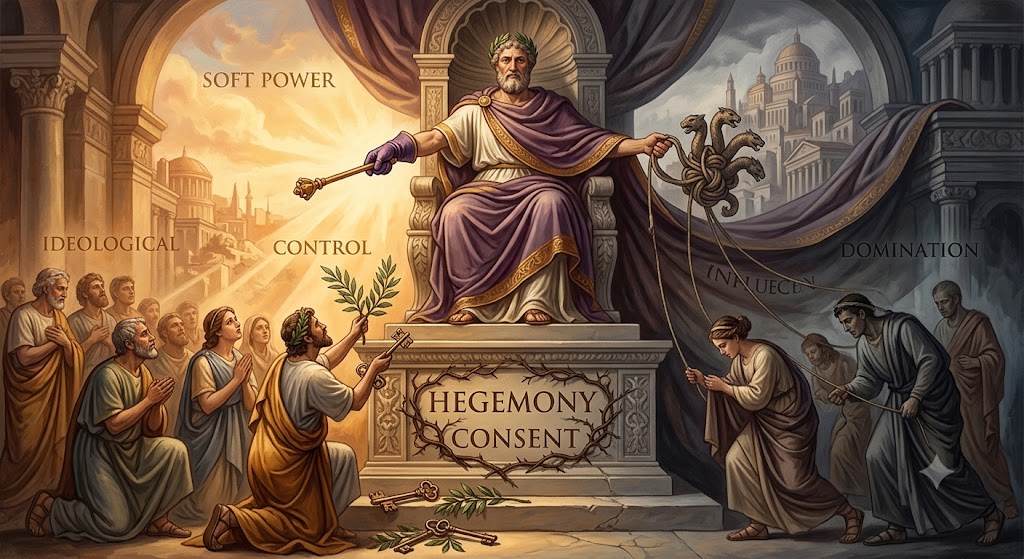
The Return of Hegemonic Politics

The defining feature of the present crisis is the re-emergence of hegemonic power politics. Military superiority is increasingly projected as the principal instrument for resolving geopolitical disputes. Strategic waterways are transformed into arenas of confrontation. Economic pressure complements military deployment. Naval dominance becomes an instrument of political influence.
Such developments evoke uncomfortable memories of earlier eras of imperial expansion when powerful States exercised control over maritime commerce and strategic sea routes according to their own geopolitical calculations. Modern international law was consciously designed to replace precisely such practices with universally applicable legal norms founded upon sovereign equality.
The legitimacy of any international order depends not upon the strength of its most powerful members but upon their willingness to remain bound by the same legal standards that govern weaker nations.
The Law Governing Naval Warfare
International law does not prohibit war. It regulates it.
The law governing naval warfare is derived from the United Nations Charter, the Geneva Conventions of 1949 and their Additional Protocols, the Hague Conventions, the United Nations Convention on the Law of the Sea (UNCLOS), customary international humanitarian law and the San Remo Manual on International Law Applicable to Armed Conflicts at Sea. Collectively, these instruments establish that even during armed conflict, the conduct of belligerents is neither unlimited nor arbitrary.
The principles are clear and universally recognised.
Military necessity permits attacks only against legitimate military objectives.
The principle of distinction requires combatants to distinguish between military targets and civilian objects.
The principle of proportionality prohibits attacks expected to cause excessive civilian harm in relation to the anticipated military advantage.
The principle of precaution obliges every belligerent to minimise civilian casualties.
The principle of humanity prohibits methods of warfare that inflict unnecessary suffering.
These principles are not moral aspirations alone. They are legal obligations.
Belligerent States and Neutral States
One of the oldest doctrines of international law distinguishes between belligerent States and neutral States.
Belligerents may direct military operations against each other’s armed forces, military installations and other legitimate military objectives. Neutral States, however, possess clearly recognised rights. Their merchant vessels, commercial cargoes and civilian seafarers enjoy protection unless they directly participate in hostilities or are demonstrably employed for military purposes.
The oceans cannot become zones where neutrality ceases to exist.
Every attack upon a neutral merchant vessel demands rigorous legal scrutiny. Merchant ships carrying food, crude oil, liquefied natural gas, fertilisers, medicines or industrial raw materials sustain civilian populations across continents. Unless such vessels effectively contribute to military operations, they remain protected civilian objects under international humanitarian law.
The deaths of innocent merchant seafarers therefore represent not merely tragic consequences of war but potential failures to uphold the legal protections owed to civilians at sea.
The Strait of Hormuz: The World’s Most Strategic Maritime Chokepoint
Few waterways carry greater strategic significance than the Strait of Hormuz.
Nearly one-third of global seaborne crude oil exports and substantial quantities of liquefied natural gas transit this narrow maritime corridor every day. It links the energy-producing Gulf to the global economy. Any disruption immediately reverberates through international markets.
The Strait has consequently become the focal point of military deployments, naval escorts, maritime surveillance, missile threats and commercial insecurity.
Freedom of navigation constitutes one of the foundational principles of the law of the sea. The uninterrupted passage of commercial shipping is indispensable not merely for regional prosperity but for global economic stability. Persistent military confrontation within or around this maritime corridor threatens energy security, food security and international commerce simultaneously.
The Law of Naval Blockade
International law recognises that naval blockades may be imposed during armed conflict. However, the law imposes strict conditions.
A blockade must be formally declared.
It must be publicly notified.
It must be effective.
It must apply without discrimination.
It must be directed exclusively against the enemy.
It cannot deliberately starve civilian populations.
It cannot obstruct humanitarian relief.
It cannot unlawfully interfere with neutral commerce.
The objective of blockade law is to reconcile military necessity with humanitarian protection. Collective economic punishment of civilian populations or arbitrary interference with neutral shipping falls outside these legal limitations.
The seas cannot become instruments for imposing unlimited economic coercion.
Neutral Shipping Under Threat
Recent attacks upon commercial vessels, including Indian-linked merchant ships such as MV Nirmal Grace, have raised serious concerns regarding the protection of neutral maritime commerce. Equally distressing are reports of Indian merchant seafarers losing their lives while engaged in peaceful commercial navigation.
Merchant sailors are not combatants.
They transport the world’s food.
They transport its energy.
They transport fertilisers essential for agriculture.
They transport medicines and industrial supplies indispensable to civilian life.
To transform commercial navigation into collateral damage is to undermine the humanitarian foundations upon which maritime law rests.
The deaths of Indian seafarers remind us that neutrality offers little comfort when military confrontation disregards legal restraint.
The United Nations Charter and the Use of Force
The United Nations Charter remains the cornerstone of the contemporary international legal order.
Article 2(4) prohibits the threat or use of force against the territorial integrity or political independence of any State.
Only two recognised exceptions exist.
The inherent right of self-defence under Article 51.
Military action explicitly authorised by the United Nations Security Council.
Whenever military operations extend beyond these recognised legal bases, questions inevitably arise regarding their conformity with international law. Strategic necessity cannot itself create legal authority.
International legality cannot become contingent upon geopolitical influence.
The Economic War Against Neutral Nations
Modern wars rarely remain confined to battlefields.
The consequences spread through financial markets, shipping routes, energy supplies, insurance premiums and commodity prices.
India illustrates this vulnerability with particular clarity.
A substantial proportion of India’s crude oil imports, liquefied natural gas supplies and fertiliser requirements originate in or transit through the Gulf region. Disruptions in the Strait of Hormuz immediately affect fuel prices, fertiliser availability, agricultural production, inflation, transport costs, industrial competitiveness and household expenditure.
Higher maritime insurance premiums increase freight charges.
Longer shipping routes delay supplies.
Energy insecurity weakens industrial growth.
Food prices escalate.
Inflation places additional burdens upon public finances.
The current account deficit widens.
Fiscal pressures intensify.
Economic growth slows.
The consequences are borne not by the belligerents alone but by billions living thousands of kilometres away.
Neutral nations increasingly become economic casualties of conflicts they neither initiated nor support.
The Erosion of the Rules-Based International Order
International law derives its authority from consistent application rather than selective enforcement.
If legal principles are invoked only when politically convenient, their normative force gradually disappears.
When neutrality no longer protects merchant shipping…
When civilian commerce becomes a legitimate target…
When maritime blockades expand beyond recognised legal limits…
When strategic dominance supersedes legal restraint…
The international order begins to shift from a system governed by law towards one governed by power.
Such transformations seldom remain confined to one region.
They reshape the entire architecture of international relations.
Legal and Cognitive Injury to Nations
The consequences extend beyond physical destruction.
Every attack upon neutral shipping inflicts what may appropriately be described as a legal injury upon the international community. Confidence in established legal norms begins to erode. Commercial actors lose faith in maritime security. Insurance markets become unstable. Diplomatic trust diminishes.
Simultaneously, nations experience a profound cognitive injury.
When States conclude that international law no longer guarantees freedom of navigation or protects neutrality, strategic mistrust replaces legal certainty. Military preparations expand. Naval deployments increase. Regional alliances harden.
The cycle of insecurity becomes self-perpetuating.
Humanity Must Remain Above Hegemony
No military victory can compensate for the destruction of the legal principles that safeguard civilisation itself.
The oceans belong to humanity.
They are not instruments of geopolitical domination.
They are not arenas for unrestricted military rivalry.
The law of the sea exists to preserve commerce, communication and peaceful coexistence among nations.
The law of armed conflict exists to limit suffering even when peace proves elusive.
These legal restraints are not signs of weakness.
They represent humanity’s collective wisdom born from centuries of catastrophic wars.
Who Will Answer?
The deaths of innocent Indian merchant seafarers, the attacks upon neutral commercial vessels, the disruption of global energy supplies, the threats to food security, the insecurity surrounding the Strait of Hormuz, the growing vulnerability of international commerce and the gradual erosion of international humanitarian law together present a challenge that transcends any single conflict.
The question before the international community is no longer confined to one region or two belligerents.
It concerns the future of the international legal order itself.
Will the world remain governed by law?
Or will law gradually yield to hegemonic power?
If strategic dominance replaces legal legitimacy, if neutral rights become expendable, if freedom of navigation becomes hostage to military coercion and if international institutions prove incapable of enforcing the very norms they were created to uphold, then humanity will have travelled a perilous distance from the ideals upon which the post-war order was built.
The greatest danger may not be the present conflict alone.
It is the precedent it creates.
For history repeatedly reminds us that when law retreats before power, civilisation inches inexorably towards wider wars.
The world cannot afford another descent into global confrontation.
The time has come for all belligerents, without exception, to reaffirm their commitment to international law, respect the rights of neutral nations, protect civilian shipping, preserve the freedom of the seas and restore diplomacy as the primary instrument of peace.
Otherwise, the question that echoes across the world’s oceans will remain unanswered:
Who will answer for the lives lost, the laws violated, the neutrality compromised, the economies imperilled and the future of a rules-based international order placed in jeopardy?


With a journalistic long journey, we bring you https://primepost.news, a dynamic platform committed to unraveling the intricate tapestry of Indian politics, particularly delving deep into the heart of Telangana and Andhra Pradesh. Our blog is not just a source of news; it’s a reservoir of insights, analysis, and thought-provoking reviews.