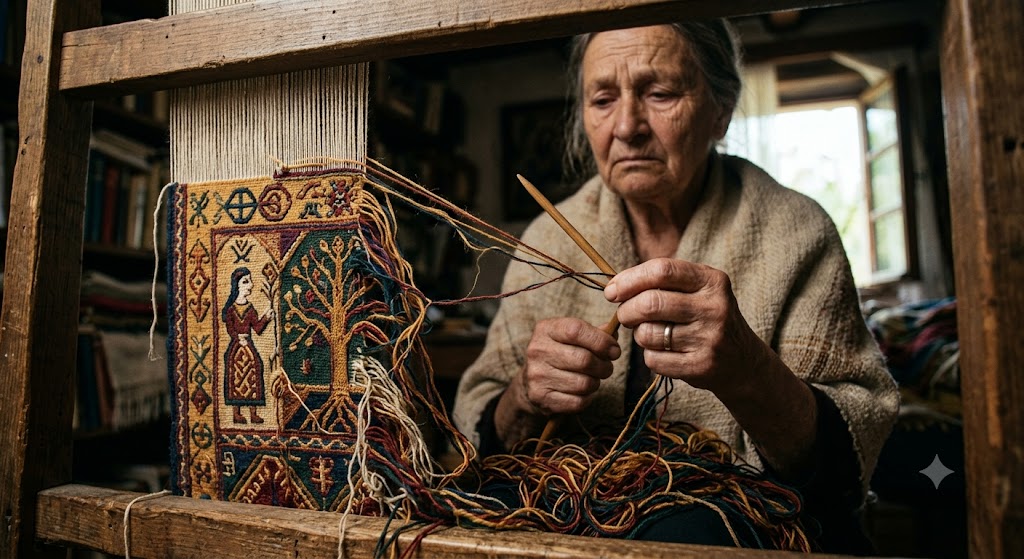
Part – 1
The Eternal Enigma of Existence, Civilisation and the Human Condition
The question “Who am I?” has haunted humanity since the dawn of consciousness. Long before the emergence of organised religion, formal philosophy, modern science or political institutions, human beings must have gazed at the stars, witnessed birth and death, endured suffering and triumph, and wondered about the meaning of their existence. Every civilisation, every culture and every generation has attempted to answer this deceptively simple question. Yet no answer has ever attained finality.
Viewed through the lens of biology, man appears to be merely another species among millions inhabiting the earth. Like every other creature, he is born, struggles for survival, reproduces and eventually perishes. The laws governing his existence are not fundamentally different from those governing the lives of birds, beasts or insects. Nature exhibits neither sentiment nor preference. The deer flees from the tiger, the tiger hunts the deer, and both are ultimately subject to the same inexorable laws of birth, decay and death. Darwin’s formulation of the struggle for existence and the survival of the fittest merely articulated a reality that nature had been practising for millions of years before humanity emerged.
Yet man differs from other creatures in one profound respect. He possesses the capacity for self-awareness. He not only lives but knows that he lives. He not only suffers but reflects upon suffering. He not only acts but questions the purpose of action itself. This capacity for introspection transformed a biological organism into a civilisational force. Human history, in many ways, is the story of consciousness attempting to understand itself.
The Evolutionary Power of Shared Knowledge
Anthropologists tell us that early human beings survived not because they were physically superior to other species but because they developed cooperation, memory, language and symbolic thought. The ability to transmit knowledge across generations fundamentally altered the trajectory of human evolution. Every generation inherited not merely genes but accumulated wisdom. Thus began the long march from caves to cities, from stone tools to supercomputers, from tribal existence to global civilisation.
Echoes of the Universe: Humanity’s Eternal Question
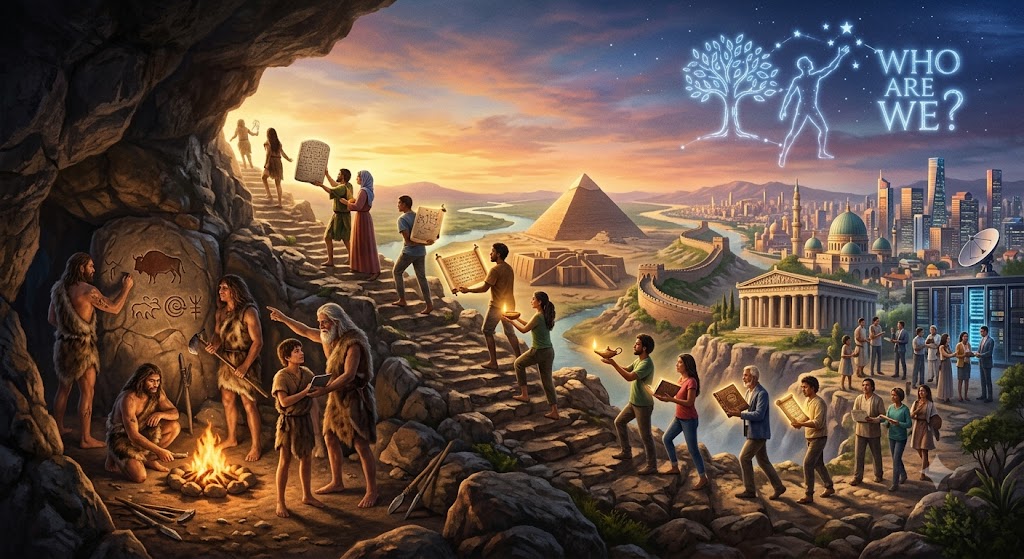
The history of civilisation is therefore not merely the history of economic production or political power. It is the history of humanity’s search for meaning amidst uncertainty. The great river valley civilisations of Egypt, Mesopotamia, the Indus Valley and China did not arise solely to satisfy material needs. They created myths, cosmologies, rituals and systems of governance that sought to explain humanity’s place in the universe. Every temple, every monument, every scripture and every philosophical treatise represented an attempt to answer the same eternal question: Who are we?
Political evolution emerged from the necessity of organising collective existence. From tribal chiefs to emperors, from monarchies to republics, from feudal systems to modern democracies, human beings experimented endlessly with structures of power. The rise and fall of empires reveal not merely struggles for territory but struggles to define order, justice and legitimacy. The Roman Empire, the Mauryan Empire, the Abbasid Caliphate, the British Empire and the modern nation-state each represented different answers to the challenge of governing human aspirations and conflicts.
Wealth, Technology, and the Price of Progress
Economic development followed a similar trajectory. The agricultural revolution liberated humanity from perpetual nomadism. The Industrial Revolution multiplied productivity beyond anything previously imaginable. Scientific advancement transformed human life expectancy, communication, transportation and material comfort. Yet every stage of progress produced new dilemmas. Wealth created inequality. Technology created alienation. Prosperity generated new forms of anxiety. Material abundance did not automatically translate into existential fulfilment.
Indeed, one of the great paradoxes of modern civilisation is that humanity has conquered distance but not loneliness, accumulated wealth but not contentment, and acquired unprecedented knowledge without necessarily attaining wisdom. The twenty-first century possesses more information than all previous centuries combined, yet the question “Who am I?” remains as elusive as it was to the earliest hunter-gatherer.
History offers countless illustrations of this paradox. Alexander the Great conquered vast territories before the age of thirty, yet died restless and unsatisfied. Siddhartha Gautama renounced princely comforts to seek understanding of suffering. Mahatma Gandhi transformed political struggle into a moral quest. Albert Einstein unlocked profound secrets of the universe while continuing to marvel at its mysteries. Their lives reveal that achievement and understanding are not identical.
The Wisdom of Unsung Lives and Honest Reflection
Equally instructive are the lives of those who failed by conventional standards. History remembers emperors and conquerors, but human experience is equally shaped by ordinary individuals whose struggles never entered official chronicles. The farmer battling drought, the worker confronting poverty, the parent caring for a disabled child, the teacher shaping young minds, the citizen enduring adversity with dignity—these lives often embody forms of courage and wisdom that statistics cannot capture. Failure, too, possesses pedagogical value. Future generations learn not only from success stories but also from cautionary tales.
An honest assessment of one’s own life is therefore among the rarest forms of wisdom. Most human beings construct narratives that magnify achievements and minimise shortcomings. To acknowledge one’s limitations without bitterness requires unusual intellectual honesty. A person who rates himself thirty out of a hundred yet remains truthful may possess greater self-knowledge than one who proclaims himself successful without introspection. Self-awareness is not self-condemnation; it is recognition of reality.
Beyond Outcomes: The Eternal Search for Internal Truth
The sages of India approached this question through a radically different lens. While political thinkers examined power and economists studied production, the Upanishadic seers turned inward. They argued that the deepest mystery was not the external world but the observer himself. Their inquiry culminated in profound declarations such as “Tat Tvam Asi”—Thou Art That—and “Aham Brahmasmi”—I Am Brahman. Whether one accepts these metaphysical conclusions or not, their significance lies in redirecting attention from external conquest to internal understanding.
Remarkably, similar insights emerged across civilisations. The Stoics of ancient Rome advocated equanimity in the face of circumstances beyond human control. Buddhist philosophy emphasised impermanence and the cessation of attachment. Confucian thought stressed ethical conduct and social harmony. Despite vast cultural differences, these traditions converged upon a common recognition: suffering often arises not merely from external events but from the mind’s relationship to those events.
Perhaps this explains why the wisest individuals in history appear less concerned with outcomes than with conduct. They recognised that consequences are influenced by innumerable variables beyond individual control. What remains within human control is integrity, effort and authenticity. The enlightened person is not necessarily one who succeeds according to society’s standards but one who lives in harmony with his understanding of truth.
The Collective Reservoir of Human Experience
Life thus emerges as neither a triumphal march nor a meaningless accident. It is an unfolding experiment in consciousness. Some lives become celebrated examples. Others become warnings. Most remain obscure. Yet each contributes to humanity’s collective reservoir of experience. Every generation inherits the lessons, mistakes, discoveries and aspirations of those who came before.
The enigma therefore persists. Who am I? A biological organism shaped by evolution? A social being moulded by history and culture? An economic actor responding to incentives? A political citizen? A spiritual seeker? The answer may contain elements of all these dimensions. Human identity is perhaps too vast to be confined within any single framework.
What remains undeniable is that the question itself has driven civilisation forward. It inspired philosophy, science, literature, art, religion and political thought. It built universities and temples, laboratories and libraries. It sent explorers across oceans and scientists into space. It continues to animate every serious inquiry into the human condition.
Arise, Awake: Engaging the Eternal Enigma
The ultimate wisdom may not lie in finding a final answer but in engaging honestly with the question. For the journey towards self-understanding is itself one of humanity’s greatest achievements. The oceans may be crossed, the mountains climbed, the planets explored and the atom divided, yet the deepest frontier remains the same as it was thousands of years ago—the unexplored landscape of the human mind.
Life remains an enigma. Yet it is this very enigma that confers upon human existence its depth, its dignity and its enduring fascination.A fitting conclusion from the Katha Upanishad is:
“Arise, awake, and stop not till the goal is reached.”
The sages did not claim that life was free of suffering, uncertainty or failure. They merely observed that understanding oneself is the beginning of understanding everything else. In that quest lies the true adventure of human civilisation.

The author of the article, M. Shiva Prasad, IPS (Retired), worked in the combined Andhra Pradesh cadre before opting for the Telangana cadre. A true Hyderabadi at heart, he has a deep love for the Telugu people. Throughout his career, he excelled at handling extremism and countering religious terrorism. He remains a passionate lover of the uniform and a dedicated law-and-order officer.

With a journalistic long journey, we bring you https://primepost.news, a dynamic platform committed to unraveling the intricate tapestry of Indian politics, particularly delving deep into the heart of Telangana and Andhra Pradesh. Our blog is not just a source of news; it’s a reservoir of insights, analysis, and thought-provoking reviews.



Simply Superb. The title itself is fascinating to follow the story written by Mr. M. Shiva Prasad, Retd. IPS. As narrated, many changes have been taken place in day today human life. Because many advancements have come in human life. One should be smart to learn them. Otherwise, this question “Am I Different?” Will arise. In olden days feeding family members was only criteria. But now it is different case. Possessing luxurious things is treated to be great. There is remarkable change in present human life. A good writeup. It’s fascinating.