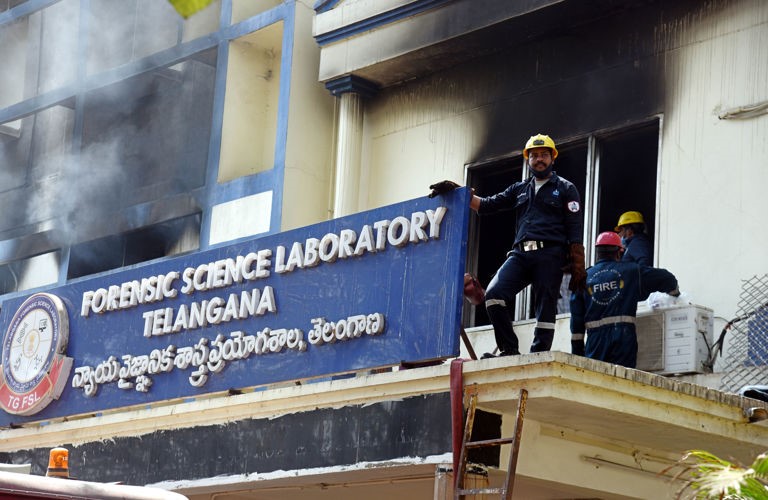
The Telangana FSL inferno, therefore, must be understood not as a confirmed obliteration of the “vote-for-note” evidence but as a cautionary episode revealing the fragility of forensic infrastructure. Official clarifications suggest that the core evidentiary materials in that particular case were already safely lodged in court custody. However, the incident underscores a deeper institutional lesson: justice in the digital age depends not only on collecting evidence but on preserving its analytical ecosystem. In the end, the flames may not have erased the past. Still, they have illuminated a pressing need for decentralised, redundant, and technologically resilient forensic systems so that the pursuit of truth is never left vulnerable to the unpredictability of fire.
In Hyderabad, Telangana, the flames engulfed portions of the forensic complex. The blaze did more than char equipment and files; it ignited a storm of suspicion. Naturally, the political rhetoric and forensic anxiety also begin. At the centre of this controversy lies a question that touches both criminal justice and constitutional accountability: Did the inferno destroy crucial evidence, particularly in the politically sensitive “vote-for-note” case, or has the spectre of evidentiary loss been exaggerated? Everything is doubtful as of now.
The Flames of Scandal: Allegations and counter-allegations
Then, political voices raised doubts that went beyond the visible damage. Some alleged that critical digital recordings, voice samples, and electronic records linked to high-profile cases, including the “vote-for-note” scandal, might have perished in the flames. The allegation was not merely about physical destruction; it carried deeper implications: if forensic materials that formed the backbone of corruption investigations were destroyed, could prosecutions themselves collapse? Such claims gained traction because modern criminal trials increasingly rely on electronic and digital evidence, voice spectrographs, call data records, and cloned storage media.

If such evidence were irretrievably lost, the integrity of prosecutions could indeed be questioned. Allegations, however politically potent, are not evidence. The legal system demands something more precise: verification through chain-of-custody records, court filings, and forensic inventories.
Official and Non-official questions
According to official statements, all material objects and forensic exhibits relating to the “vote-for-note” investigation had been examined and returned to the jurisdictional court several years earlier. This assertion is legally significant. Once forensic reports and exhibits are submitted to a court, often through agencies such as the Anti-Corruption Bureau, custodial control shifts from the laboratory to the judicial record system. In criminal procedure, the moment evidence is filed with a court and incorporated into the charge sheet,
its evidentiary life becomes anchored in the judicial process rather than in the physical premises of a laboratory. Even if a duplicate or working copy exists in the forensic facility, the primary evidentiary value lies with the material on record before the court. Thus, the destruction of a laboratory copy does not automatically nullify prosecution evidence already placed on the judicial record. From this standpoint, the claim that the inferno obliterated the core “vote-for-note” evidence appears, at least on current official accounts, legally unsupported.
What was lost?
Reports suggest that the affected areas housed digital forensic workstations, servers, computers, and analytical equipment. Such infrastructure forms the backbone of modern evidentiary science. These machines do not merely store files; they hold working clones of seized devices, metadata logs, extraction histories, and analytical notes used during examination.
If the principal exhibits in that specific case were indeed safe in court custody, the deeper concern shifts to a broader forensic domain. Fires in forensic laboratories are rarely about a single case; they potentially impact entire ecosystems of pending investigations. Loss of such infrastructure raises a subtle but serious issue: the possibility of impairing the ability to reproduce or re-verify forensic analyses. Courts often rely on the principle that forensic conclusions must be capable of independent re-examination. If the analytical environment itself is destroyed, defence counsel in future trials may question whether the prosecution can still demonstrate reproducibility and integrity of digital evidence. Equally significant is the reported presence of seized property awaiting analysis or pending collection after completion of reports. This category occupies a grey zone in criminal law. These items may not yet have reached court custody; they remain within the forensic chain of custody. Destruction of such exhibits, if established, could affect ongoing investigations rather than concluded cases.
Is it the scandal of scandals?
Several categories of forensic materials, particularly those related to digital investigations, were speculated to be at risk: voice recordings, storage drives, DNA datasets, and cloned electronic media. While officials have maintained that sensitive materials were retrieved or already secured, the very possibility of loss exposes a systemic vulnerability: the centralisation of crucial evidentiary resources in a single physical facility. In an era where criminal investigations rely on terabytes of digital data, the destruction of even interim forensic datasets can complicate the prosecution’s ability to respond to future judicial scrutiny. Courts often demand access to raw data, not merely final reports. If such raw datasets are compromised, legal arguments regarding evidentiary reliability could emerge in future litigation.
It affects the right under Article 21.
The debate over the FSL inferno is not merely administrative or political; it touches the constitutional guarantee of fair trial under Article 21 Criminal justice depends on the preservation of evidence in a manner that ensures both prosecution credibility and defence rights. Loss of forensic materials, even inadvertently, invites questions about due process, transparency, and institutional responsibility. Yet, it is equally important to distinguish between symbolic suspicion and actual evidentiary destruction. The rule of law cannot operate on conjecture. Unless inventories, forensic logs, and judicial records confirm the loss of specific exhibits, courts are unlikely to treat political allegations as proof of evidentiary annihilation.
Procedural Scrutiny
Even in a hypothetical scenario where certain laboratory copies were destroyed, it would not automatically collapse prosecutions such as the “vote-for-note” case. Courts primarily rely on certified forensic reports, sealed exhibits, and documented chain-of-custody records already submitted during the investigation. As long as those remain intact within judicial archives, the evidentiary foundation of the case survives.
The true vulnerability lies elsewhere in the possible weakening of forensic reproducibility,
loss of unanalysed exhibits, and disruption of ongoing investigations that had not yet reached
the courtroom stage. These consequences, though less dramatic than the destruction of all
evidence, could still shape the trajectory of future criminal trials.

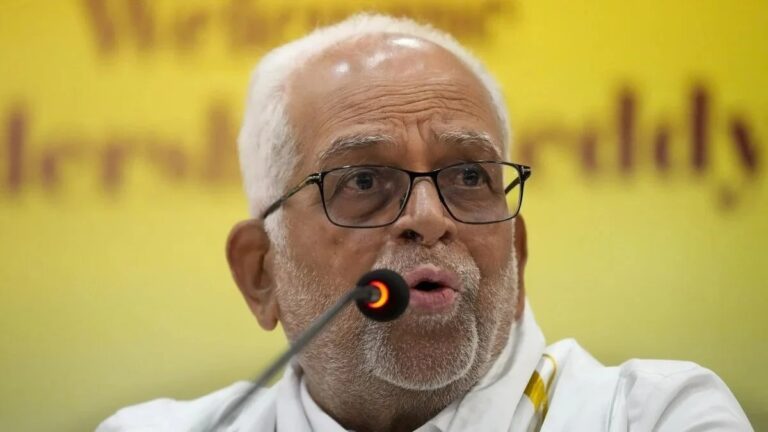
Law professor and eminent columnist
Madabhushi Sridhar Acharyulu, author of 63 books (in Telugu and English), Formerly Central Information Commissioner, Professor of NALSAR University, Bennett University (near Delhi), presently Professor and Advisor, Mahindra University, Hyderabad. Studied in Masoom Ali High School, AVV Junior College, CKM College, and Kakatiya University in Warangal. Madabhushi did LL.M., MCJ., and the highest law degree, LL.D. He won 4 Gold Medals at Kakatiya University and Osmania University.



Sufficient evidences have been provided in the case of ‘Vote For Note’. And every one watched live over T V while handing over cash. Still for what evidence the case is written off. It’s a million dollar question. Definitely political involvement is there it seems. These acts will spoil the belief and trust in our judiciary.