- Astronomical Price Rise and Financial Hardship
- Diverting the Discourse
- How Political Battles Over ‘Vandemataram’ Eclipse India’s Pressing Economic Crises
- Centralization, Inequality, and the Need for Parliamentary Accountability
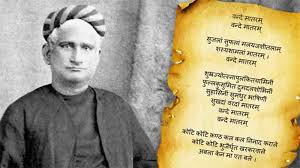
‘Vandemataram‘ is a word. This is not only an assembly of letters. It was a group of letters that worked as a slogan which constantly woke up the people, leading them to movements. During the freedom struggle, ‘Vandemataram’ was a group of letters that inspired crores of Indians. The letters were first used as weapons exactly 150 years ago. It was a wonderful occasion for all the Indians. We have to think of a programme in which we remember those golden days and inspire new generations.
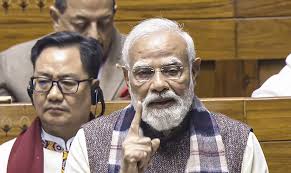
Accordingly, a debate was conducted in the recent session of Parliament on ‘Vandemataram.’ The occasion was appropriate but the intention of the leader of the House, Prime Minister Narendra Modi, was not. He had a mala fide intention. Modi criticized the first prime minister of India, Jawaharlal Nehru, for allegedly condensing the song, instead of conveying the complete theme of independence, to suit the wishes of some people (Mohammad Ali Jinnah), and called Nehru an anti-national. That naturally led to counter-criticism and a lot of discussion. The Congress leaders led the attack on Modi. They told the parliament that it was only the Congress party that led the independence movement and made ‘Vandemataram’ a war cry. The Congress mounted a strong attack on the BJP, saying neither its mother organization, the Jana Sangh, nor its paternal organization, the RSS, took part in the freedom struggle. These discussions were not limited to Parliament. The responses were heard outside as well. It is for sure that this will continue to be debated for some time and no other public issue would come up for debate.
The ‘Vandemataram’ Controversy: Politics of Historical Revision
Modi did not raise the ‘Vandemataram’ issue casually. It was very purposeful with an ulterior motive. He has been hoping to derive some benefits. Modi wants to establish Nehru as an anti-national in view of the present generation and thus prove the Congress also as a culprit. The other interest of Modi was to avoid debate on major social and economic issues. If he raised the ‘Vandemataram‘ issue and continues to debate over it in and outside parliament, the other pressing issues that would embarrass the government could be avoided. The government can get its important bills passed in parliament without any debate. This is the scheme of all ruling parties. The Congress party should take this aspect into account before finalizing its floor strategy. The party has to set the debate on ‘Vandemataram‘ aside and concentrate on the current boiling issues. Congress leader Priyanka Gandhi has correctly expressed this sentiment. She referred to the need to keep discussion on ‘Vandemataram‘ aside for the debate on the high prices of essential commodities, unemployment, poverty, and other related issues.
The civil society also has to understand this aspect and react to the situation accordingly. It has to ask the government as to how it plans to solve the problems and spell out its future course of action. Lately, it has become a habit for the parliamentarians to raise a controversy, debate in harsh terms, and then the opposition stages a walkout or the Speaker or Chairman of the House suspends the concerned Opposition members. The session would invariably end after the government gets its bills passed without an iota of a debate. As a result, the problems faced daily by the people are not debated in Parliament. This is not at all desirable.The governments have been declaring that the people are very happy with the governance. Both central and state governments are not above this. Importantly, the Centre has totally forgotten the social and economic problems faced by the people.
The Unaddressed Reality
It is important to note that 80 percent of the people in India are suffering from social and economic problems. Rising prices of essential commodities bother all of them. These prices have gone up astronomically in the last ten years. I have taken the figures from the national narrative. The prices in our state might differ here and there. But price rise is a fact. Chiefly, the prices of food grains have gone up like nobody’s business. The red gram (toor dal) was selling at Rs. 70 a kilo in 2014 and now it is available at Rs. 150. Black gram (Urad dal) was at Rs. 47 a kilo in 2014 and now at Rs. 123. Bengal gram was costing Rs 47 and now Rs. 88. The cost of potatoes has risen between 50 to 80 percent. The prices of cooking oil have gone up more than three times. We know what we have been paying for diesel and petrol.
Wages, Debt Traps, and the Crisis of the Gig Economy
This is the burden imposed by the government on every Indian. However, the salaries or wages of the employees and workers are not going up at the same rate. An employee in the private sector who was paid Rs. 20 thousand in 2014 is now paid Rs. 30 thousand. This is about a private employee who has got security from contract outsourcing. In cities such as Hyderabad, 30 to 40 percent of wages would go towards house rent. If a couple have two children, they have to spend about 30 to 40 percent of their income on education. The rest 40 percent will have to be spent on daily travel and health. How an average wage earner is buying the essential commodities is a thousand-dollar question. That is why about 60 to 70 percent of the employees or workers are living in a veritable hell. Thousands of people who did post-graduation and are working in private companies, schools, and colleges are getting caught in debt traps. Some people are working in some private jobs besides their main avocation. Some others are serving in Swiggy and Zomato supply chains also. Some are riding bikes through Rapido service. These are the real issues to be debated in Parliament. The members of parliament have to spare their time and try to find out solutions for these problems.
Unemployment, Mechanization, and the Rural-to-Urban Exodus
Another problem afflicting the civil society is unemployment. Solving this problem is urgent. Crores of people are suffering on account of unemployment. Most of the unemployed have no job skills because of the outdated system of education. The technology and mechanization growing at an extraordinary pace have been distancing people from work. Hence, only a few could find suitable jobs. Among them, those who have businesses, lands, and other resources are able to withstand financially. In this aspect also, there is a difference between the towns and villages, where the conditions are worse. Mechanization has grown in agriculture. The small and marginal farmers are not able to make agriculture viable. Their lands are being purchased by companies. These lands will see corporate cultivation in the future. About 60 percent of the youth are leaving villages and migrating to towns and cities. Because of this, urbanization is vastly growing in India.
Erosion of Constitutional Values and Social Divisiveness
The growing unemployment is causing many other problems. The youth are becoming slaves to drugs. They are not like the earlier generations who were working hard and living with self-respect. This generation is depending on the handouts by the government and its subsidies. Many such problems are bothering the society. The sexual attacks on girls and women are on the increase. This phenomenon is on the rise in towns and cities. Governments have been treating the constitution, after it came into being 75 years ago, as a piece of rough paper. It is implementing the Articles that would strengthen its arguments. It is destroying the unity of the people by bringing about divisions based on religion, caste, and regions.
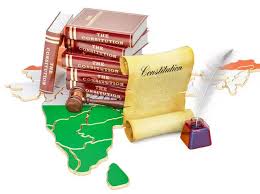
There is no inquiry or action taken by the governments on the attacks and atrocities on Dalits and Adivasis. The upper castes are using the reservations issue to provoke the underprivileged. Every issue is sought to be brought under a centralized system. The business and trade opportunities are being given to those who protect their interest. Many undesirable things are happening because of that. The recent mess created by IndiGo was a glaring example before us. It is now evident that any sector if allowed to be captured by a few will undermine public interest.
The same kind of results would come from the centralized religion, caste, or region. Article 38 in the constitution makes it obligatory to see that the resources and wealth have to be distributed justly and equitably among the people of all regions and classes. Against this provision, today wealth in the country is being accumulated at one place. Lies saying that there is no poverty and no poor people are being spread.
We understand in what conditions the people are living only if we visit the villages. I don’t want to list all the problems here. But the ultimate responsibility of resolving the people’s problems rests with the government. The proper platform for the government is the parliament. The governments do well to utilize the forums of parliament or assemblies for debating the problems faced by people and resolving them instead of indulging in undue criticism and vilification.
Prominent columnist
Laxmaiah Mallepalli is an Ambedkarite and a Dalit activist. A senior journalist, presently he is Special Officer for Budhavanam Project and chairman for Centre for Dalit Studies. He was responsible for Scheduled Castes and Scheduled Tribes Sub-Plan Act, 2013. He has been working to implement the same Act in other states. He is a regular columnist of Mana Telangana.