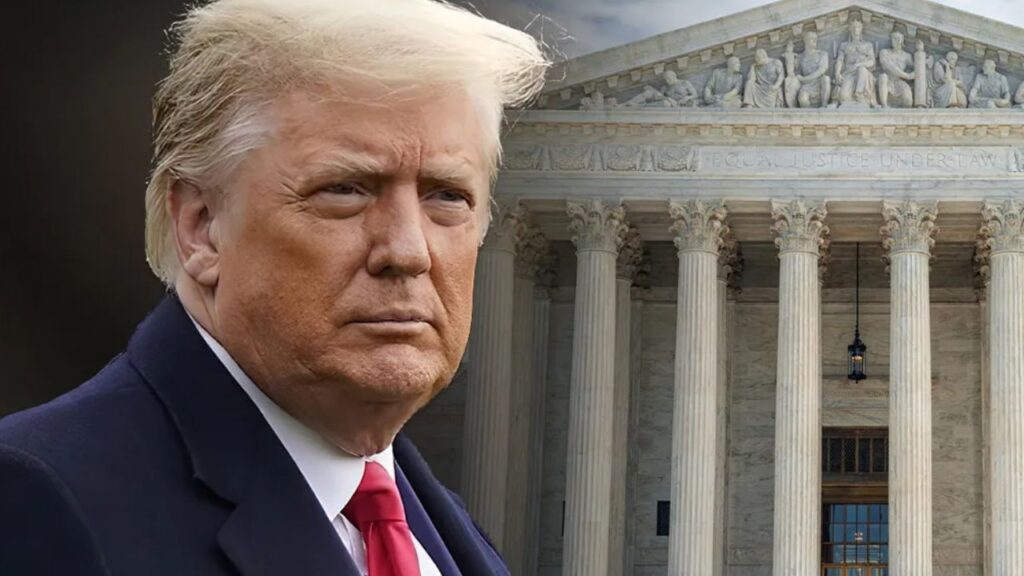
In a landmark legal development that has sent ripples through the global economy, the United States Supreme Court has delivered a significant blow to President Donald Trump’s aggressive trade agenda. On Friday, the highest court in the U.S. struck down the broad tariffs imposed by the Trump administration on various international trading partners, including India. This ruling is being viewed as a major check on executive power, specifically challenging the President’s ability to bypass Congress in matters of international trade and taxation. The 6-3 majority decision marks a rare instance where a conservative-leaning court has moved to curtail the discretionary powers of a Republican president.
The core of the legal battle centered on the International Emergency Economic Powers Act (IEEPA) of 1977. President Trump had invoked this nearly 50-year-old law to declare national emergencies over issues such as the fentanyl crisis and the massive U.S. trade deficit. Using these declarations as a justification, he bypassed the usual legislative routes to impose sweeping tariffs on goods from China, Mexico, Canada, and dozens of other nations. India, a key strategic partner, was also hit with an 18% tariff under these measures. However, the Supreme Court ruled that the IEEPA does not grant the President the unilateral authority to levy taxes or tariffs indefinitely and on such a massive scale.
Chief Justice John Roberts, writing for the majority, emphasized that the power to regulate commerce and impose taxes rests primarily with the U.S. Congress. He noted that while the President does have certain emergency powers under the 1977 Act, these are intended for controlling imports during specific crises, not for rewriting the nation’s entire trade policy at will. Roberts pointed out that the President was seeking an “extraordinary power” to impose tariffs in unlimited amounts and without a clear expiration date. The Court clarified that for such significant economic measures to be constitutional, there must be clear and explicit authorization from Congress, which the current law simply does not provide.
The implications for India are particularly noteworthy. For the past few years, Indian exporters have faced significant hurdles due to these unilateral tariffs, which affected various sectors of the economy. This ruling offers a glimmer of hope for Indian businesses and the government, as it challenges the legality of the 18% duty. While the diplomatic relationship between the two countries remains strong, the trade friction caused by these “emergency” tariffs had been a point of contention. The Court’s decision suggests that the President cannot simply use broad “national security” or “emergency” labels to target specific trading partners like India without a solid legislative foundation.
Furthermore, the ruling has opened the floodgates for potential legal action from major global corporations. Companies such as Costco, Toyota Group, and Revlon have already been fighting these tariffs in various courts. With the Supreme Court now declaring these specific IEEPA-based tariffs unlawful, these companies—and hundreds of others—are expected to seek refunds for the billions of dollars they have already paid into the U.S. treasury. This could result in a massive financial headache for the U.S. government, as it may be forced to reimburse vast sums collected over the last few years.
However, it is important to understand the limits of this ruling. The Supreme Court specified that this decision does not apply to all tariffs. For instance, the specific duties on steel, aluminum, and copper will remain in place because they were enacted under different laws (such as Section 232 of the Trade Expansion Act). Those tariffs were not part of this specific legal challenge and therefore continue to be valid. This means that while the “broad” and “universal” tariffs are gone, targeted sectoral tariffs might still persist.
Ultimately, while this is a massive political and legal defeat for Donald Trump, it does not mean that the U.S. is moving away from a “protectionist” stance. The Supreme Court made it clear that the power to impose tariffs still exists—it just belongs to Congress, not the President alone. If the Trump administration wants to reimpose these duties, they will now have to convince the U.S. Parliament to pass new legislation. For India and the rest of the world, this verdict provides a much-needed sense of predictability in international trade, ensuring that global commerce isn’t subject to the sudden, unilateral whims of a single executive leader.

Deputy Editor, Prime Post
Anand Gantela is a seasoned media professional with nearly three decades of experience across the spectrum of Indian journalism. Having worked extensively in both print and broadcast media, he has held key positions at renowned outlets such as Prajashakthi, Andhra Bhoomi, Mudra, Media India, Siti Cable, Mana Telugu, and Maa TV. From ground-level reporting to managing news bureaus and overseeing bulletin production, Anand has witnessed the evolution of news firsthand. His wealth of experience reflects a deep understanding of the dynamic and ever- evolving landscape of news reporting.