The Only Desire: The Nectar of Bhagavad Experience of Sri Krishna
Tiruppavai by Godadevi from Tamil
Muppaththumoovar Amarar-ku-Munsenru
Kappam Thavirkkum Kaliye! Thuyilezhaai!
Seppamudayaai! Thiraludayaay! Settraarku
Veppam Kodukkum Vimalaa! Thuyilezhaai!
Seppanna Menmulai-ch-chevvaai-ch-Chirumarungal
Nappinnainangaai! Thiruvey! Thuyilezhaai!
Ukkamum Thattoliyum Thandun Manaalanai
Ippothe Emmai Neer Att-el or Empaavaai.
English Translation
Valiant warrior, you have confronted enemies before,
33 crore celestials complain of fear of demons,
Pure, upright with immense strength, and kind,
Inclined to protect always: You have no enemies,
But you terrorize the Foes of your devotees; Awake!,
O beautiful Neela, with two golden pots of bosom, pink lips,
Slender waist; Perfect, no less than Lakshmi, wake up!
Get us a fan, a mirror, and let Krishna bathe with us.
Meaning …
“O Lord of immense strength, who rushes forth even before danger arises to protect the thirty-three classes of celestial beings! O You who lie in divine repose—please awaken!
O One endowed with unfailing truth and valor, who never breaks His word! O Supreme Protector capable of saving all worlds! O Pure One, who grants scorching punishment to enemies!
O Nappinnai, with perfectly proportioned limbs, rosy lips, slender waist, complete and flawless in beauty, You who are verily Lakṣmī Herself— please awaken!
Grant us the hand-fan that removes perspiration, grant us the mirror for adornment, and along with these, bring Your Lord to us right now, and immerse us all together in the sacred bath of divine communion.”
Context After an intense verbal exchange between the Gopikās and Nīḷādevī, a rare and profound silence descends. Śrī Kṛṣṇa remains reclined on His couch, as though observing a vow of silence. The Gopikās had spoken sharply; Nīḷādevī did not respond. This silence is not ordinary silence; it is divine silence preceding the birth of grace. In this pasuram, Āṇḍāḷ teaches that:
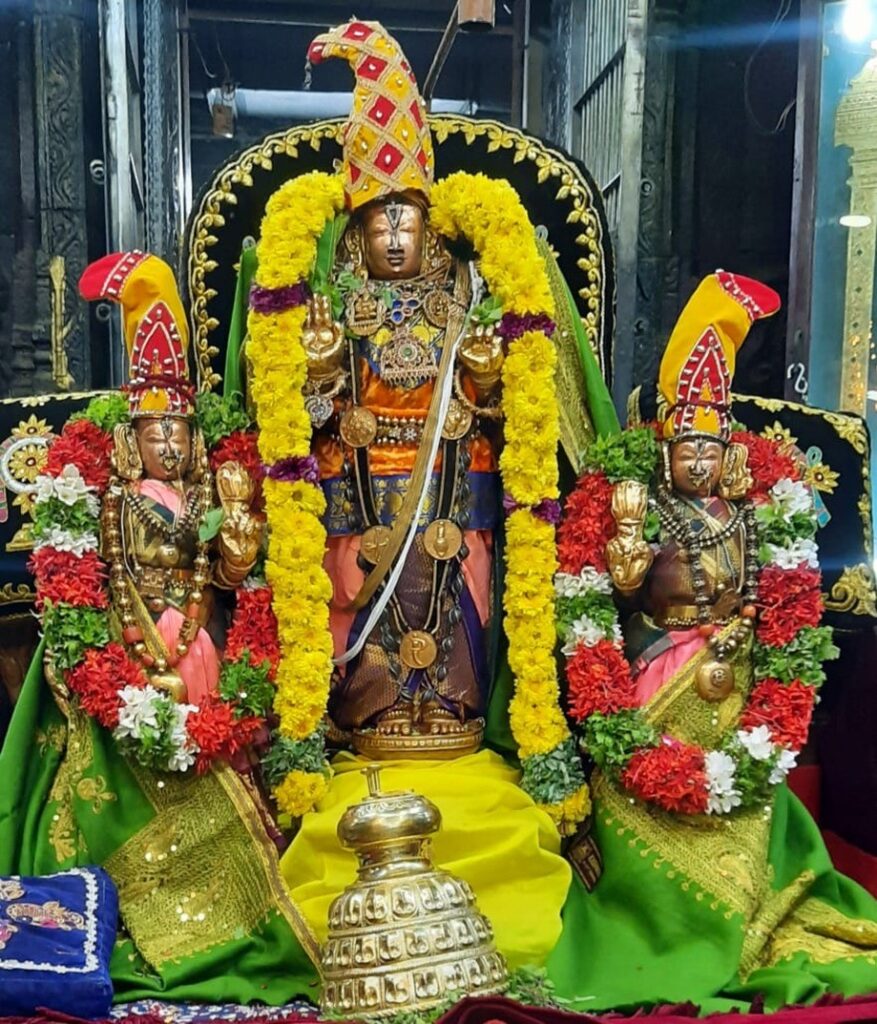
- True knowledge arises only when the sense of “I” and “mine” is relinquished.
- That knowledge matures into devotion (bhakti).
- Devotion ripens into detachment (vairāgya).
Only then does one receive the bath of Brahmānanda—the supreme experience of the Lord.
The Gopikās first address Śrī Kṛṣṇa, and then Nīḷādevī, following this inner spiritual order.
Goda’s poetic phrases (Padārtha)
“Muppattu-mūvar amararku mun senru kappam tavirkkum kaliye” – O mighty One who goes ahead of time to protect the thirty-three classes of gods before calamity strikes!
“Tuyil ezhāy” – Please awaken from Your divine sleep!
“Seppam uḍaiyāy” – You are the embodiment of truth and unfailing valor; You never break Your word.
“Tiṟal uḍaiyāy” – You possess the power to protect all worlds.
“Seṭṭārkku veppam koḍukkum vimalā” – You are pure and blemishless, yet terrifying to enemies.
The Gopikās remind Him: “You promised to come with us. Why do You now remain reclining on Your couch?”
Then they praise Nīḷādevī:
“Seppanna mel-mulai, sev-vāy, siṟu maruṅgul Nappinnai naṅgāy tiravē”
– O Nappinnai, endowed with symmetrical beauty, rosy lips, slender waist, and perfect completeness—You are Lakṣmī Herself. Please awaken!
What the Gopikās Ask from Nīḷādevī
They seek three things:
1. Ukkamum – A hand-fan to remove perspiration after the sacred bath.
2. Taṭṭoḷiyum – A mirror for adornment after bathing,
3. Above all – Her Lord Himself. Their prayer is: “Bring Your Lord to us right now, unite us with Him, and grant us the fortune of bathing together in His presence.”
Philosophical Meaning (Bhāvārtha)
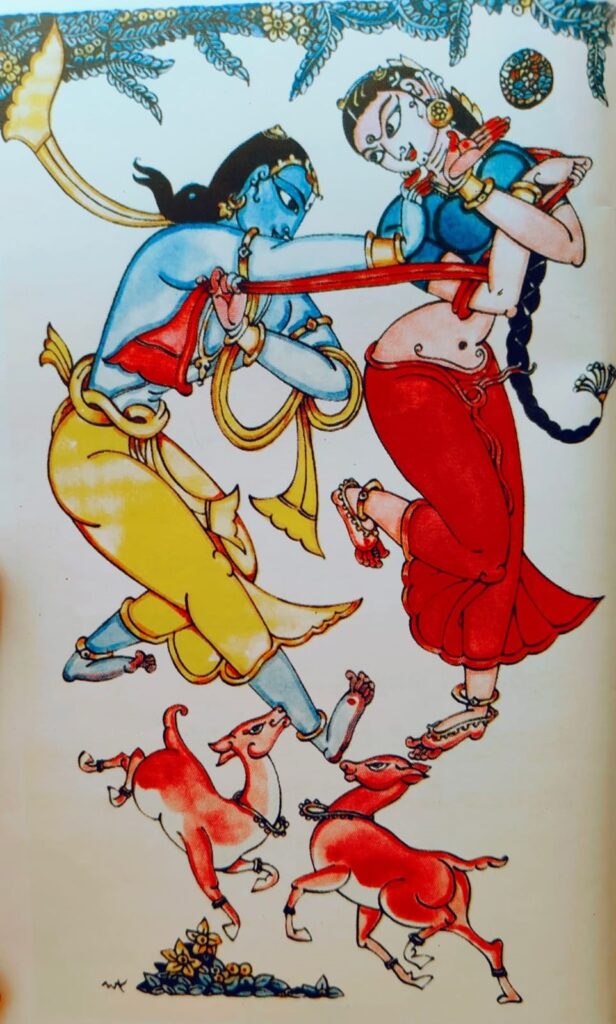
You have no enemies of Your own. Yet, those who trouble Your devotees become Your enemies.The hands that granted refuge to Draupadī became instruments of terror to Duryodhana and others.
Partiality toward devotees (āśrita-pakṣapāta) is the very nature of Bhagavān. You protect the thirty-three god —powerful beings—without even being asked. Will You not protect us, who are weak and helpless? The gods desire kingdoms, positions, and power. We desire none of these. What we seek is only one thing: The nectar of Bhagavad-anubhava. The gods drank nectar and became deathless. But we die the moment we are separated from You, dying of the agony of separation. Will You not protect such beings as us? Inner & Esoteric Meaning (Viśeṣārtha) (a) The Thirty-three Deities – Tattvic Meaning According to the Vedas, the deities are thirty-three:
- 11 in the earth realm
- 11 in the atmosphere
- 11 in the celestial realm
Or: - 11 Rudras
- 12 Ādityas
- 8 Vasus
- Dyāvā–Pṛthivī (Heaven and Earth)
All are creations of Bhagavān. He has no inherent enemies. Only those who oppose His devotees become His enemies.
(b) Nīḷādevī as the Embodiment of Jñāna–Bhakti–Vairāgya - Rosy lips → Compassion and affection toward beings
- Two bosoms → Knowledge (jñāna) and devotion (bhakti)
- Slender waist → Detachment (vairāgya)
Only when:
Knowledge → Devotion → Detachment: to become mature, does one attain experience of the Supreme. This perfect harmony of the three makes Nīḷādevī “Naṅgāy”—the perfectly complete one.
(c) Inner Meaning of the Fan and the Mirror
Two essentials for the sacred bath:
- Mirror (Taṭṭoḷiyum) – Self-realization – Represents “Om”
- Hand-fan (Ukkamum) – Removes the perspiration of ego that arises after self-awareness – Represents “Namaḥ”
Between Om and Namaḥ, when the name Nārāyaṇa is placed, it becomes the Aṣṭākṣarī Mantra. Āṇḍāḷ teaches that through this path of knowledge and devotion alone, Bhagavān is attained.
Ācārya-based Interpretation (Sampradāyic Meaning)
In the Śrī Vaiṣṇava tradition:
- Fan → Aṣṭākṣarī Mantra
- Mirror → Dvaya Mantra
- The one who brings the Lord close → The Ācārya
Approaching the Father (Nārāyaṇa) through the Mother (Śrī / Pirāṭṭi) is the path of Śaraṇāgati.
Hence, the Gopikās do not ask the Lord directly, but appeal through the Divine Mother.
Viśiṣṭādvaita Perspective
Prakṛti and Puruṣa are distinct, yet inseparably related – like word and meaning: different, but never separable. Thus, though Nīḷādevī and Śrī Kṛṣṇa are distinct, they are one in essence. He creates the universe, nature, and beauty itself, yet the beauty that enchants Him resides with the Divine Mother.
Essence
This is a Mārgaśīrṣa bath-vow pasuram. It is not an external bath, but an inner, spiritual immersion. It is the prayer of the soul that: # immerses itself in divine contemplation, #seeks union with the Lord in His presence.
When “I” and “mine” are abandoned: - Knowledge arises,
- Knowledge matures into devotion,
- Devotion yields detachment,
- Detachment opens the gateway to the bath of Brahmānanda.
That is the supreme meaning of this pasuram.

Law professor and eminent columnist
Madabhushi Sridhar Acharyulu, author of 63 books (in Telugu and English), Formerly Central Information Commissioner, Professor of NALSAR University, Bennett University (near Delhi), presently Professor and Advisor, Mahindra University, Hyderabad. Studied in Masoom Ali High School, AVV Junior College, CKM College, and Kakatiya University in Warangal. Madabhushi did LL.M., MCJ., and the highest law degree, LL.D. He won 4 Gold Medals at Kakatiya University and Osmania University.