Tiruppavai by Godadevi from Tamil
Nottrusuvargam Pugugindra Ammanay
Mattramum Thaaroro? Vassal Thiravadhaar
Nattra Thuzhay Mudi Naaraayanan Nammaal
Pottra-p-parai Tharum Punniyanaal Pandorunaal
Kootrathin Vaay Veezhnda Kumbakarnanum
Thottram Unakke Perum Thuyilthan Thandaano
Aattra Anandhal Udayaiy! Arungalame
Thettraamaiy Vandhu Thira-el or Empaavaai
- English Translation by Madabhushi Sridhar
Enjoying Paradise after devotional Nomu (vow)
Speak at least one word, Amma, open the door
Naaraayana’s crown is decorated with Tulasi garlands
He inspires us to sing in his praise & grants Parai
Has the dying Kumbhakarna gifted you sleep?
Do not slip in the post-sleep effect; step out cautiously.
Slowly, get up from slumber; you are a jewel.
Open the door and join us for our Nomu, dear.
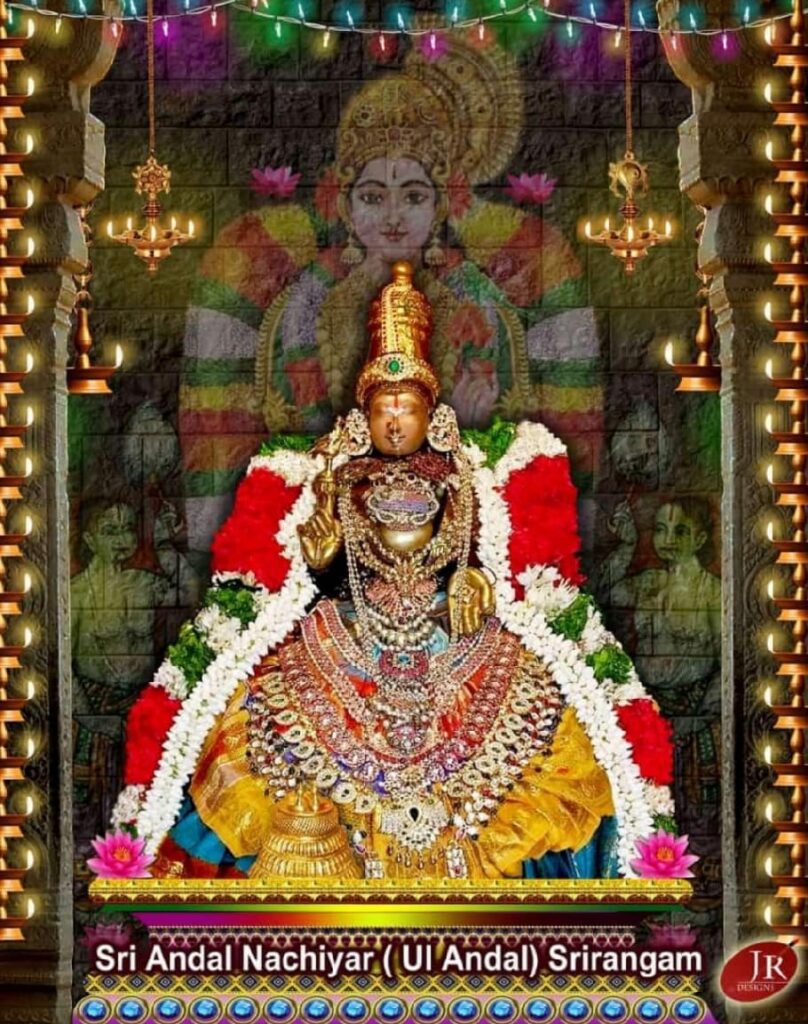
In the tenth Tiruppāvai paasuram, Goda Devi (Āṇḍāḷ) awakens and invites the fifth Gopika to join the thirty-day Sri Nomu (Vrata). This paasuram carries profound inner meaning beyond the surface act of awakening a sleeping companion.
The essence of this tenth song is as follows:
“Oh noble girl, a jewel among devotees! Are you enjoying deep sleep? If not willing to open the door, at least respond to us.”
Nārāyaṇa, adorned with Tulasi garlands upon His crown, inspires His devotees to sing Pallaandu (Mangalaśāsanam) and grants them Parai—symbol of divine grace, spiritual knowledge, and access to higher lokas. He is the very embodiment of Dharma.
Goda playfully asks whether Kumbhakarna, when he marched toward death at the hands of Lord Rāma, handed over his extraordinary sleep to this Gopika! She urges her to shed her sleepy state, walk carefully without stumbling, awaken gently, and open the door to join the Vrata.
Inner Meaning of Parai
Krishna initially promises to grant the divine Parai instrument to the Gopikas when they reach Him. The inner meaning of this promise is far deeper: Krishna assures liberation of the soul from the endless cycle of birth, death, and rebirth.
On this tenth day, Goda approaches a Gopika who is an ardent devotee of Krishna. In truth, this Gopika is not sleeping at all. She is immersed in constant meditation on the auspicious deeds and divine qualities of Nārāyaṇa. Such deep absorption makes her appear deaf and dumb to the external world.
Goda knows this state very well. Hence, she says, in essence:
“I know you are enjoying Sri Krishna Anubhavam.”
Parallel with Sītā’s Resolve
When Sītā insists on accompanying Rāma into exile, He hesitates. Sītā then declares:
“Being with you is heaven for me; being without you is hell.”
The Gopika is in a similar spiritual state. For such souls, the Vrata itself is secondary. They possess unwavering faith that Krishna will take care of everything. Bhagavān is Ānanda-svarūpa, the embodiment of bliss, manifesting here as Krishna. Once one gains His grace and comes within His compassionate sight, no other spiritual path is necessary.
This is the core message of the tenth paasuram: Knowing Krishna is liberation itself.
Dialogue Between Goda and the Fifth Gopika
Goda: You are a jewel among devotees. Please come and lead us. Kindly respond. Since you love Krishna the most, we can gain easy entry if you accompany us. Yet you remain silent.
The Gopika remains silent—partly out of humble surprise at being addressed as a leader, and partly because she is absorbed in deep Krishna-dhyāna, unable to hear external calls.
Goda: Have you shut the doors and stopped speaking? Are you alone enjoying Krishna’s presence? You have surrendered everything to Him—please think of us too. Say something, at least in anger!
Gopika: You say I have surrendered everything to Krishna. Do you think Krishna is inside this house with me?
Goda: If Krishna were inside, you could not hide Him—even if you hide yourself. The fragrance of Tulasi adorning His crown would reveal Him. Tulasi Devi, consort of Vishnu, is dear to Him. Wherever Tulasi grows, Krishna resides. Wherever Krishna is present, Tulasi fragrance spreads.
Gopika: When He embraced me long ago, the Tulasi fragrance spread upon my body. Perhaps that is
what you smell now. Besides, when you are all standing at my door, how could He cross you and enter my house? Krishna is not here.
Goda: Can doors stop Him? He pervades every inch of the universe. He appears wherever He wills and showers compassion on all. Please share your joy of Krishna with us too. He grants Punya equally to all.
Did Kumbhakarna not walk knowingly into death by attacking Lord Rāma? When Rāma protects all, why should He kill Kumbhakarna? Did Kumbhakarna gift his sleep to you before his death?
Kumbhakarna and Sage Agastya Kumbhakarna is also a name associated with Sage Agastya. Agastya, born from a pot (kumbha), played a pivotal role in cosmic balance.
Legends say:
- When Agastya approached the Himalayas, the mountain bowed in humility.
- When Vindhya grew arrogantly to rival Meru, Indra prayed to Agastya. Vindhya bent before him like a disciple and remained so by Agastya’s blessing.
- Agam means hill, stha means stopping—thus Agastya is “the one who restrained the mountains.”
- He authored Dravida Vyākaraṇa and digested the demon Vātāpi, destroying him from within.
Goda humorously suggests that even Agastya’s power is defeated by the Gopika’s yoga-nidrā.
Reference to the Three Āḻvārs
Goda alludes to the first three Āḻvārs:
- Poigai Āḻvār (Saro Yogi)
- Bhoothath Āḻvār (Bhootha Yogi)
- Pey Āḻvār (Mahā Yogi)
Pey Āḻvār, born in a red lotus in a well at Mylapore, appeared mad to the world—like one who was deaf, dumb, or blind. His entire life was devoted to singing the glories of Bhagavān. Once, Pārvatī and Parameśvara tested him by offering a boon. Pey Āḻvār simply asked them to thread a needle for him, as he was unable to do so while stitching a quilt. He had no worldly desires, seeking only Bhagavān. Pleased by his simplicity, Vishnu appeared before him, inspiring Pey Āḻvār to sing the glory of Trivikrama at Tirukkovilur.
During heavy rains:
- Poigai entered Pey’s tiny room—“One can sleep, two can sit.”
- Bhoothath joined—“Three can stand.”
- Then Nārāyaṇa Himself entered as a radiant light.
Recognizing this divine presence, the three Āḻvārs sang Mangalaśāsanam. Goda refers to this divine light in the tenth paasuram. Yoga Nidra, Not Tamasika Sleep The Gopika inside is not in Tamasika Nidra (ignorant sleep). She is in Yoga Nidra, the wakeful sleep of divine absorption.
In this tenth Tiruppāvai paasuram, Goda subtly incorporates the mantra of Sri Parāṅkuśa Dāsāyana (Nammāḻvār), revealing the supreme state of devotion where the soul rests entirely in Bhagavān. This paasuram teaches that true awakening is not physical, but spiritual. Those who are immersed in Krishna-consciousness may appear asleep to the world, yet they are fully awake in divine bliss. The tenth Tiruppāvai thus celebrates the highest state of devotion—where Krishna alone suffices, and liberation follows naturally.

Law professor and eminent columnist
Madabhushi Sridhar Acharyulu, author of 63 books (in Telugu and English), Formerly Central Information Commissioner, Professor of NALSAR University, Bennett University (near Delhi), presently Professor and Advisor, Mahindra University, Hyderabad. Studied in Masoom Ali High School, AVV Junior College, CKM College, and Kakatiya University in Warangal. Madabhushi did LL.M., MCJ., and the highest law degree, LL.D. He won 4 Gold Medals at Kakatiya University and Osmania University.