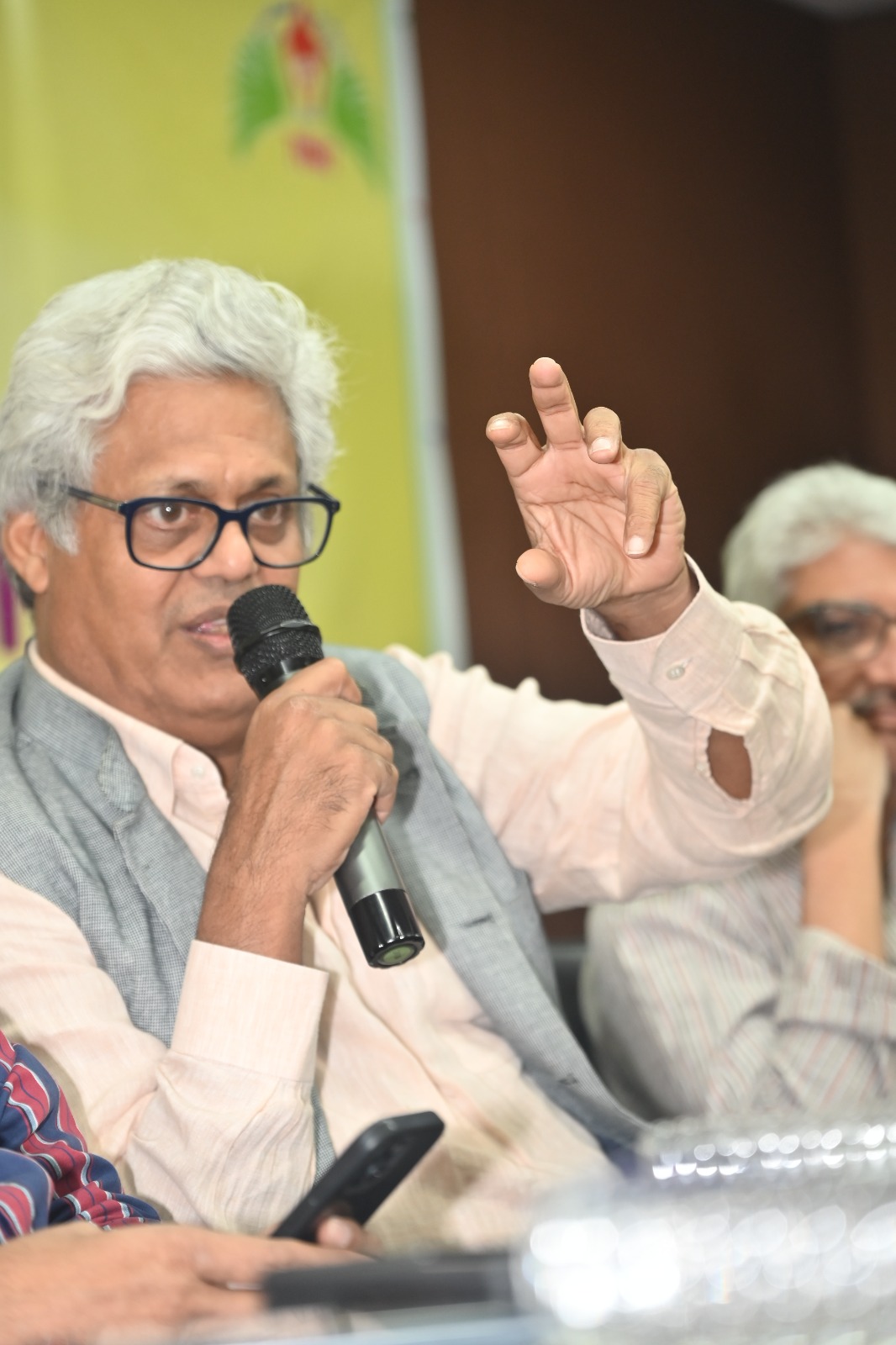
The Era of “Speaking Truth to Each Other”
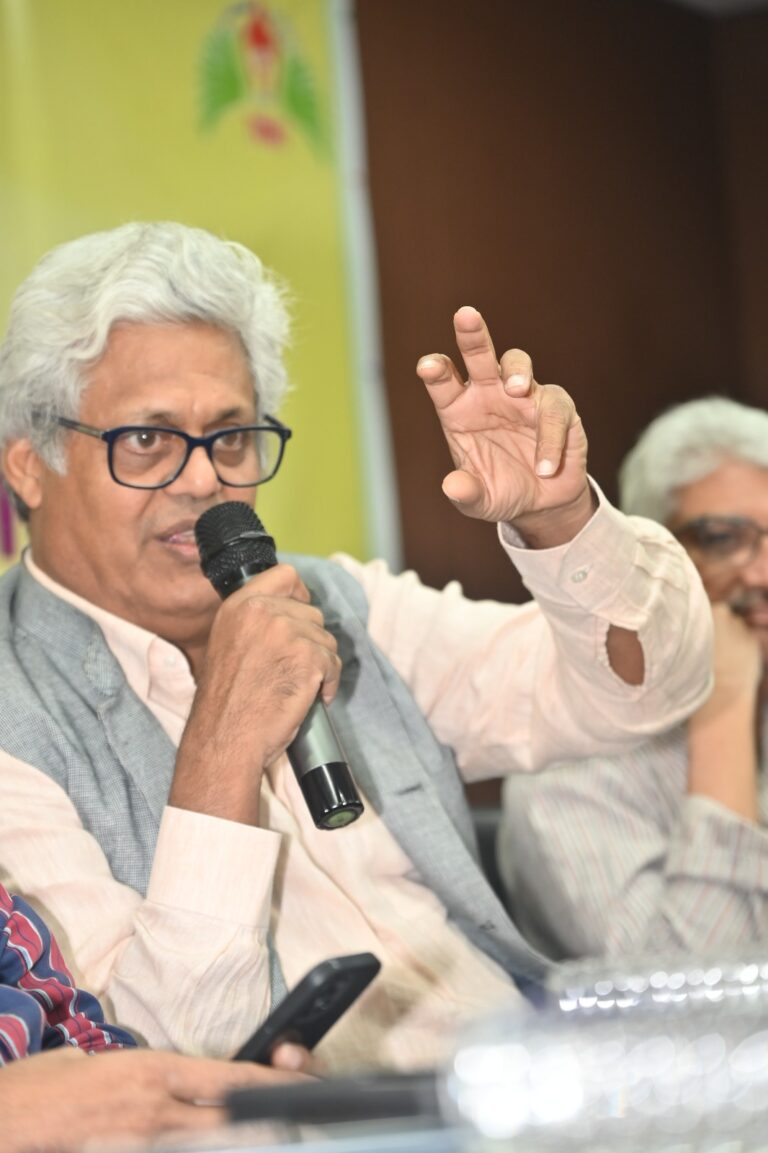
M.K. Venu, Founding Editor of “The Wire” said that that social media has been a “boon” for journalism primarily because it broke the old distribution monopolies. “In the past, a few large media houses had controlled newspaper distribution, sometimes using “distribution mafias” to keep competitors out. Today, social media acts as an open, global distribution channel. A story uploaded in India can receive a response from Washington within minutes”.
He references Arun Shourie’s observation that modern power already knows the truth and often manipulates it. Therefore, the primary role of social media now is to allow citizens and independent journalists to build communities and speak truth directly to each other. This lateral communication creates an informed citizenry that cannot be easily silenced by corporate or state interests, he said.
Venu, having 42-years of experience in legacy journalism (print and electronic media) and he started new career with The Wire in 2015. Initially, they focused only on text, but by 2017, they realized they had to adapt to a multimedia format, integrating video and social media promotion across Twitter, Instagram, and Facebook. He described modern journalists as “all-rounders” who must write, film, and promote simultaneously.
The Positives: Democratization and Distribution
Venu argued that social media has been a “boon” for journalism primarily because it broke the old distribution monopolies. In the past, a few large media houses had controlled newspaper distribution, sometimes using “distribution mafias” to keep competitors out. Today, social media acts as an open, global distribution channel. A story uploaded in India can receive a response from Washington within minutes.
The Power of the Individual
He cited Ravish Kumar as a prime example of democratization. When Kumar left NDTV, millions of subscribers followed him to his independent YouTube channel, proving that individuals can now challenge the “immortality” of big corporate brands using just a computer and a small team.
The “Medium is the Message” and Professional Evolution
Invoking media theorist Marshall McLuhan, Venu discussed how technology has become an extension of our central nervous system. He noted that writing for social media has fundamentally changed how journalists communicate sentences are shorter, flowery language is gone, and the form dictates the content. The democratization of the space allows for minute-by-minute updates on global events (like the Iran conflict), often provided by citizen journalists rather than nationalistic state-run channels.
The Negatives: Technology and the “Amputation of Intellect”
Despite the benefits, Venu warned of significant dangers like outsourcing creativity. He warned that over-reliance on AI and tools like ChatGPT can lead to the “amputation of our own intellect”. Referring to Mahatma Gandhi’s philosophy on machines, Venu emphasized that while technology is a tool, we must not let it “kill human creativity” or suppress the “soul” of journalism. Lack of Filters: Unlike legacy media, social media often lacks filters, placing the burden of fact-checking and filtering misinformation directly on the consumer and the journalist. Instead, he advocates for professional self-regulation—similar to the ethical “style sheets” used in legacy print journalism—and the formation of independent digital associations like DigiPub to protect editorial freedoms from state onslaught
The Political Economy and State Pressure
During the Questions and Answers session, Venu addressed the “Global Zamindars” (Big Tech) and “National Zamindars” (Large Media Groups). Tenancy Farmers: He categorized independent outlets and YouTubers as “tenancy farmers” who use the space provided by Big Tech. While Big Tech holds concentrated power, it currently provides the agency for independent voices to survive.
State Resistance
He noted that while legacy media is often the “fastest to fold” under government pressure, independent digital platforms continue to offer resistance, even when faced with defamation cases or website blocks. In this section, Venu shifts the traditional journalistic paradigm of “speaking truth to power.” Therefore, the primary role of social media now is to allow citizens and independent journalists to build communities and speak truth directly to each other. This lateral communication creates an informed citizenry that cannot be easily silenced by corporate or state interests.
Venu concluded that while the digital age presents a struggle between human creativity and algorithmic control, the ability for citizens to “speak truth to each other” remains the most potent tool for preserving democracy in the modern era.
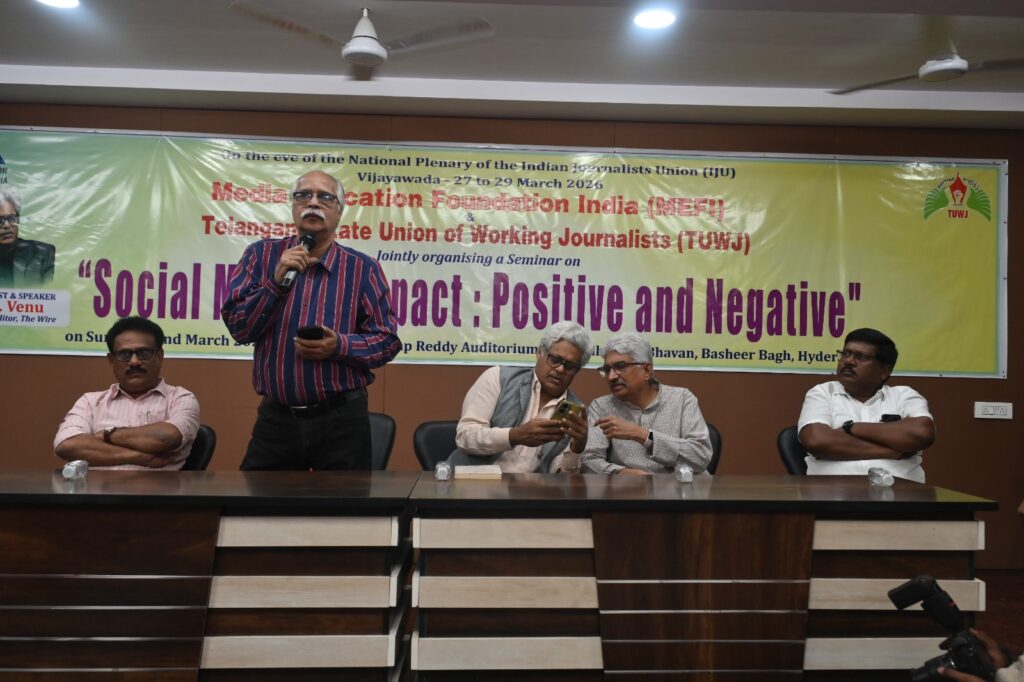
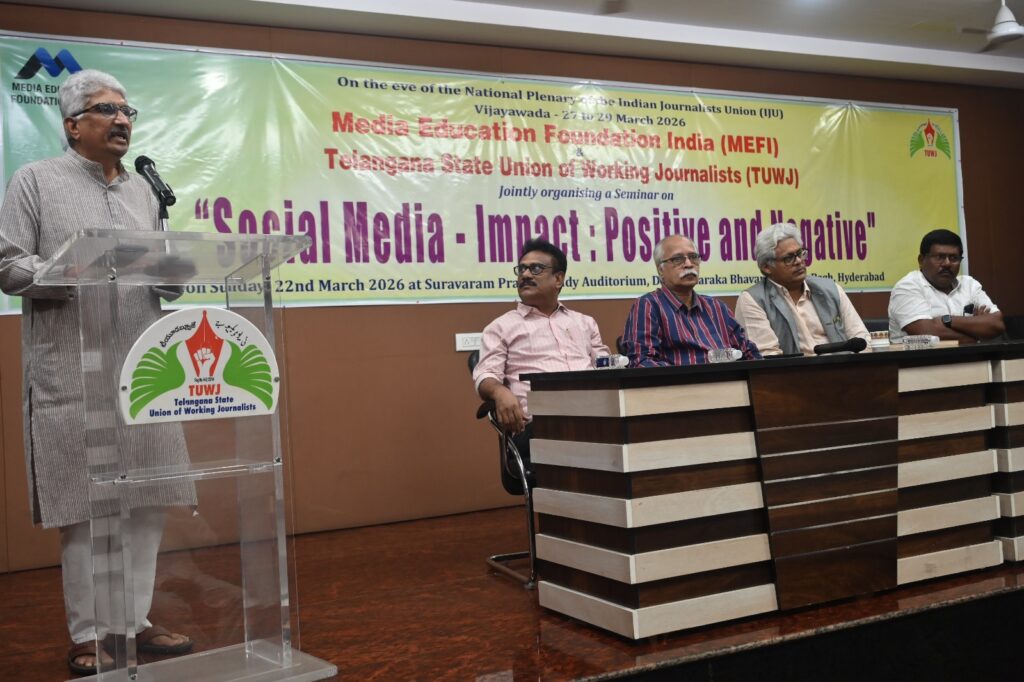
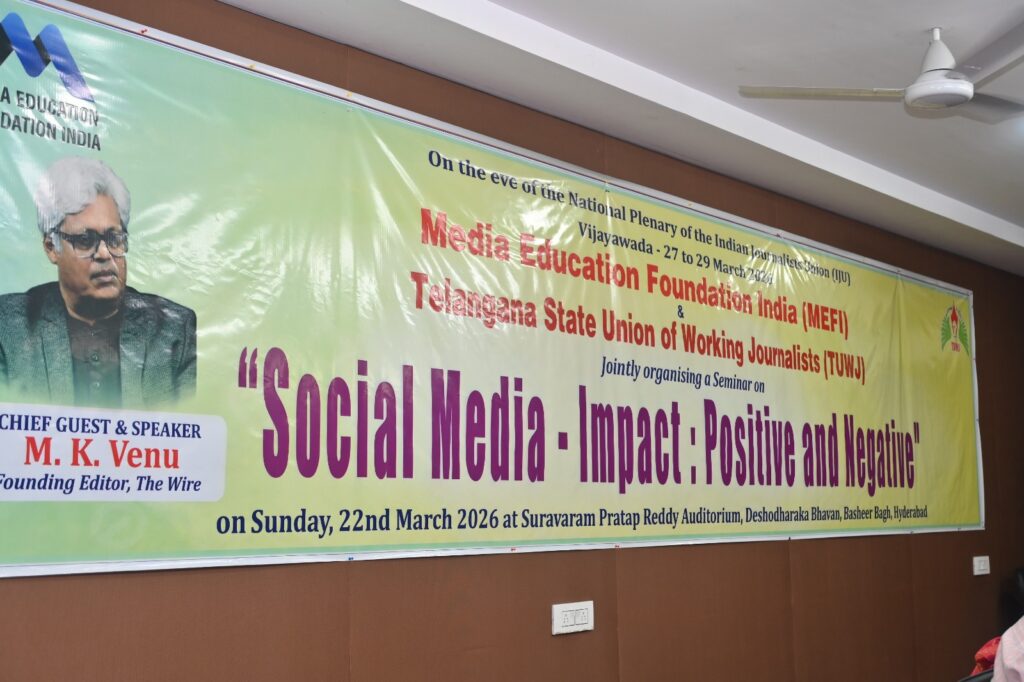
On the eve of the National Plenary of the Indian Journalists Union (IJU), to be held in Vijayawada from March 27 to 29, 2026, a seminar titled “Social Media Impact: Positive and Negative” was jointly organized by the Media Education Foundation India (MEFI) and the Telangana State Union of Working Journalists (TUWJ). The event took place at the Suravaram Prathapa Reddy Auditorium of Desoddaraka Bhavan in Basheerbagh on March 22, 2026. Veteran journalist Somasekhar presided over the seminar. MEFI trustee and former IJU president Devulapalli Amar, TUWJ state president K. Virahat Ali, and general secretary K. Ramnarayana also took part in it.
Editor, Prime Post
Ravindra Seshu Amaravadi, is a senior journalist with 38 years of experience in Telugu, English news papers and electronic media. He worked in Udayam as a sub-editor and reporter. Later, he was associated with Andhra Pradesh Times, Gemini news, Deccan Chronicle, HMTV and The Hans India. Earlier, he was involved in the research work of All India Kisan Sabha on suicides of cotton farmers. In Deccan Chronicle, he exposed the problems of subabul and chilli farmers and malpractices that took place in various government departments.