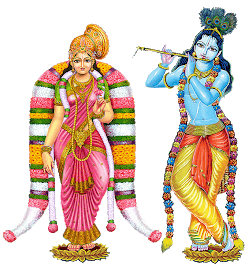
The doors made of precious stones symbolize ego and self-interest. These doors can be opened only by the compassionate instruction of the Aacharya (Teacher). Devotees immersed constantly in Krishna-consciousness neither hear nor speak of worldly matters—they appear deaf or dumb to the external world. Thus, Goda questions the Gopika within the palace:
“Are you deaf or dumb? Why do you not listen to us?” Finally, the Gopikas implore the girl’s mother to awaken her. The mother responds by chanting a thousand names of the Lord—Maamayan, Madhavan, Vaikunthanan. Hearing the sacred names, the pious and God-loving Gopika awakens instantly, drawn forth by divine remembrance. Light as Life Here, light is equated with life itself. Without light, the palace—the body—is lifeless. The Pramida (the bowl of the lamp) represents the body; the oil within is love. When one kindles life with the oil of love, it illuminates the path toward God. The Veda and the Vedabhashyas (commentaries) are like two sacred sticks used in worship. When these sticks are turned toward God and ignited, the fire that emerges is Jnana—true knowledge. When Jnana is united with Bhakti (love), one attains the clearest Darshan of the Lord.
Goda’s Tamil Pashuram 9
Thoomani Madathu Chchutrum Vilakkeriya
Dhoopam Kamazha Thuyil Anai Mel Kann Valarum
Maaman Magale Manikkadavam Thal Thiravaay
Mameer Avalai-ezhuppeero? Un Magal Than
Oomaiyo! Andri-ch-chevido! Anandalo!
Ema-p-perm Thuyil Mandira-p-pattalo
Mamayan Madhavan Vaikuntan Endrendru
Naamam Palavum Navindr-el or Empaavaai
English Poem 9
In a diamond-studded palace & amidst bright lamps
And fragrance of Dhoopa, sleeping on a soft bed,
Oh, Uncle’s daughter, open the Bells hanging Doors
Oh, Aunt, why don’t you wake up your daughter?
Is she dumb, deaf, or sleepy on a silky bed?
Or is she in slumber caused by any magic spell?
Mysterious Madhava, Vaikunthesha –Come,
Let us sing His name thousands of times.
The Jewel-Bedecked Palace of Consciousness
One Gopika lies in deep slumber on a soft, luxurious bed, surrounded by the fragrance of Sugandha Dhoopa incense, inside a palace adorned with precious jewels. Yet, she does not awaken. The other Gopikas plead with her mother:
“Oh, Aunt, at least you must wake her up. Please unlock the precious stone-studded door with hanging bells, so that she may join us in performing Sri Vrata, Sri Nomu, or Tiruppavai.”
This palace is symbolic. The Nava Ratnas (nine jewels) represent purification. The human body itself is a palace; however, it loses its brilliance due to worldly bonds and attachments. As a person progresses spiritually and matures inwardly, they shed the consequences of action (karma phala) and regain luminosity. The Nava Ratnas signify the Nava Dwaras or Nava Randhras—the nine apertures of the body. When impurities are expelled, the inner self shines forth.
Dependence on Him
Among the nine fundamental relationships between Jeeva (the individual soul) and Paramatma (the Supreme Soul), one is that of dependence. Paramatma is the Aadhaara—the eternal support—while Jeeva is the Aadheya, the one who depends. For every living being, Paramatma becomes the sustaining body of the soul itself.
Paramatma shines eternally with the original Nava Ratnas. Within Him, the devotee is visible—clearly and distinctly—like an object seen through a transparent Marakatha Petika (emerald jewel box). The Gopikas praise the palace of this Gopika, declaring that its inner brilliance exceeds even that of Bhagavan’s abode, for it glows with natural, self-born jewels. This radiance arises from her uninterrupted meditation upon Paramatma.
The Gopikas standing outside wonder aloud:
“Our lamps are placed outside the heart, but your lamps have illuminated us from within. How is this possible?”
She replies that she keeps every hall within her palace lit, constantly awaiting the arrival of Sri Krishna, who may come at any moment for divine, loving exchange.
The Nine Relationships with Paramatma
There are nine sacred relationships between Jeeva and Paramatma:
- Father–Son
- Protector–Protected
- Sheshi–Shesha (Master and the residuary soul)
- Bhartha–Bharya (Husband who bears responsibility and the dependent wife)
- Jnatha–Jneya (Knower and the known—He is knowledge embodied, Jeeva is the object of that knowledge)
- Swamy–Dasa (Ruler and the ruled)
- Aadhaara–Aadheya (Support and dependent)
- Atma–Sharira (Soul and body)
- Bhokta–Bhogya (Enjoyer and the enjoyed)
The awareness of these nine relationships is symbolized by the nine jewels with which the palace is built. Within this palace, the Gopika dissolves herself entirely in Him, giving the appearance of sleep. This state is not ignorance, but Prajna—supreme wisdom—absorbed meditation upon God in all nine relationships.
That Prajna itself is the jewel-studded palace, radiant with countless lamps of knowledge. The fragrance of Dhoopa signifies that, alongside knowledge, worship and disciplined practice are also present.
— Madabhushi Sridhar

Law professor and eminent columnist
Madabhushi Sridhar Acharyulu, author of 63 books (in Telugu and English), Formerly Central Information Commissioner, Professor of NALSAR University, Bennett University (near Delhi), presently Professor and Advisor, Mahindra University, Hyderabad. Studied in Masoom Ali High School, AVV Junior College, CKM College, and Kakatiya University in Warangal. Madabhushi did LL.M., MCJ., and the highest law degree, LL.D. He won 4 Gold Medals at Kakatiya University and Osmania University.