A Garland of Maṅgalam
This 24th Pashuram of Tiruppavai provides “A Sri Vaishnava Reading with Acharya Insights”. Tiruppāvai, the thirty sacred hymns of Āṇḍāḷ (Goddā Devī), is not merely a devotional poem but a graduated spiritual journey. Each pāsuram leads the devotee from discipline (vrata), through surrender (śaraṇāgati), into the highest ecstasy of love (parabhakti). The twenty-fourth pāsuram occupies a unique place in this progression. Coming immediately after the Siṃhāsana Pāsuram (23rd), it transforms the atmosphere of royal revelation into one of intimate, almost anxious love. Here, devotion reaches a point where the devotee forgets the Lord’s omnipotence and longs instead to protect Him.
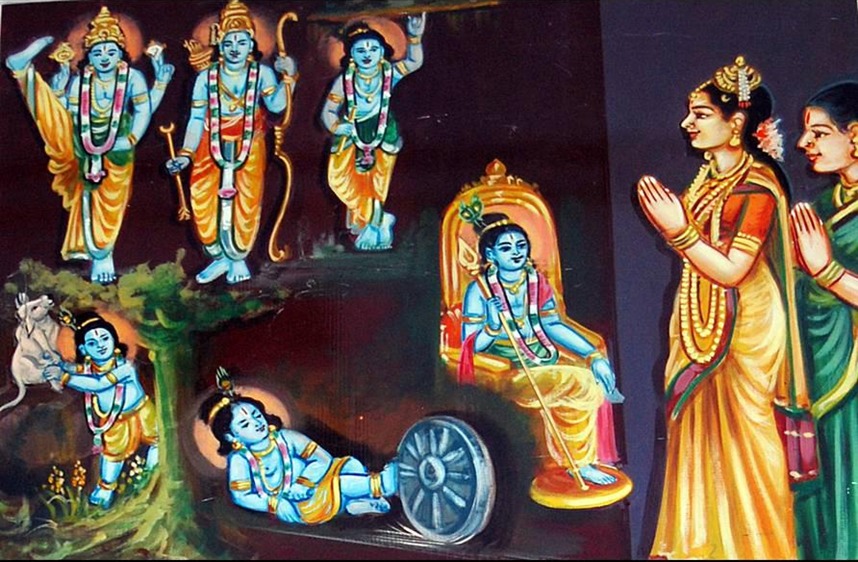
This article presents Tiruppāvai 24 as a Maṅgalāśāsana Pāsuram—a hymn of auspicious benediction—interpreted within the Śrī Vaiṣṇava tradition and aligned with the insights of Periyavāccān Piḷḷai and Maṇavāḷa Māmuni.
The emotional seed of the entire paasuram
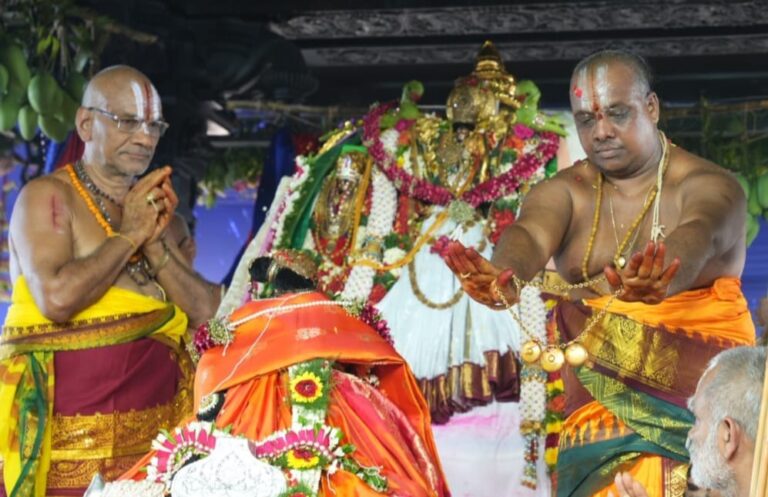
In the narrative imagination of the Āḻvārs, Śrī Kṛṣṇa responds to the call of the Gopikās by rising from His inner chamber and walking to the assembly hall. He moves with leonine majesty and ascends the throne, with Nīḷā Devī joining Him. At this moment, the Gopikās notice His divine feet appearing reddened, as though fatigued.
This single image becomes the emotional seed of the entire pāsuram. The Gopikās are struck by remorse: Have we caused pain to the Lord by making Him walk for our sake? This is not poetic exaggeration but the psychological truth of mature devotion. Love no longer calculates power; it only worries about the beloved.
Periyavāccān Piḷḷai observes that this pāsuram arises from “bhagavān śrama-smaraṇam”—the remembrance of the Lord’s exertions for His devotees. The Gopikās feel that throughout His many avatāras, He endured immeasurable hardship, yet rarely did anyone sing auspicious benedictions to ward off evil or fatigue. That omission, they feel, must now be corrected.
Structure of the Paasuram: A Garland of Maṅgalam
Unlike earlier pāsurams that petition or command, Tiruppāvai 24 is structured entirely as a sequence of pōtti—auspicious salutations:
- Aḍi pōtti – Benediction to Your feet that measured the worlds
- Tiṟal pōṟṟi – Benediction to Your valor that destroyed Laṅkā
- Pugaḻ pōtti – Benediction to Your glory in childhood feats
- Kaḻal pōtti – Benediction to the posture of Your feet
- Kuṇam pōtti – Benediction to Your forbearance in lifting Govardhana
- Vēl pōtti – Benediction even to the weapon in Your hand
Maṇavāḷa Māmuni notes that the repetition of pōtti is deliberate: it mirrors the way a loving mother repeatedly circles the lamp during ārati, unwilling to stop lest even a trace of inauspiciousness remains. The hymn thus becomes a rhythmic ritual of protection.
Parārtha: Devotional Meaning
Outwardly, the Gopikās ask for the paṟai (ritual drum). But the Ācāryas unanimously clarify that paṟai here signifies not a material object, but the right to proclaim the Lord’s glory eternally. What they truly desire is uninterrupted service through praise.
Each heroic act recalled—Vāmana’s strides, Rāma’s march to Laṅkā, Kṛṣṇa’s childhood victories, Govardhana-dhāraṇa—is not cited to demonstrate power, but to highlight strain, vulnerability, and self-giving. The focus is not what He can do, but what He has endured for the sake of His devotees. This reversal of emphasis is the emotional heart of the pāsuram.
Viśeṣārtha: Inner and Symbolic Meaning
Śrī Vaiṣṇava commentators consistently read these narratives symbolically:
- Śakaṭāsura represents karmic bondage that blocks divine joy; its destruction signifies liberation from accumulated karma.
- Vatsāsura and Kapitthāsura symbolize sensory obsessions (taste and smell), whose removal allows spiritual perception.
- Laṅkā stands for the fortress of ego within the mind; Rāvaṇa is ahaṅkāra enthroned.
- Govardhana embodies refuge (śaraṇāgati), where the Lord shelters souls from the storms of pride and divine misunderstanding.
Thus, the Lord’s feats are not merely cosmic events but inward acts of grace performed within the devotee.
Śrī Vaiṣṇava Tattva: When the Protector Becomes the Protected
At the doctrinal level, Tiruppāvai 24 illustrates a profound Śrī Vaiṣṇava insight: in the highest stage of devotion, the distinction between protector (rakṣaka) and protected (rakṣya) collapses.
- Knowledge (jñāna) affirms:
- “He alone protects the universe.”
- Love (bhakti) responds:
- “Let nothing harm Him.”
Periyavāccān Piḷḷai explains that this is not ignorance but parabhakti, where love eclipses even awareness of divine omnipotence. Maṇavāḷa Māmuni echoes this by citing examples from the Rāmāyaṇa: Kauśalyā blessing Rāma, Janaka singing bhadram te, Viśvāmitra uttering svasti rāghavayoḥ astu. In every case, those who know Rāma’s divinity still feel compelled to protect Him. This is the same spirit that animates Periyāḻvār’s Pallāṇḍu, where the poet blesses even the Lord’s conch and discus. Āṇḍāḷ inherits and intensifies this tradition.
Tiruppāvai 24 as the Pinnacle of Loving Anxiety
The tradition recounts devotees like Dhānurdāsa, who followed the Lord’s procession with a dagger ready, lest harm befall Him. Such stories are not exaggerations but illustrations of what the Ācāryas call “ubhaya‑vēdanā”—the pain of loving too deeply.
Tiruppāvai 24 is suffused with this loving anxiety. The Gopikās do not remember why they came; they forget the vow’s reward. All that remains is the urge to circle the lamp, to tie the protective thread, to sing maṅgalam again and again.
Is Govinda safe? The summit of bhakti
Tiruppāvai 24 is neither prayer nor philosophy. It is love at its most audacious—love that seeks to protect the Protector of all worlds. Within Śrī Vaiṣṇava thought, this pāsuram stands as a luminous testimony to the truth that the highest devotion does not stand in awe of power, but trembles in tenderness before grace.
The summit of bhakti is reached when the soul forgets that God saves it, and worries instead whether God is safe. That summit is Tiruppāvai 24.

Law professor and eminent columnist
Madabhushi Sridhar Acharyulu, author of 63 books (in Telugu and English), Formerly Central Information Commissioner, Professor of NALSAR University, Bennett University (near Delhi), presently Professor and Advisor, Mahindra University, Hyderabad. Studied in Masoom Ali High School, AVV Junior College, CKM College, and Kakatiya University in Warangal. Madabhushi did LL.M., MCJ., and the highest law degree, LL.D. He won 4 Gold Medals at Kakatiya University and Osmania University.