Before Tirumala Sri Venkateshwara wanted to be
always at the threshold. First, he wanted to be a tree, but
there is a possibility of the removal of the tree.
Similarly, a stone or even a hillock could be removed.
He requested to be birth as a ‘threshold.
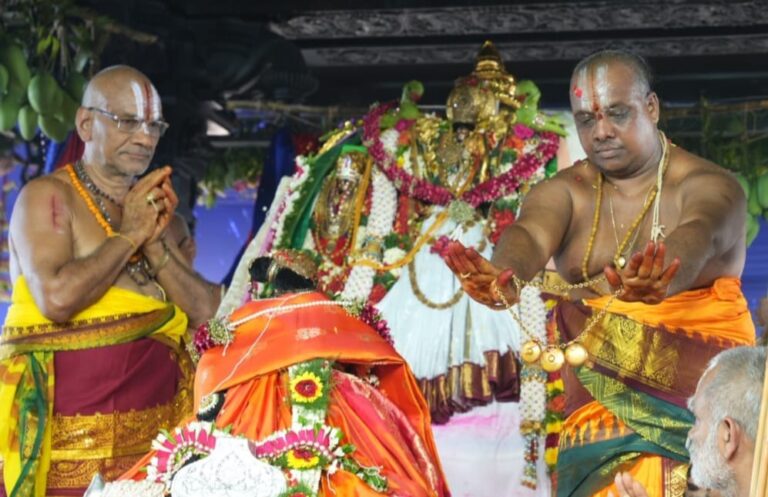
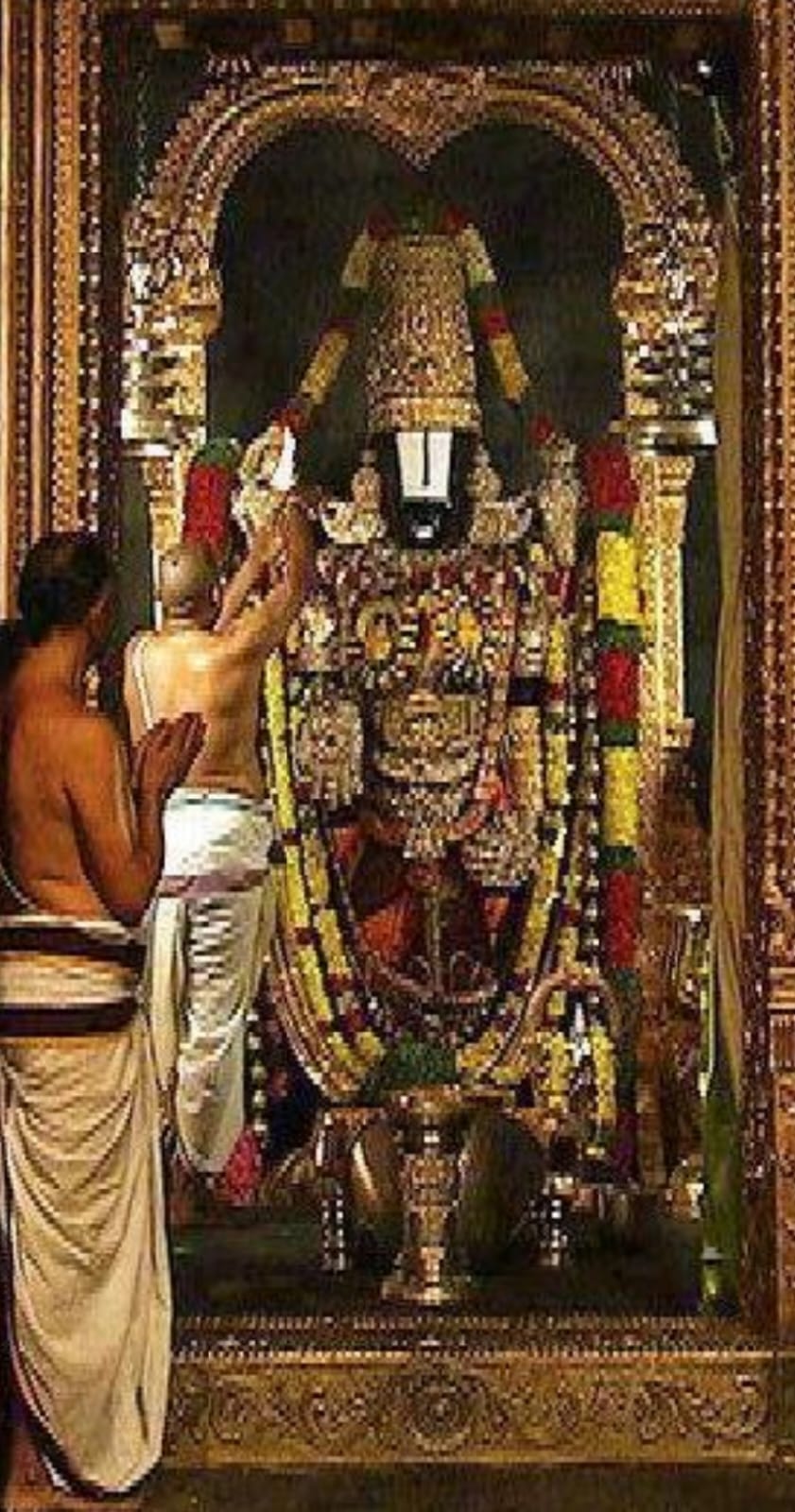
The sacred threshold immediately before the inner
sanctum (Garbha Griha) of Lord Venkateswara at
Tirumala is known as Kulasekhara Padi. This point is
considered extremely holy and marks the boundary
between the outer world and the divine presence of the
Lord. The threshold is named after Sri Kulasekhara
Alwar, a revered saint who wished to be a step at the
Lord’s doorway to be constantly touched by the feet of
devotees and the Lord’s priests. Devotees have
their darshan (sight of the deity) from this threshold.
Only the temple priests are permitted to cross the
Kulasekhara Padi and enter the innermost sanctum
where the main idol resides.
Devuni Kadapa: An ancient temple located in Kadapa, Andhra Pradesh, known as “God’s threshold” or “Gateway to reach Lord Sri Venkateswara Swamy”. There is a centuries-old tradition that pilgrims should visit the temple in Devuni Kadapa first before proceeding to Tirumala for the main darshan. Located on Tirumala hill, near the Swami Pushkarini (temple tank), this temple should be visited and worshipped first before visiting Lord Venkateswara’s main temple, according to
temple tradition and the Varaha Purana.
Goda, waking up Kulasekhara
In this Paashuram, Goda, in this 7th song, is waking up Kulasekhara Alwaar. He is a shining
jewel among the 10 Aalwaars. He is a Kshatriya, of the ruling class. He is a guru of gurus, i.e.,
Paraama Acharya. (Namaskaram to my Gurus). Thus, the acharya mantra is ‘Asmat Parama
Gurubhyonnamah’. (Salutations to Guru of Gurus, ex, Kulasekhara)
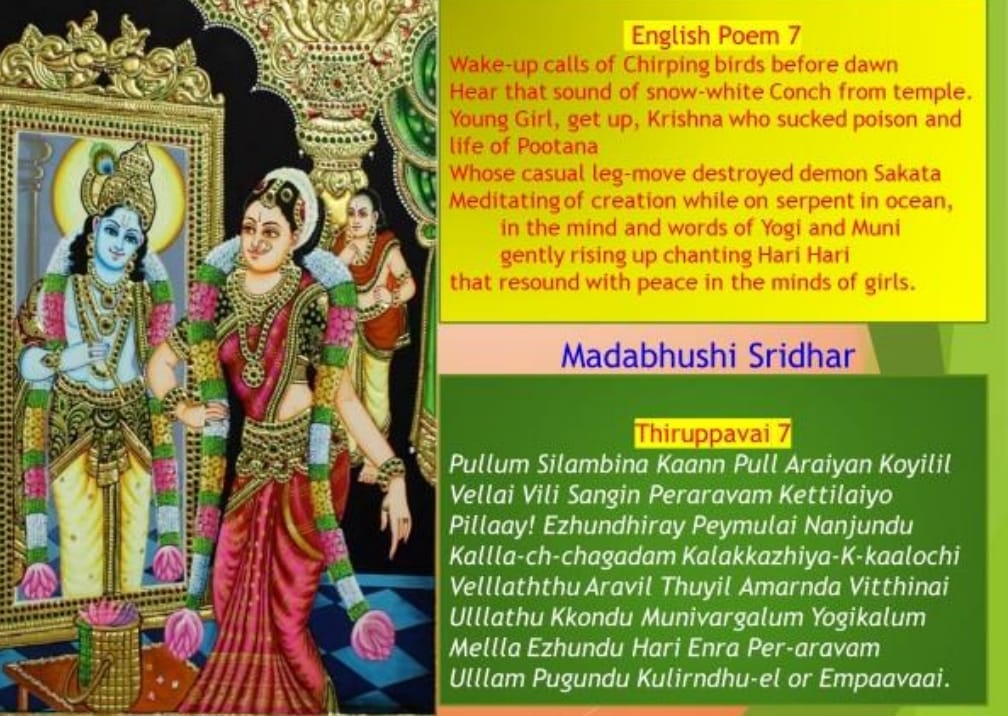
Madabhushi Sridhar -Tiruppavai – 7
Tiruppavai by Godadevi from Tamil
Keechu Keechu Endru Engum Aanaichathan Kalandhu
Pesina Pecharavam Kettilaiyo? Peypennnay!
Kasum Pirappum Kalakalappa-k-kai Perthu
Vaasanarum Kuzhal Aaychiyar Matthinal
Osaipaduttha Ththayir- aravam Kettilaiyo?
Nayaga pennppillaiy! Naaraayanan Moorthy
Kesavanai padavvum Nee Kettekidatthiyo
Thesamudaiyai Thirav-el or Empaavaai.
The morning dialogues of Bharadwaja birds
English Translation
As dozens of birds chirp together at dawn
OH, crazy, listen to the morning dialogues of Bharadwaja birds.
Hear the music of golden necklaces & bangles.
Of lovely hands; feel the fragrance of flowers in their hair
Churning curds by staffs, can’t you hear?
O, the lady of Naaraayana, get up, to lead us.
To Keshava and to sing with us, His praise.
Awaken, open the doors & let us go, my girl.
Gopika at the doorstep indicates three points to convince Gopika inside about the passage of
the night and the beginning of dawn. In the 6th Paashuram chirping of birds, Conch sound,
chanting of Hari Hari by Yogis and Munis are the three sounds of the morning to be noticed.
Birds render great service to mankind by waking them up at the right time with their sounds
unknowingly. Sankha Naadam (sound of the Conch) tells us that it is time to pray to God. It is
Omkaram, which links us to God, whereas the third sound is the chanting of Munis and Yogis,
which is the result of human effort.
What is the meaning of the chirping sounds of birds? Goda says they are planning to fetch food
together for their children. They can fly with two wings- Knowledge and Practice. Rishis
meditate for some time, then come out to discuss with other Rishis, and they go back to
penance. The chirping is nothing but such conversation, Goda says.
This Song mentions Bharadwaja Muni. Bharadwaja birds, which are found in the Kerala-Tamil
Nadu coastal region, make sounds like Parrots. Prince Raama, during his exile, stays for a night
at Bharadwaja’s Ashram (residence). Thereafter, Bharatha, with his family, Gurus, royal staff,
and army, arrives at the forest in search of Raama, and pays respects to Bharadwaja in his
Ashram. Bharadwaj asks Bharatha, “What else do you want to do to Raama, who is innocent
and harmless? Why are you searching for him?”
The question is quite derogatory and suggestive of suspicion. Pained, Bharatha falls on his feet
and cries: “Muni, you know past, present, and future, don’t you know my role, and can’t you
read my mind?” Bharadwaja wants to test him further. He creates a spacious Royal palace for
all who came with Bharata and asks him to take the King’s seat. Bharatha leaves it and goes to
a nearby seat meant for the Minister and operates the hand-fan towards the Simhasana as if
Raama is sitting there. This proves that he was not fond of occupying the king’s seat.
Bharadwaja spent all Taposakthi to build this palace just to test the devotion of Bharata. But
he was happy to discover a great Bhagavatottama in him. Bharadwaja uses all his PurushAyush
(300 years of life of a pious man) to learn a small part of Veda Adhyana. He invokes from God
another PurushAyush to study the Vedas further. He could not complete and asked for another
300 years from Prajapathi. Three terms Ayush of 300 years each were not enough for him to
learn even a little portion of the Vedas. When Bharadwaj did Tapas again, Prajapati appeared
and showed there three big hills of Vedas and a fistful of earth on each Hill.
He said: “In all these years, you have learnt three fistfuls from the three Hills of Vedic knowledge. Now you can stop learning and start the practice of what you gained”. To reach God, one must serve His
devotee. This is a quote from the Bharadwaja Samhita. Bharadwaja was trying and testing who
would be such a divine devotee whom he could cultivate as a contemporary colleague, and he
found Bharatha after spending all his Taposhakti& knowledge attained in 900 years. Goda says
it is not enough to meditate on God; one should frequently meet the devotee.
Sarvam Sri Krishnaarpanam. (Everything is dedicated to Him).
In Brindavan, Gopikaas always meditates on Sri Krishna. Even when they are immersed in
their daily activities, they do not forget Sri Krishna. Whatever they think, say, and do, they
offer it to Sri Krishna. Sarvam Sri Krishnaarpanam. (Everything is dedicated to Him).
Krishna and their association with Gopikaas
Gopikaas attained Bhakti not because of their learning and knowledge. It is because of their
association with Krishna in Vrepalle. Each of those villages used to bring what all they made
or cooked for Krishna. A mother-in-law could not tolerate this madness, and to teach a lesson
to the daughter-in-law, she entrusted a huge stock of Curds and Milk to be sold in a day. That
Gopika took it to the nearby town for sale and could sell it all easily by chanting the names of
Govindaa, Damodaraa, and Maadhavaa instead of the milk products she carried. They got
dissolved in the thoughts of Krishna.
While churning the buttermilk with staffs, they were meditating on Krishna. Goda is asking
Gopika, “Can you hear those churning sounds? As they churn, their bangles and necklaces
shake and produce a lot of sound”. And the flowers decked in their plaits get loosened,
spreading their fragrance. Goda addresses the girl inside as a leader and requests her to lead all
the Gopikaas to the abode of Sri Krishna.
Krishna became Keshava when he killed a demon-horse in a very unusual manner. It was the
demon Keshi, in horse form, that attacked Krishna with an open mouth. Little Krishna pushed
his hand into his mouth. Keshi was happy that he could eat the tender hand away. But that was
a play (a leela) for little Krishna, who increased the size of his hand, making Keshi breathless.
Keshi died as the enlarged hand spread to the entire body.
Goda’s words are quite symbolic. Cows are Vedic sentences; their milk represents God’s
beautiful form and wonderful deeds. Discovering them through the Teacher and remembering
them is reflected in Curds. Curd is the experience. Churning staffs relate to God; the thread is
the thread of love for God, while churning is the action. The result is the mind that could be
offered to God, that is, butter. That butter melts down with the heat of separation from God.
Retain the butter and offer it to Krishna before you are separated from Him. When the Ocean of Milk was churned, three sounds emerged.
1. Sound of returning rivers as Mandhara Hill was placed in the ocean as a churning staff, raising the water levels.
2. Sound that emerged while Vaasuki (Serpent) was tying a rope around Mandhara.
3. Sound of surging waves in the ocean due to the rotation of Mandhara in the ocean.
Similarly, three sounds emerged from Gopikaas- the sound of bangles, their song, and of churning curds. Churning of Milk is compared with the churning of the Milky Ocean by Goda. The act of churning is the
Gopikaas’ penance.
– Madabhushi Sridhar
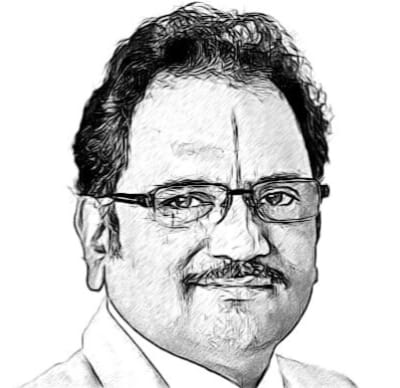
Law professor and eminent columnist
Madabhushi Sridhar Acharyulu, author of 63 books (in Telugu and English), Formerly Central Information Commissioner, Professor of NALSAR University, Bennett University (near Delhi), presently Professor and Advisor, Mahindra University, Hyderabad. Studied in Masoom Ali High School, AVV Junior College, CKM College, and Kakatiya University in Warangal. Madabhushi did LL.M., MCJ., and the highest law degree, LL.D. He won 4 Gold Medals at Kakatiya University and Osmania University.