(Apex Justice – 1)
| It is the first of a series of significant judgments that shaped the Constitution of India in 2025 |
On 16 January 2025, the Supreme Court reaffirmed the constitutional depth and purpose of Article 142, which empowers it to pass any order necessary to do “complete justice.” The judgment in Biswajit Das v. Central Bureau of Investigation (2025 INSC 85) is a clear statement that procedural constraints whether statutory or self-imposed cannot be allowed to defeat substantive justice.
A Bench comprising Justice Dipankar Datta and Justice Manmohan warned that if the Court were compelled to examine only a narrowly framed issue while ignoring substantial questions of law and fact, “justice could be a real casualty.” This observation captures the constitutional philosophy underlying Article 142: justice must be real, effective, and comprehensive—not merely formal or technical.
To transcend procedural boundaries
A recurring issue before the Supreme Court is whether it remains bound by the limited scope fixed at the stage of issuing notice, or whether it may expand the inquiry if justice so demands. In this case, the Court answered decisively: the Supreme Court is not irreversibly bound by the restricted scope earlier fixed, if adherence to such limitation would result in injustice.
Article 142, the Court held, authorises it to transcend procedural boundaries where necessary to ensure that the truth, legality, and fairness of the entire case are properly examined.
A case of a fraudulent insurance claim
The appellant, Biswajit Das, was a Development Officer in the Life Insurance Corporation of India. He was accused of facilitating a fraudulent insurance claim by falsely projecting that the insured person had died. He was convicted by the Trial Court for offences under the Indian Penal Code, 1860 (forgery, cheating, and criminal conspiracy) and under the Prevention of Corruption Act, 1988, for abuse of official position.
In 2009, the Gauhati High Court affirmed his conviction. When Das approached the Supreme Court, a two-judge Bench in 2014 issued notice but restricted the hearing to a single issue whether his conviction under the Prevention of Corruption Act could be sustained.
Use Article 142 to protect justice
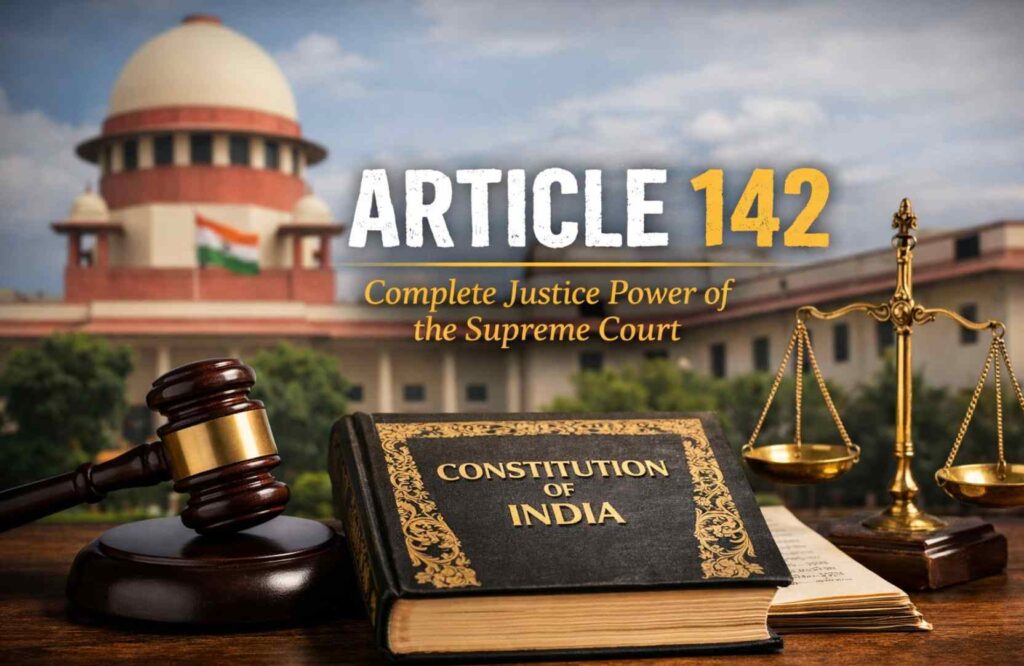
In its 2025 judgment, the Supreme Court held that such an earlier limitation does not operate as a constitutional bar. The Court clarified that Article 142 is not an automatic power but a carefully exercised discretion, to be invoked only when judges are satisfied that a restricted examination would undermine justice. Where the Court finds that a partial inquiry would distort the legal or factual truth, it may expand the scope of appeal, even if it had earlier confined it. Procedural self-restraint cannot become a fetter on constitutional duty.
Applying this principle, the Court examined the entire record, not merely the Prevention of Corruption Act charges. Upon a comprehensive review, it upheld the conviction under both the IPC and the Prevention of Corruption Act, affirming the findings of the Trial Court and the High Court.
We need complete justice
This judgment reinforces the Supreme Court’s role as a constitutional court of complete justice, not merely an appellate forum bound by procedural technicalities. It confirms that Article 142 empowers the Court to rectify injustices that might otherwise persist due to narrow procedural limitations or earlier restrictions. More importantly, the ruling underscores a fundamental constitutional principle: procedure is a handmaid of justice, not its master. When procedure threatens to obscure truth or legality, the Constitution empowers the Supreme Court to intervene decisively.
The Constitution is not for mechanical
Biswajit Das v. CBI stands as a reminder that justice under the Constitution is not mechanical. Article 142 exists precisely to ensure that the Supreme Court can rise above technical barriers when necessary. By holding that it may expand the scope of an appeal in the interest of complete justice, the Court reaffirmed its constitutional obligation to ensure that justice is not only done, but done fully and effectively.

Law professor and eminent columnist
Madabhushi Sridhar Acharyulu, author of 63 books (in Telugu and English), Formerly Central Information Commissioner, Professor of NALSAR University, Bennett University (near Delhi), presently Professor and Advisor, Mahindra University, Hyderabad. Studied in Masoom Ali High School, AVV Junior College, CKM College, and Kakatiya University in Warangal. Madabhushi did LL.M., MCJ., and the highest law degree, LL.D. He won 4 Gold Medals at Kakatiya University and Osmania University.




Yes. It’s true justice the Constitution is . Article 142 exists to ensure the Supreme Court can rise technical when to deliver complete justice. A worthy subject to bring into people’s notice about the Article 142 to deliver the complete justice. Thanks for enlightening this.