We need not blame journalists, social media, police, or judges. We should think about and suggest what to do next to preserve the media’s freedom. Study the judgment in the name of Nallam Balu, which happened a few months ago. This judgment is a watershed moment for free speech in the digital age. It was delivered by Justice N. Tukaramji of the Telangana High Court on September 10, 2025.
The Rule that evolved: “The police shall not act as a tool in the hands of the ruling dispensation to stifle the voice of the opposition. Democracy thrives not on silence, but on dissent and debate.”
Social Media users’ freedom to criticise: Rightly Court Intervened
The High Court found that the police acted as a “tool” for political parties. It ruled that:
- Political Satire is Protected: Harsh criticism or satire does not constitute a crime unless it directly incites physical violence.
- Procedural Illegalities: Defamation is a non-cognizable offense. The police cannot register an FIR for it; only a Magistrate can authorize an investigation upon a private complaint by the “aggrieved person.”
“Shield” for citizens
The court established a “shield” for citizens against arbitrary police action. Here are the core points expanded with their legal implications:
Absolute Protection for Political Criticism
- The Rule: Harsh, satirical, or even “vulgar” political criticism is protected under Article 19(1)(a).
- The Implication: The court observed that “democracy thrives on dissent.”Satire and criticism of the government are not crimes unless they pose an “imminent threat” to public order.
Closure of Frivolous Complaints
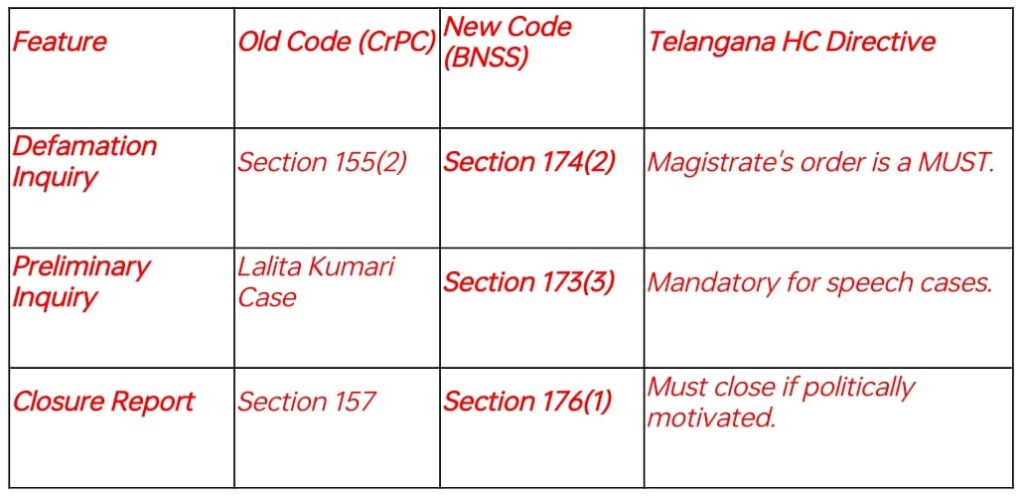
- The Rule: If a complaint is found to be politically motivated or lacks substance, the police must close it under Section 176(1) BNSS (citing “no sufficient grounds”).
What is not Defamation?
A comparison of a political party to a “pest.”An allegation that the government operates on a “20% commission.”Language that the prosecution termed “abusive and vulgar.”
Nalla Balu has posted the above comment on “X” (Twitter). He is asocial media user who was targeted for satirical posts about political leadership.
FIR Registered: The police registered multiple FIRs across different stations (Karimnagar, Ramagundam, etc.) under sections of the BNS for “promoting enmity,” “public mischief,” and “defamation.”
In “X,” the author criticized the Telangana Government and the Chief Minister, Revanth Reddy.
1. Verification of Locus Standi
- The Rule: For defamation, the police must verify if the complainant is the “aggrieved person.”
- The Implication: A third-party (like a party worker or a police constable) cannot file a defamation complaint on behalf of a leader. This stops “proxy” FIRs used to harass critics.
2. Mandatory Preliminary Inquiry
- The Rule: Before registering a cognizable offence, a preliminary inquiry is mandatory to see if the statutory ingredients (the basic legal requirements of a crime) exist.
- The Implication: Police can no longer claim they “had to register an FIR because a complaint was given.” They must now legally justify that the post actually constitutes a crime before filing the FIR.
3. High Threshold for Speech-Related Offences
- The Rule: Sections involving “promoting enmity” or “public mischief” require prima facie evidence of incitement to violence or public disorder.
- Legal Precedents: The court strictly applied the standards of Kedar Nath Singh (1962) and Shreya Singhal (2015).
- The Implication: Mere “offensive” words are not enough to criminalize a person.There must be a clear link between the words and a threat of physical violence.
4. Defamation is Non-Cognizable
- The Rule: Under the BNSS, defamation remains a non-cognizable offence.
- The Procedure: Police cannot register an FIR directly.The complainant must go to a Magistrate. Police can only act if the Magistrate issues an order under Section 174(2) BNSS (formerly $Section 155(2)$ CrPC).
5. No “Mechanical” Arrests
- The Rule: Police must follow the Arnesh Kumar v. State of Bihar (2014) guidelines.
- The Implication: Arrest should be the exception, not the rule, especially for offences with sentences under seven years. Police must prove that the arrest is “necessary” (e.g., to prevent tampering with evidence).
6. Mandatory Legal Opinion
- The Rule: In sensitive cases (politicians/social media influencers), the SHO must seek the opinion of the Public Prosecutor before registering the FIR.
- The Implication: This adds a layer of professional legal scrutiny, reducing the influence of local political pressure on the police station.
Goes to the High Court of Telangana
In this case of Nalla Balu @ Durgam Shashidhar Goud v. State of Telangana, Criminal Petition Nos. 4903, 4905, and 8416 of 2025). It is one of the first major High Court rulings to interpret and apply the new criminal codes—the Bharatiya Nyaya Sanhita (BNS) and Bharatiya Nagarik Suraksha Sanhita (BNSS)—to the digital age and political dissent.
Summary Table: CrPC vs. BNSS in this Context

Law professor and eminent columnist
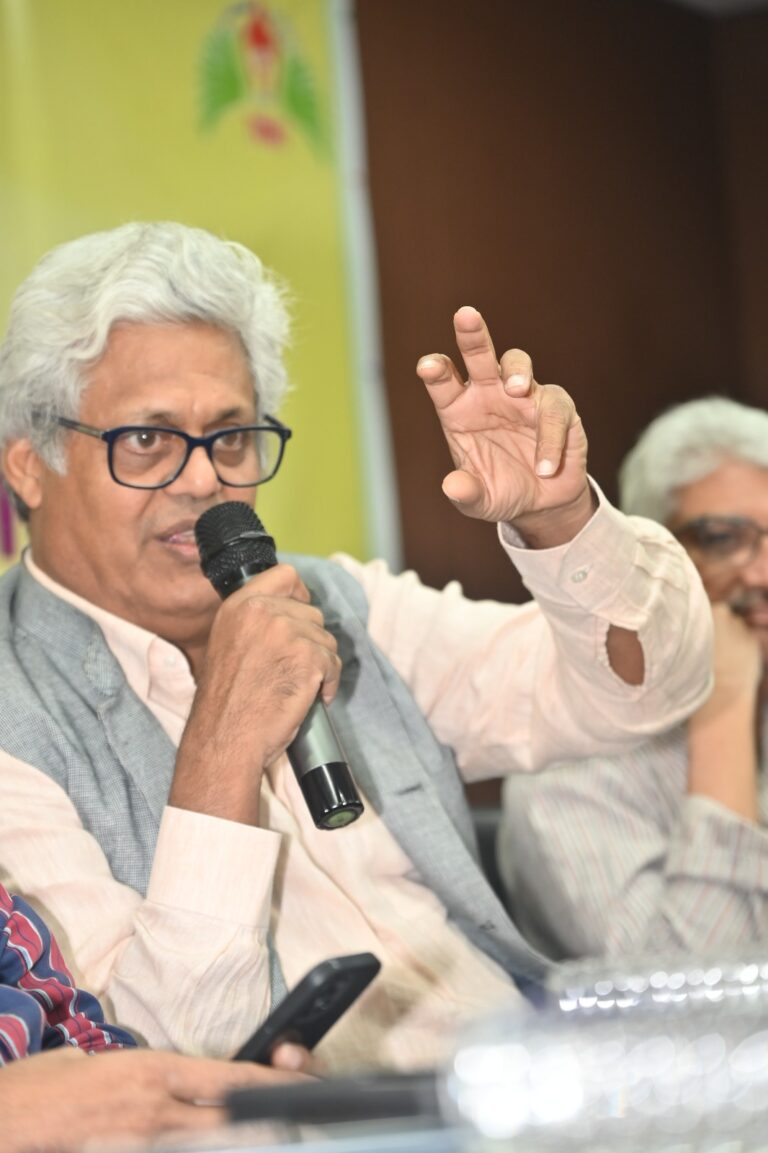
Madabhushi Sridhar Acharyulu, author of 63 books (in Telugu and English), Formerly Central Information Commissioner, Professor of NALSAR University, Bennett University (near Delhi), presently Professor and Advisor, Mahindra University, Hyderabad. Studied in Masoom Ali High School, AVV Junior College, CKM College, and Kakatiya University in Warangal. Madabhushi did LL.M., MCJ., and the highest law degree, LL.D. He won 4 Gold Medals at Kakatiya University and Osmania University.