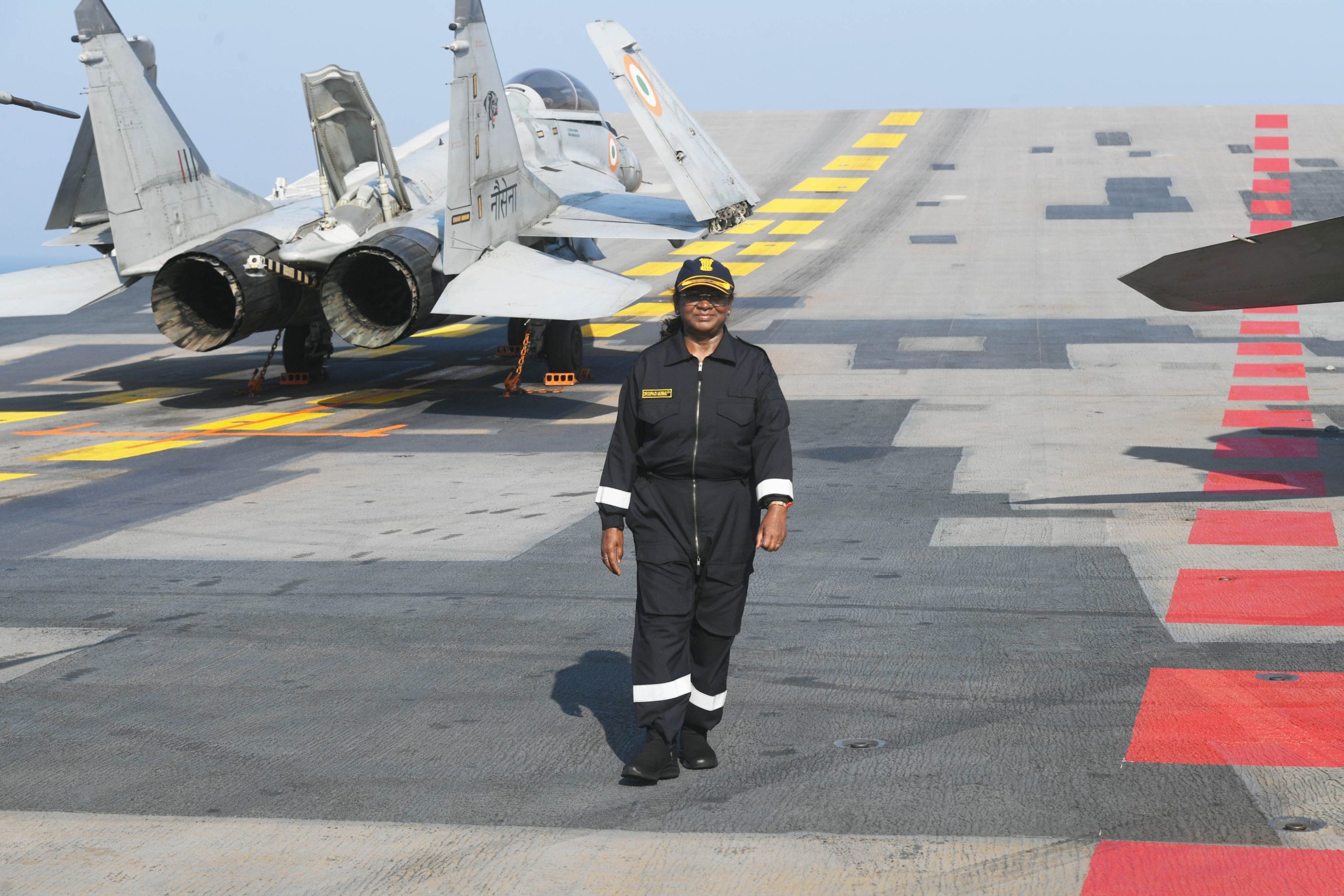
In a momentous event that bridged the past and the present, President Droupadi Murmu embarked on a deep-sea journey onboard the INS Vaghsheer on Sunday. This over two-hour sortie off the coast of Karwar was more than just a military inspection; it was a powerful symbolic gesture, making her only the second President in India’s history to dive into the depths of the ocean in a submarine. By doing so, she has followed in the historic footsteps of the late Dr. APJ Abdul Kalam, reinforcing a legacy where the nation’s highest leader personally validates the country’s frontline defense technologies.
The tradition of “Presidential Sorties” serves a dual purpose: it acts as a supreme morale booster for the armed forces and signals India’s growing military self-reliance to the world. In February 2006, the “People’s President,” Dr. Kalam, created history when he spent nearly four hours onboard the INS Sindhu Rakshak. While Dr. Kalam’s dive was a milestone for the Russian-origin Kilo-class submarines, President Murmu’s sortie marks a new era. Her presence onboard the INS Vaghsheer—an indigenously built Kalvari-class vessel—showcases how far India has come in its journey toward Atmanirbhar Bharat (Self-Reliant India).

Accompanied by the Chief of Naval Staff, Admiral Dinesh K. Tripathi, President Murmu witnessed the “Silent Sentinel” in its natural element. The INS Vaghsheer is the sixth and final submarine of the Project-75 series, built at the Mazagon Dock Shipbuilders Limited in Mumbai. During the dive, the President was briefed on the sophisticated sonar systems, stealth features, and advanced torpedo-launching capabilities that make the Kalvari class one of the deadliest underwater platforms in the world.
The experience of a submarine sortie is unique and physically demanding. Unlike a flight in a fighter jet, which President Murmu has also experienced, a submarine mission is about endurance, stealth, and operating in a high-pressure, enclosed environment. By spending over two hours submerged, the President experienced the “silent service” lifestyle of the naval submariners, who often stay underwater for weeks at a time to protect the nation’s maritime boundaries.

Officials noted that the President was deeply impressed by the technical prowess of the indigenously designed systems. Her visit to the Karwar naval base, which is part of the massive “Project Seabird,” highlights the strategic importance of the Western seaboard. As India looks to modernize its fleet with more nuclear and conventional submarines, the Supreme Commander’s personal involvement serves as a strong endorsement of the Navy’s future roadmap.
The legacy of such sorties reflects the evolving nature of India’s defense. While Dr. Kalam’s 2006 dive was about a rising India testing its wings, President Murmu’s 2025 dive is about a confident India leading through indigenous innovation. In her message to the crew, she noted that the discipline and technical skill of the Indian Navy are the true foundations of national security.
This historic dive completes a “triad” of sorts for President Murmu, who has previously flown in a Sukhoi-30 MKI and visited the freezing heights of Siachen. By descending into the depths of the Arabian Sea, she has sent a clear message: from the skies to the peaks and now the deep ocean, India’s leadership stands firmly behind the men and women who guard the nation’s frontiers.
Deputy Editor, Prime Post
Anand Gantela is a seasoned media professional with nearly three decades of experience across the spectrum of Indian journalism. Having worked extensively in both print and broadcast media, he has held key positions at renowned outlets such as Prajashakthi, Andhra Bhoomi, Mudra, Media India, Siti Cable, Mana Telugu, and Maa TV. From ground-level reporting to managing news bureaus and overseeing bulletin production, Anand has witnessed the evolution of news firsthand. His wealth of experience reflects a deep understanding of the dynamic and ever- evolving landscape of news reporting.