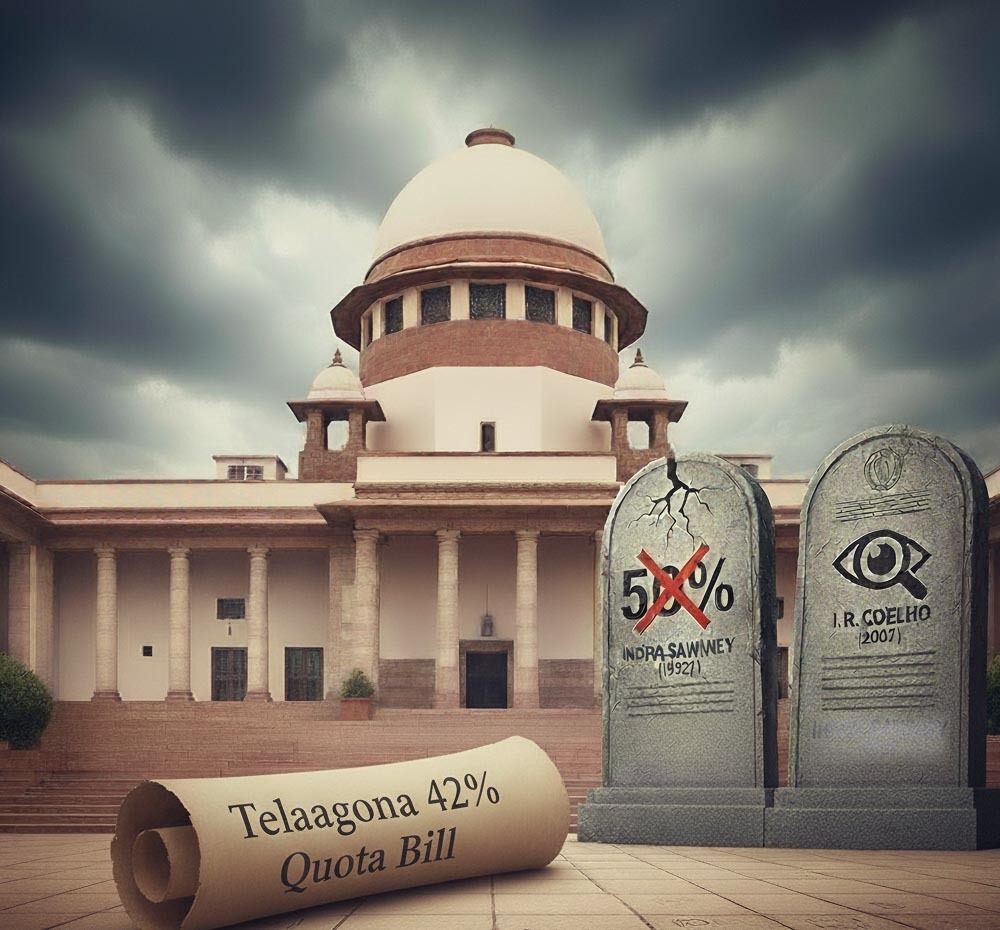
Telangana’s push to provide 42% reservation for Backward Classes (BCs) in education, employment, and politics is currently encountering significant legal hurdles. The government’s immediate attempt to implement the quota has already faced judicial intervention. The State High Court has issued a stay on G.O. No. 9, which provided for 42% reservation for BCs in local body elections. The State Government appealed to the Supreme Court to lift this stay but did not receive relief.
This decision led to significant discontent among BC associations, resulting in a state-wide bandh (shutdown) supported by all major political parties. In this backdrop, the focus has shifted to the two reservation bills unanimously passed by the Telangana Legislative Assembly and forwarded to the Central Government. There is a strong demand to not only approve these bills but also to place them under the Ninth Schedule of the Constitution.
A major debate is now raging among intellectuals and political circles, If the Centre approves the bills and places them in the Ninth Schedule, will the reservation quota be safe from judicial challenge? This critical question brings two monumental Supreme Court judgments, The Indra Sawhney Judgment (1992) and The I.R. Coelho Judgment (2007), back into the spotlight.
The Indra Sawhney Verdict (1992): The 50% Wall
The central doctrine of the Indra Sawhney & Others v. Union of India judgment is the rule that total reservations cannot exceed 50%.
The Ruling: The nine-judge bench held that the principle of equality of opportunity (Article 16(1)) mandates that reservations, being an exception, must be kept within reasonable bounds. The 50% cap was established as the general rule, permitting a breach only in “extraordinary circumstances”.
The Telangana Angle: Since Telangana’s proposed 42% BC quota, when added to the existing Scheduled Caste (SC) and Scheduled Tribe (ST) quotas, will significantly breach the 50% ceiling, it faces an immediate existential threat under this 1992 ruling. The State must convincingly prove “extraordinary circumstances” to the satisfaction of the Apex Court.
The I.R. Coelho Verdict (2007): The Judicial Review Window
To overcome the Indra Sawhney cap, the political strategy is to place the law in the Ninth Schedule. This is where the I.R. Coelho v. State of Tamil Nadu judgment becomes crucial.
The Ruling: The Supreme Court definitively clarified that laws inserted into the Ninth Schedule after April 24, 1973, are not immune to judicial review. Such laws can be struck down if they violate the Basic Structure of the Constitution.
The Telangana Angle: The principle of Equality from which the 50% cap is derived is considered part of the Basic Structure. Therefore, even if the Telangana quota law is successfully placed in the Ninth Schedule, the Supreme Court, invoking the I.R. Coelho principle, retains the power to examine whether such a massive quota violates the fundamental constitutional fabric.
A Constitutional Battle Ahead
The current political and legislative developments in Telangana are setting the stage for a major constitutional confrontation. Even if the BC reservation bills are approved and added to the Ninth Schedule, their ultimate fate will be decided by the Supreme Court, where the principles laid down in Indra Sawhney and I.R. Coelho will serve as the judicial yardsticks for determining the balance between social justice and constitutional equality.

Deputy Editor, Prime Post
Anand Gantela is a seasoned media professional with nearly three decades of experience across the spectrum of Indian journalism. Having worked extensively in both print and broadcast media, he has held key positions at renowned outlets such as Prajashakthi, Andhra Bhoomi, Mudra, Media India, Siti Cable, Mana Telugu, and Maa TV. From ground-level reporting to managing news bureaus and overseeing bulletin production, Anand has witnessed the evolution of news firsthand. His wealth of experience reflects a deep understanding of the dynamic and ever- evolving landscape of news reporting.



1 thought on “Can the Ninth Schedule Bypass the 50% Ceiling?”