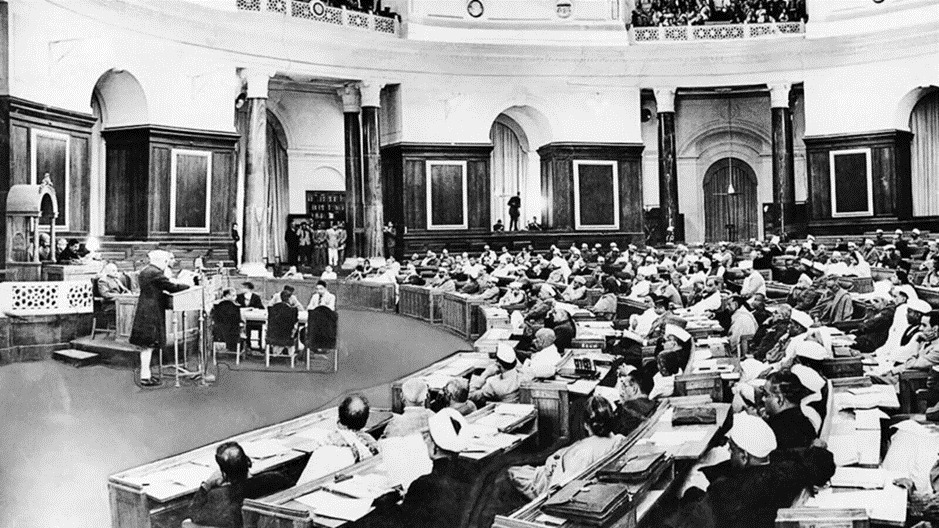
Under the leadership of Dr. Rajendra Prasad functioned as the permanent Chairman of the Constituent Assembly, who later became the first Swatantri Bharath Rashtrapati. The genesis of the Indian Constitution started on December 11, 1946. Under the leadership of Dr. Sachidanand Sinha and later Dr. Prasad structured our rule book.
Consisting of 395 members, they have built the Constitution. The Constituent Assembly, which is now a double-house of Parliament. There were 13 committees, each tasked with specific roles in framing the Constitution. Undoubtedly Dr. B.R. Ambedkar led the rule book as chairman of the Drafting Committee, and hence one should always remember as the chief architect of the Indian Constitution. Besides Ambedkar, Jawaharlal Nehru, Sardar Vallabhbhai Patel, K.M. Munshi, Muhammed Saadulah, Alladi Krishnaswamy Iyer, Gopala Swami Ayyangar, N. Madhava Rao, T.T. Krishnamachari, and others were the pillars of our democratic system.
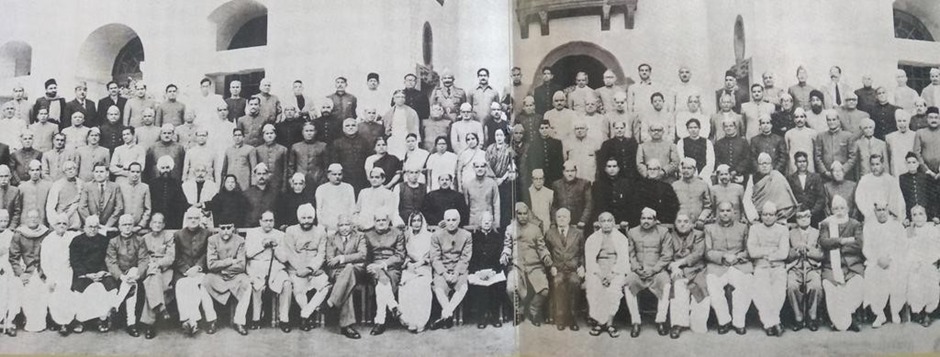
After the tragedy of the partition of Akhand Bharath, so-called, with love (Desh Bhakti), the following members withdrew from the Constituent Assembly. Bengal (Now East Bengal): – Abdullah al Mahmood, Liaquat Ali Khan, Fazlur Rahman, H.S. Suhrawardy. Punjab (Now West Punjab): Muhammad Ali Jinnah, Zafarullah Khan, Iftikhar Hussain Khan, Northwest Frontier: Khan Abdul Ghaffar Khan (who was called Gandhi of border), Sardar Bahadur Khan. Sind: Abdus Sattar Abdur Rahman, Alhajj Muhammad Hashim Gazder, Balochistan: S.B. Nawab Mohammad Khan Jogezai. Before paying tributes to each member of the Constituent Assembly, we should not forget to offer ‘Namaskar and Johar’s to Bhagat Singh, Lala Lajpat Rai, Sardar Vallabhbhai Patel, Subhash Chandra Bose, Mahatma Gandhi, Ram Prasad Bismil, Chandra Shekhar Azad who contributed immensely during the freedom struggle.
This assembly held various meetings (for the first time, it held a meeting on December 9th 1946 in Central Hall of Parliament House) during its existence. This assembly had an enormous task. And that task is to frame the Constitution of this country. There were various notable members of the assembly viz., Rajendra Prasad, K. M. Munsi, Jawaharlal Nehru, Vallabhbhai Patel, B. R. Ambedkar etc. Members of the constituent assembly played a very pivotal role in shaping the contour of the Indian Constitution. However, it has largely remained obscured the role played by the women members of the constituent assembly. At the same time, we cannot ignore the mothers of our Constitution. The notable female freedom fighters were Rani Lakshmi Bai, Annie Besant, Sarojini Naidu, Savitribai Phule, Umbai Kundapur, Matangini Hazra, Aruna Asaf Ali, Bhikaji Cama, Tara Rani Srivastava, Lakshmi Sahgal, Kittur Rani Chennamma, Sucheta Kriplani, Amrit Kaur. Let us quote important leaders like below:
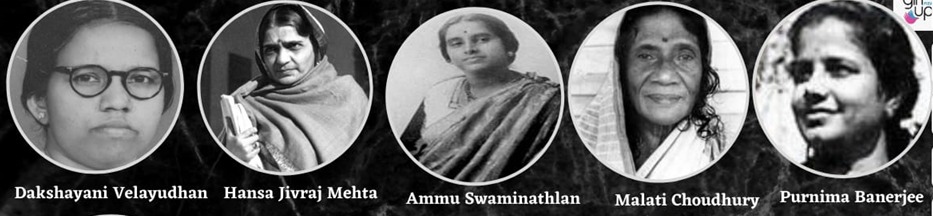
- Hansa Jivraj Mehta fought for gender equality. She was pivotal in drafting the Fundamental Rights and ensuring that gender justice was central to constitutional debates. She was born on 3rd July 1897. She contributed remarkably as a social activist. She was politically very active. She envisioned ‘reform’ as a crucial tenet for social upliftment and fought for India’s Independence. On 15 August 1947, a few minutes after midnight, Mehta, on behalf of the “women of India”, presented the national flag to the assembly—the first flag to fly over independent India. She served as the vice-chairman of the Human Rights Commission of the United Nations in the year 1950.
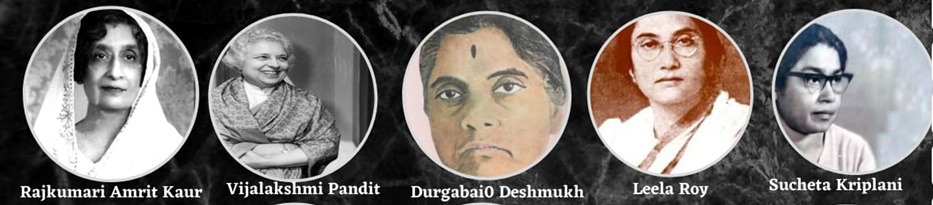
- Rajkumari Amrit Kaur, along with Hansa, modelled the Indian Women’s Charter of Rights and Duties, and fought for the Uniform Civil Code (UCC). She recognised herself as a feminist and worked extensively in the women’s movement that pushed for the abolition of child marriage (the Sarda Act), the Devadasi system, for better educational opportunities for women, and personal
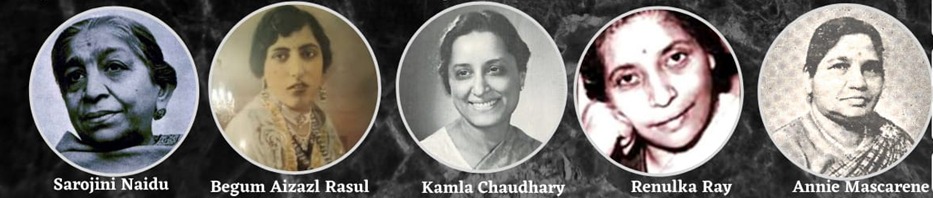
law reforms. She also initiated a number of Constituent Assembly debates, trying to make the UCC a justiciable part of the constitution. Mehta, Rajkumari Amrit Kaur, Ambedkar, and Manoo Masani were in strong opinion of UCC being a part of the state’s responsibility to form a single Indian identity over the multiple and often clashing cultural and religious identities. However, their motion to pass this as a Right was overturned. - Sarojini Naidu, the legendary (the “Nightingale of India”) championed civil liberties and labor rights:. is possibly one of the most famous names from the drafting committee. She is popularly called the ‘Nightingale of India’. She was the first Indian woman to be president of the Indian National Congress and to be appointed as Governor to a State. Besides her exemplary work in the field of women’s empowerment, she was known for her literary prowess and was
elected as a member of the Royal Society of Literature. The Royal Society of Literature is a learned society founded in 1820 by King George IV, to “reward literary merit and excite literary talent”. - Ammu Swami Nathan has struggled to uplift women workers. She was born on the year 22nd April 1894. She was a fierce advocate for gender equality and justice. She was later elected as a member of the Rajya Sabha from Madras State. She was a bold and fearless woman, a remarkable social worker, and a politician. Among various achievements, her role on various economic issues and problems of women workers was quite notable. She was quite active in India’s struggle for Independence.
- Malati Choudhury was a staunch ‘Gandhian’. She was born on the year 26th of July 1904. She fought for Indian civil rights. She fought for the cause of oppressed members of society with untiring zeal. She later on also joined the
‘bhoodan movement’ organized by Acharya Vinoba Bhave. She was very active and trenchantly raised her voice against the ’emergency’. - Dakshayani Velayuudhan was the only Dalit woman to be elected to the Constituent Assembly; she served as a member of the assembly. She also happened to be the youngest member of the committee at 34.She was born on 4th July 1912. She belonged to the Pulayar Community. She Velayudhan’s life and politics were influenced and defined by the rigid caste system. She contributed to breaking the rigid caste oppressions, especially helping in the empowerment of Dalits. She always worked for social reform & marginalized
Voices. Dakshayani gave a voice to marginalized communities and spoke out against untouchability. - Durgabai Deshmukh focused her energy on social welfare and advancing women’s education. was the only female member of the Panel of Chairmen in the Constituent Assembly. She played a significant role in the enactment of many social welfare laws. She was also the one who proposed Hindustani (Hindi+Urdu) as the national language of India.
- Annie Mascarene played a major role in discussions around federalism and national unity. She was one of the first women to join the Travancore State Congress and became the first woman to be part of the Travancore State Congress Working Committee. She was one of the leaders of the movement for independence and integration with the Indian nation in the Travancore State.
- Begum Qudsia Aizaz Rasul—was the only Muslim woman among the fifteen and was elected from U.P. in the Constituent Commmittee of India. Coming from a family of influential taluqdars of Oudh (UP), she was one of the few women who successfully contested from a non-reserved seat and was elected to the U.P legislative assembly. In her lifetime, she was always active in the political scenario. She was elected to the Rajya Sabha in 1952. Between 1969 and 1971, she was the Minister for Social Welfare and Minorities. In 2000, she was awarded a Padma Bhushan for her contribution to social work. She was a women’s hockey player who fought for reservations. Born on 2nd April 1909, she was the daughter of Sir Zulfiqar Ali Khan. She was very instrumental in leading the consensus amongst the Muslim leadership to give up the staunch demand for reserved seats based on religious minorities. She was against the concept of ‘separate minorities’ for Muslims.
- Vijaya Lakshmi Pandit brought an international perspective, emphasizing the importance of global cooperation. She was the sister of Jawahar Lal Nehru and her political career had started early and she served a total of three jail sentences under British rule. She was appointed as the first woman and became the first Asian to be elected President of the U.N. General Assembly in 1953.
- Sucheta Kripalani, who later became India’s first female Chief Minister, advocated strongly for labor rights. Sucheta Kriplani came from the present-day Haryana and is celebrated for her pivotal role in the Quit India Movement
in 1942. She was also responsible for establishing the Women’s Wing in the INC in 1940. She was the first woman Chief Minister of India when she took over the office from Chandra Bhanu Gupta (Uttar Pradesh) in 1963. - Purnima Bannerjee, was perhaps one of the most strong-headed women elected from Allahabad (present-day Prayagraj), Uttar Pradesh and worked extensively towards rural engagement. She took part in the Salt March and the Quit India Movement and was subsequently imprisoned.
- Renuka Roy, hailed from West Bengal and was a strong advocate for gender equality. Renuka argued for a uniform personal law code, stating how the position of Indian women was iniquitous.
- Leela Roy was a feminist who, time and again, had protested and fought for what was right. From a young age, she threw herself into social work and education for girls, supported vocational training and emphasised the need for girls to learn martial arts to defend themselves. Over the years, she set up a number of schools and institutes for women.
- Kamla Chaudhary had come from an affluent family in Lucknow but had struggled to get an education. She was one of the most active women in the Civil Disobedience Movement in 1930. The British government jailed her several times. In 1946, she was made the Vice President at the 54th conference of the Congress held in Meerut. She was a member of the Constituent Assembly from 1947 to 1952, and she was also a prolific writer and wrote extensively on gender discrimination, exploitation of peasants, and the poor condition of widows in society.
Our dreamland, ‘We, the people of India’, with this well-built Preamble of the Constitution of India, forever continues to be a powerful opening preambular statement with which this document reveals itself, in spite of several unconstitutional amendments. The fact that this country chose to be a ‘sovereign, democratic, republic’ has been realized, and two phrases, ‘socialistic and secular, ‘ were added that were culled out of the characteristics that cannot be removed. (Courtesy, art designs of the above 9 pictures are used, with thanks, to Drishti website, indicated as d SHORTS, https://www.drishtiias.com/blog/women-of-the- drafting-committee-of-the-indian-constitution https://www.facebook.com/watch/?v=2085141928981321)
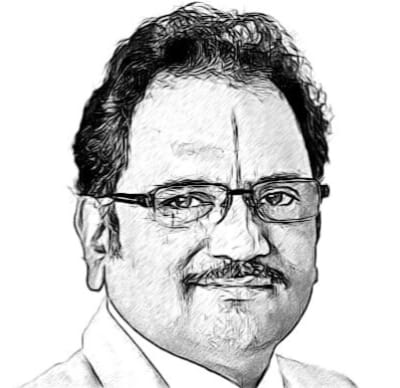
Law professor and eminent columnist
Madabhushi Sridhar Acharyulu, author of 63 books (in Telugu and English), Formerly Central Information Commissioner, Professor of NALSAR University, Bennett University (near Delhi), presently Professor and Advisor, Mahindra University, Hyderabad. Studied in Masoom Ali High School, AVV Junior College, CKM College, and Kakatiya University in Warangal. Madabhushi did LL.M., MCJ., and the highest law degree, LL.D. He won 4 Gold Medals at Kakatiya University and Osmania University.
Email: cicsridhar@gmail.com
Mobile: 8447651505