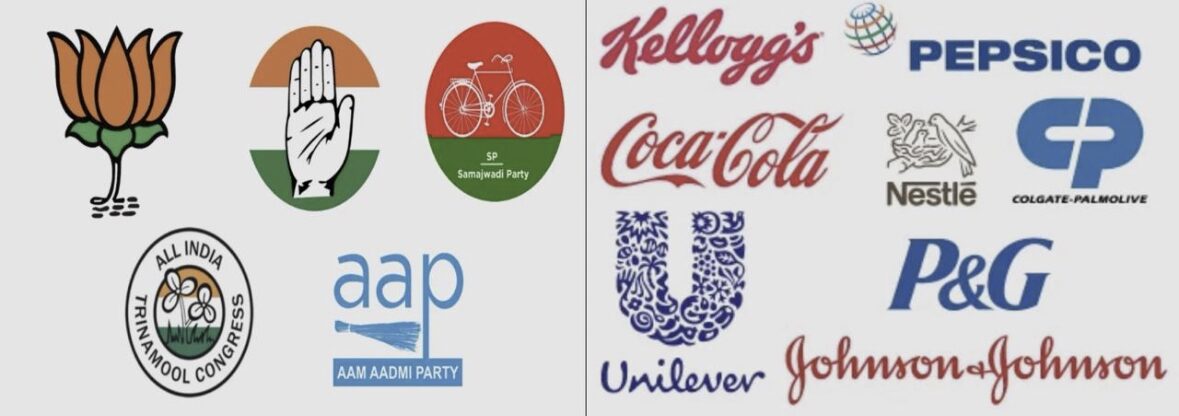
In today’s competitive landscape, the similarities between political campaigns and ‘Fast-Moving Consumer Goods (FMCG)’ product launches are striking. Nowadays elections begin to look like structured market launches.
Data is the New Play Book
Political parties begin with the ‘voters’ list’, booth-wise analysis, demographics, and swing constituencies.
FMCG companies depend on Nielsen Data & retail audits to track penetration, consumption, and growth pockets.
Buying data cannot ensure winning.
Data may inspire, but proper analytics & execution decides outcome
Focussed Hierarchy Wins the Battle Ground
A political party’s machinery from high command to booth worker mirrors an FMCG organisation’s CEO-to-salesman structure.
Strategy is crafted at the top, but execution happens at the ‘last mile’.
A disengaged booth worker or an unmotivated salesman can nullify even the best-laid plans
Investments Decide Seriousness
Political campaigns require heavy investments for logistics, digital war rooms, travel, volunteers, and media.
FMCG launches, demand budgets for R&D, advertising, trade margins, and distribution expansion.
Money alone doesn’t guarantee success; allocation and timing do.
Overspending in the wrong constituency or market, doesn’t help to gain share & value
Activations Create Acceptance
Politics: Padayatras, rallies, and door-to-door campaigns.
FMCG: Sampling, road-shows, retailer meets and in-store promotions.
These will help to communicate Ideology or Product Information
Ultimately, awareness converts participants into votes or product trials
Media Is the Loudest Campaigner
Political media plans include TV debates, print, social media, influencers, and WhatsApp narratives.
FMCG brands respond with TVCs, digital ads, outdoor media, and retail visibility.
In both cases, creativity & frequency matters.
If people don’t see you uniquely & frequently, you are forgotten
Freebies vs. Schemes
Free electricity, ration cards, or cash transfers in politics resemble price-offs, extra grammage, and “Buy One Get One” (BOGO) schemes in FMCG. These tools accelerate adoption but rarely build long-term loyalty.
Sustainable success increases on belief, not just on benefits
ROI Is the Real Scorecard
Political strategists increasingly track rally-to-ballot conversion and booth efficiency.
FMCG marketers measure Return on Advertising Spend (ROAS), cost per trial, and scheme effectiveness.
High cost with weak conversion is an expensive failure
Small Margins, Big Outcomes
For a political party, a 1-2% swing in vote share can change a government. Similarly, a half-percentage gain in market share can add hundreds of crores of rupees to an FMCG company’s revenue.
Leadership Strategy will be admired when both volume & marginal gains are achieved.
Records are built on small or big, but consistent swings
Saturation and Fatigue
Over-campaigning or anti-incumbency can lead to voter fatigue. Over-promotion in FMCG erodes margins and dilutes brand equity.
In saturated environments, growth comes from ‘differentiation and diversification’.
Political parties articulate long-term national visions beyond election cycles.
FMCG companies pursue category expansion and rural-reach strategies.
Short-term gains ensure survival, but having long-term strategy is much desired
Conclusion
Modern politics increasingly mirrors FMCG marketing in structure, execution, and economics.
One sells Leadership, the other sells Products, but both compete for trust, attention, and loyalty.
Whether it is a ballot box or a shopping basket, the decision ultimately rests with highly influenced voter or consumer.
Business Correspondent
Ananth Peravally is a Sales & Marketing professional with over 30 years of experience in the FMCG sector. He has worked across leading Indian and multinational organizations, including Parle, Kellogg’s, Godfrey Phillips, GEF, and Bunge. He has been instrumental in the launch, growth, and turnaround of key brands, notably Kellogg’s Chocos, GPI’s Four Square Cigarettes, GEF’s Freedom Rice Bran Oil, Bunge’s Fiona Sunflower Oil in different states of South & West India. He holds a Bachelor of Arts degree and PGDMM. Expert in brand building, go-to-market strategy, and sales execution in competitive consumer markets.
Email: ananthperavally@gmail.com
Mobile: 9391054297


Loved how clearly you showed the shift from ideology to branding, segmentation, and recall. Insightful, sharp, and slightly unsettling (in a good way). Well done! Keep posting more. Best wishes.
Thanks KS for your feedback
I really appreciated the way you connected booth-level workers (politics) with sales officers (branding and segmentation). The thought process is very well-structured—neat, clear, and crisp.
Sir ji, thanks
A very thought provoking read. Really liked how you drew parallels between modern election practices and FMCG launch/procedures presenting the nuanced argument so clearly. Very well articulated. Thoroughly enjoyed reading this piece.
Simple and good analogy Ananth. Politics purpose is public service and marketing is part of business. I guess politics is tougher than brand marketing as in politics, target audience is very wide cuts across all sections of society. Usually, marketing is focused on certain target. However, in both the cases chances of winning is less than 50% and both have to work keeping in view of very long term in mind.
Thanks for your valuable feedback Sir.