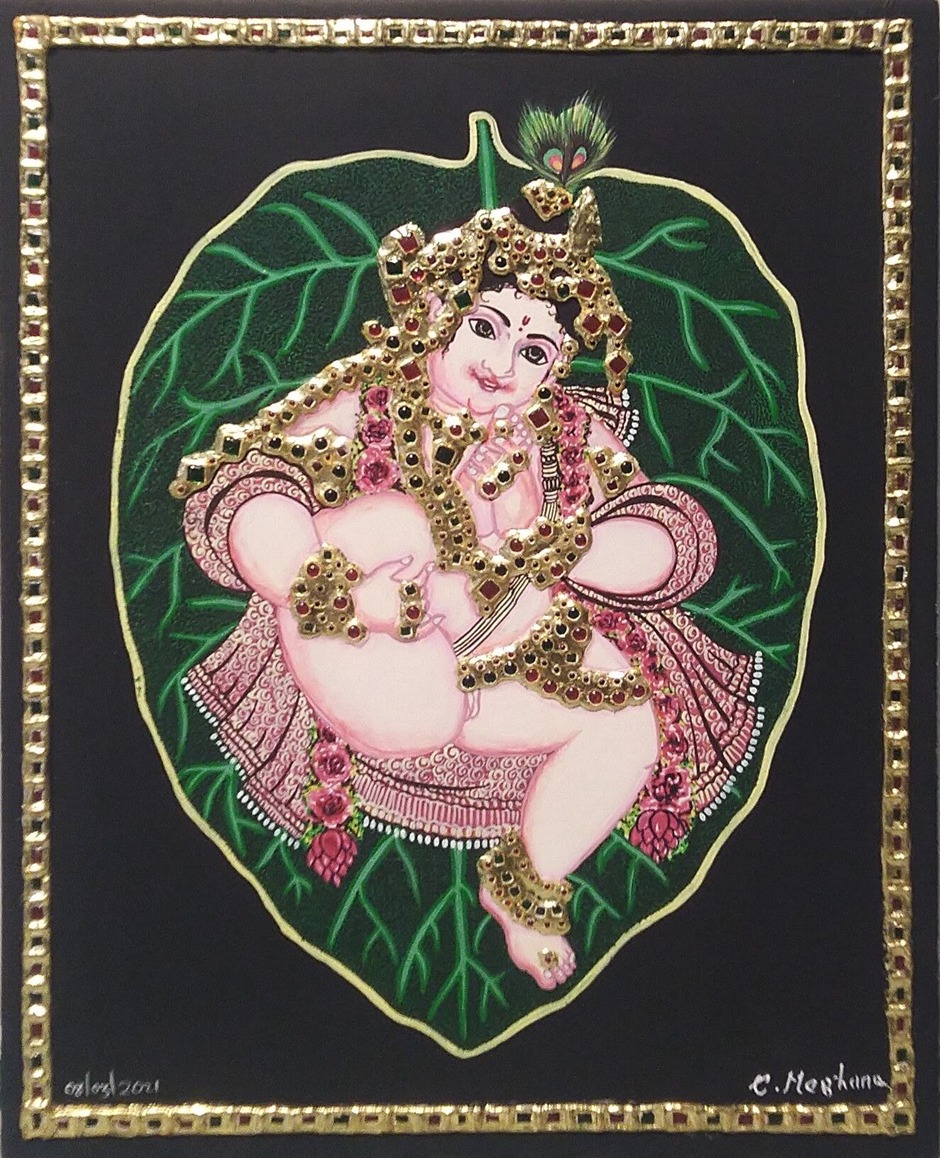
Goda Devi’s Tiruppavai (Tamil)
Maaley! Manivanna! Maargazhi Neeraaduvaam
Melaiyaar Seivanangal Venduvana Kettliyel
Gnalath-thai Ellam Nadunga Muralvana
Paalanna Vannathu un Paanchajanyamey
Polvana Sangangal poi-p-paadu Udaiyanave
Saalap-preum Paraiyey Pallaandu Isaipparey
Kola Vilakkey Kodiyey Vidhaaname
Aalin Ilayai! Arul-el or empaavai
English Translation by Madabhushi Sridhar
Lord on Banyan Leaf, like lively Blue Sapphire,
We came up with best practices for Margali Bath.
If You listen, we tell our desire: Grant the Conches
Like your milky white, resounding Panchajanya
That sends spine-chilling terror in enemies and
Free your devotees from fear; Big Drums to
Attract many, melodious Singers; Bright Lamps
Flags & Decorative cloths to hail your glory.
Relationship rooted in love
The twenty-sixth pasuram of Tiruppavai is one of the most philosophically rich and emotionally intense hymns of Andal. In this hymn, the collective voice of the Gopikas reaches the height of surrender, where devotion is no longer expressed through effort, ritual, or bargaining, but through complete dependence on the grace and affection of Sri Krishna. This paasuram is not merely poetic; Andal explains it is deeply philosophical, presenting the core Srivaishnava understanding of surrender, divine accessibility, and loving service.
Cosmic Vision and Divine Capability
The paasuram opens with a majestic cosmic image. Vishnu is described as resting like a radiant blue sapphire on a banyan leaf at the time when the entire universe stands on the edge of dissolution. This image conveys supreme power combined with effortless ease. Sri Krishna holds countless universes within Himself, yet appears as an innocent child, untouched by the weight of creation. By invoking this vision, the Gopikas affirm that nothing is impossible for Him. If He can preserve the cosmos during destruction, granting their simple requests is surely within His power.
The Meaning of the Sacred Bath in Margasirsha
The holy bath of the winter month is not presented as a physical ritual alone. Andal elevates it into a spiritual metaphor. The true bath is associated with Krishna himself. To bathe in His presence means to immerse oneself in His grace, compassion, and remembrance. The Gopikas seek not ritual purity, but divine closeness. Their vrata is therefore an inner discipline of love and surrender rather than an outward observance aimed at rewards.
Approaching God Through the Path of Elders
The Gopikas declare that they have come following the path shown by the elders. This establishes an important principle for spiritual life. One should not invent new paths driven by ego or novelty, nor act against the wisdom of those who have lived before. At the same time, Andal does not promote blind imitation. From the practices of elders, one may adopt what is suitable for one’s own context and welfare. The strength lies in conviction: when questioned, one should be able to say that the path followed is rooted in tested wisdom, not personal whim.
What the Gopikas Ask For – and What They Do Not
The Gopikas ask for conches, big drums, bright lamps, flags, decorative cloths, singers, and protective coverings. These are not objects of luxury or power. They are instruments of worship, community, and guidance.
Significantly, they do not ask for the divine discus (Chakram), the weapon of destruction. Power belongs to Maha Vishnu alone; devotees seek reassurance, identity, and fearless devotion.
- The conch (Shankh) represents sacred sound and assurance.
- Its white radiance calms devotees while instilling fear in negative forces. The drum (Parai) represents collective calling and joyful participation.
- Lamps symbolize inner clarity and guidance.
- Flags and decorations express dignity and celebration in service.
Together, these requests show spiritual maturity: the desire is not to control destiny, but to live in God’s presence with confidence and joy.
Why Divine Weapons Are Not for Everyone
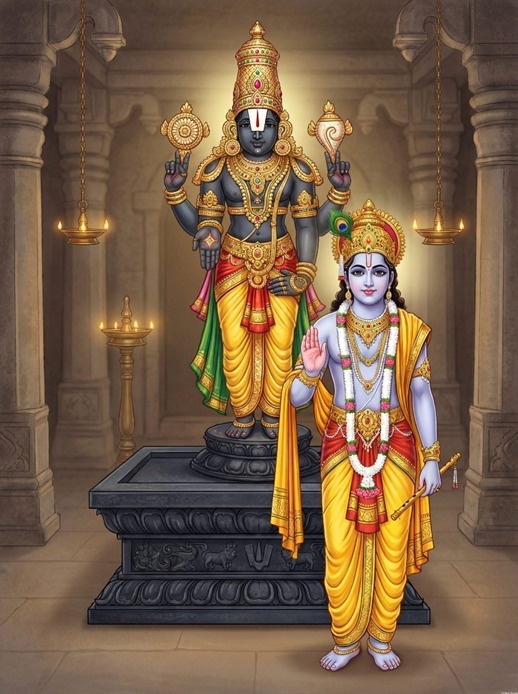
Sacred tradition repeatedly warns that divine weapons cannot be handled by the unqualified. The story of Krishna’s childhood friend, who insisted on receiving the discus (Chakra Ayudha), despite warnings, ends in tragedy due to misuse. Similarly, weapons like the Brahmastra caused devastation when used by undeserving hands, for instance, Ashwatthama. When Vishnu appears before Subrahmanya Swamy, who performed penance on the banks of Pushkarini in Tirumala (hence the name Swami Pushkarini), Shiva also appears to meet Vishnu. Attracted by the environmental beauty of Tirumala Hills, Shiva expressed a desire to stay there. Vishnu says that the entire Tirumala Hills is the Adishesha, his bed and cot, and Shiva can reside at the serene endpoint of Tirumala Hills, which is now known as Kapila Teertham. This place is very sacred with the spring of divine water flowing from Tirumala Hills, where Alwars used to stay and take a bath. Hence, it is also called Alwar Theertham. Shiva, being a great friend of Vishnu, also desired to have the Chakra – Disc of Vishnu. Vishnu did not give because of the risk involved. Sankh and Chakra of Vishnu generally cannot be handled by others. The conch – Sankh is so dear to Vishnu that He cannot imagine life without it. Hence, Gopikas wanted Vishnu to be always with them.
These narratives reinforce the wisdom of the Gopikas: they choose the conch of surrender, not the discus of power. Even great divine companions desired the discus, but Vishnu withheld it out of compassion, knowing the risk involved. The conch and discus are inseparable from Him, yet the conch symbolizes closeness and companionship, while the discus represents authority and destruction. By asking for the Shankham, a Conch, the Gopikas express their wish that Vishnu should never be separated from them.
Maale and Manivanna – Divine Love Beyond Measure
Andal addresses Krishna as Maale and Manivanna, names rich with affection. These words convey that God’s love for devotees exceeds the devotees’ love for Him. Divine compassion is not a response to effort; it is self-generated and overflowing. Stories from the epics illustrate this truth. Rama accepted and protected those who sought refuge without suspicion. Krishna served as a charioteer for His devotees, performing the humblest tasks despite being an unparalleled warrior.
The Lord’s love is described as self-luminous, like a precious blue gemstone that shines by its own nature. This love is reflected in His very form and color. He constantly thinks of how to help those who depend on Him. His greatness lies not in distance, but in intimacy.
The Mother’s Name and Divine Playfulness
Manivanna was also the affectionate name used by Yashoda. When the Gopikas address Sri Krishna with this maternal name, He is pleased. Though he pretends indifference, He smiles inwardly and invites them to speak freely. This scene reveals an important truth: there is no bargaining with God. The Gopikas have not performed their vrata to obtain rewards. They seek Krishna himself, His presence, His affection, and the joy of singing His glory.
Krishna’s Madness of Love
Krishna was born to one family and raised in another, only to immerse Himself in the life of the Gopikas. Their longing and His longing mirror each other. He makes them yearn for Him, while He Himself yearns for them. Divine love here is mutual, intense, and overflowing. He is described as the embodiment of love itself. Like a precious gem that sustains others but needs nothing for itself, Sri Krishna becomes the very life of those who possess Him.
Symbolic Fulfillment of the Requests
Sri Krishna reflects on the Gopikas’ requests and responds symbolically.
- He offers a conch from His temple, a musical instrument associated with His playful life in the pastoral village, and brings divine singers into their midst.
- For flags, He sends His divine companion, who represents movement and service. For covering and protection, He offers His own cloth.
- For light, He grants the presence of the divine mother, whose radiance equals His own.
- Through these gifts, He fulfills not only their spoken requests, but their deeper longing for divine association.
Connection to the Ultimate Teaching of Surrender
This paasuram reflects the essence of the supreme teaching of surrender: abandon all self-reliance and take refuge in the Lord alone. The promise is clear and unconditional: freedom from fear and responsibility for the devotee’s welfare rests entirely with Sriman Naaraayana. The holy bath of the winter month thus becomes a symbol of living constantly in divine presence.
Loving dependence on Sri Krishna.
Tiruppavai Pasuram 26 marks the transition from effort-based devotion to grace-centered spirituality. This song of Goda symbolizes the Charama Shloka –
Sarva Dharmaan Parityajya Maam Ekam Sharanam Vraja,
Aham Twa Sarva Paapebhyo Moksha Yishyami Maashuchah.
- It teaches that the highest spiritual achievement is not power, knowledge, or even liberation, but loving dependence on God.
- Through simple requests and profound symbols, Andal reveals that true fulfillment lies in belonging completely to the divine, with fearlessness, joy, and shared celebration.

Law professor and eminent columnist
Madabhushi Sridhar Acharyulu, author of 63 books (in Telugu and English), Formerly Central Information Commissioner, Professor of NALSAR University, Bennett University (near Delhi), presently Professor and Advisor, Mahindra University, Hyderabad. Studied in Masoom Ali High School, AVV Junior College, CKM College, and Kakatiya University in Warangal. Madabhushi did LL.M., MCJ., and the highest law degree, LL.D. He won 4 Gold Medals at Kakatiya University and Osmania University.
Email: cicsridhar@gmail.com
Mobile: 8447651505



Jai shri krishna 🙏
Radhe Radhe🙏