Sri Rama, Sri Krishna, we hail thy feet
Tiruppavai by Godadevi from Tamil
Andri Ivvulagam Alanday, Adi Pottri
Sendru Angu Ththenn Ilangai Chettray, Thirall Pottri
Pondrachchagadam Udathaai, Pugazh Pottri
Kandru Kunilaai Erindhaay, Kazhalpottri
Kundru Kkudaiyai Edutthaay, Gunam Pottri
Vendru Pagai Kedukkum Nin Kaiyyil Vel Pottri
Endrendrum Un Sevakamea Ethiparai Kolvaan
Indru Yaam Vandhom Irange Lorempaavaai.
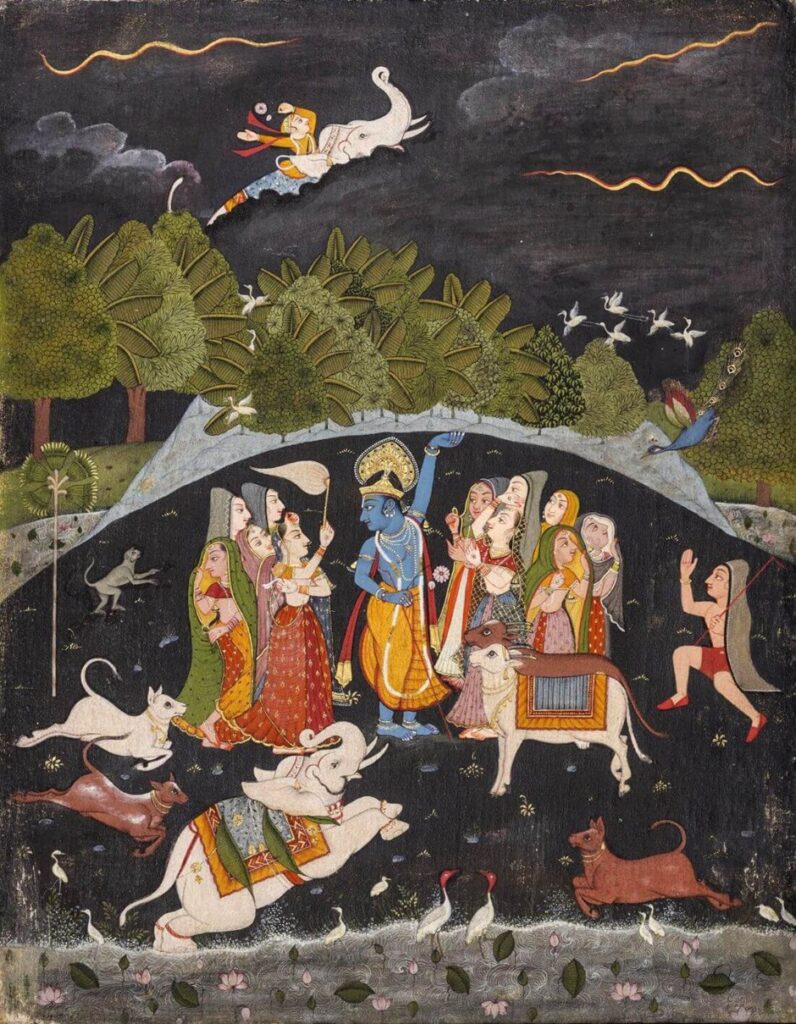
English Translation by Madabhushi Sridhar
Hail thy feet that mapped the entire world in two steps,
Hail thy valor that vanquished Lanka’s king in the south,
Hail thy fame that kicked off the demon-cart,
Hail thy pose of throwing the calf away at the fruit, killing two demons,
Hail thy generosity that lifted a hill like an umbrella,
Hail thy spike that destroyed the enemies,
Hail thy bravery, to obtain the desired parai,
Came now, for Bliss and Blessing, for our Vrata.
Sri Krishna: Alone Is the Protector of the Universe
When the Gopikās called Him, Śrī Kṛṣṇa rose from His resting chamber and walked majestically — sometimes like a lion, sometimes with the grandeur of an elephant — and ascended the throne. Nīḷā Devī came up to the doorway, offered auspicious benedictions, and seated herself beside Him on the throne. As the Lord placed one foot on the footstool and the other upon His thigh, His divine foot appeared reddened, as if bruised.
“Oh no,” thought the Gopikās, “Have we caused strain to the Lord’s feet by making Him walk?”
Pada-Padaartha (Word-by-word sense – condensed)
- Anṟu – On that day
- Iv-ulagam aḷandāy – You who measured these worlds
- Aḍi pōtti – Auspiciousness to Your divine feet
- Senṟu angu ten-ilangai seṟṟāy – You went there and destroyed beautiful southern Lanka
- Tiṟal pōṟṟi – Auspiciousness to Your valor
- Poṉṟa śakaṭam udaithāy – You kicked and destroyed the deceitful Śakaṭāsura
- Pugaḻ pōtti – Auspiciousness to Your glory
- Kaṉṟai kuṇilā eriṉdāy – You whirled Vatsāsura like a spinning top and hurled him away
- Kaḻal pōtti – Auspiciousness to the posture of Your feet
- Kuṉṟu kuḍaiyā eḍuttāy – You lifted Govardhana as an umbrella
- Kuṇam pōtti – Auspiciousness to Your forbearance and grace
- Venṟu pakai keḍukkum kaiyil vēl pōtti – Auspiciousness to the spear in Your hand that destroys enemies
- Enṟenṟu un sevagamē ētti – Thus praising Your heroic deeds again and again
- Iṉṟu yām vandōm – Today we have come
- Iraṅgēl ōr empāvāy – Please show compassion; this alone is our sacred vow
Narrative Meaning
The Gopikaas felt remorse that they had caused fatigue to Sri Krishna’s feet by summoning Him from His chamber. They reflected that in the past, whenever the Lord endured hardship for the sake of devotees, no one had sung auspicious benedictions or warded off evil glances. They now felt compelled to correct that lapse. In truth, they desired nothing but to glorify the Lord’s virtues. Outwardly, they asked for the paṟai (a ritual drum), but inwardly, their longing was only to sing His praise forever.
They remembered:
- How His feet turned red merely from Lakṣmī Devī gently massaging them.
- How bruised they must have been when, as Vāmana, He measured earth and sky with two strides.
- How much pain His feet endured while walking through demon-infested forests as Rāma.
- How tender His feet were when He kicked Śakaṭāsura at just seven days old.
- How firmly He planted His feet to hurl Vatsāsura against another demon.
- How His little finger bore unimaginable strain while holding Govardhana for seven days.
“Who sang auspicious blessings for those feet then?” they wondered. “If no one did, let us do it today.”
They also remembered Rāma’s fearless journey to Lanka — crossing every fortress, confronting Rāvaṇa in his own stronghold, giving him chance after chance to repent before finally slaying him. To that invincible valor, they sang maṅgala. They sang auspiciousness to His weapon — the spear in His hand — not because He needs protection, but because love demands it. Thus, they offered benedictions for each heroic act.
Why This Maṅgalāśāsana?
Goddess Godā ties a protective thread and sings auspicious hymns to the Lord’s feet. Though He protects the universe, she longs to protect Him. This is nothing but love. Just as elders ward off the evil eye for a bride, groom, newborn child, or one dressed in finery, devotees offer ārati and maṅgalam to the Lord’s image and during festivals. Āḻvārs sang such benedictions; their shrines became Divya Deśas. Godā Devī assumes the loving roles of Yaśodā, Devakī, Kauśalyā, and Aditi. Feeling that no one had sung maṅgala to the Lord at crucial moments of His divine toil, she pours out her love through this pāsuram.
Inner Reflection
Once one knows that the Lord alone protects the universe, how can harm reach Him? How can He suffer? Yet love overtakes knowledge. In the height of devotion, the devotee forgets God’s omnipotence and worries for Him instead. This is not ignorance — it is supreme love.
Avatāra Reflections
As Vāmana, His feet bruised while measuring the rugged worlds. As Rāma, He walked through forests and fought endless battles. As Kṛṣṇa, enemies surrounded Him from birth. Though He is the inner ruler of Indra, He lifted Govardhana to humble Indra’s pride and protect the cowherds. Each act invited loving anxiety, and thus maṅgala.
From Periyāḻvār to Godā
Periyāḻvār sang Pallāṇḍu, fearing that the Lord’s dazzling beauty might invite harm. Godā inherits that same madness of love and expresses it here. Just as Dhānurdāsa once followed the Lord’s procession with a dagger ready to give up his life should harm come to Him, the Gopikās too wish to guard the Guardian Himself. This pāsuram overflows with that love.
Structural Analysis
Tiruppāvai 24 comes after the “Lion-Throne Pāsuram” and becomes the Maṅgalāśāsana Pāsuram. This is not prayer, not petition, not philosophy; it is overflowing love offering protection to God Himself.
Parārtha (Devotional Meaning) The Gopikās list the Lord’s divine feats — Vāmana, Rāma, Kṛṣṇa — not to glorify power, but to lament His unacknowledged toil. The paṟai they seek is the instrument of eternal praise, not a material reward.
Viśeṣārtha (Symbolic Meaning)
- Śakaṭāsura – destruction of karmic bondage
- Vatsāsura & Kapitthāsura – annihilation of sensory obsession
- Lanka – egoic fortress of the mind
- Govardhana – refuge granted through surrender
The Lord does not merely defeat external enemies; He dismantles inner bondage.
Śrī Vaiṣṇava Tattva
(a) Sarveśvaratva + Sauśīlya: The Supreme Lord, though omnipotent, submits to devotees’ love.
(b) Reversal of Rakṣaka–Rakṣya Bhāva: In mature devotion, the Protector becomes the Protected. This is not ignorance — it is parabhakti.
(c) Maṅgalāśāsana Tradition: From Periyāḻvār’s Pallāṇḍu to Godā’s Tiruppāvai, Śrī Vaiṣṇavism celebrates love bold enough to bless God Himself.
Philosophical Essence
- Knowledge says: He protects the universe
- Love says: Let no harm touch Him
Their union is Tiruppāvai 24.
One-line Essence “The pinnacle of devotion is the love that longs to protect the One who protects all.”

Law professor and eminent columnist
Madabhushi Sridhar Acharyulu, author of 63 books (in Telugu and English), Formerly Central Information Commissioner, Professor of NALSAR University, Bennett University (near Delhi), presently Professor and Advisor, Mahindra University, Hyderabad. Studied in Masoom Ali High School, AVV Junior College, CKM College, and Kakatiya University in Warangal. Madabhushi did LL.M., MCJ., and the highest law degree, LL.D. He won 4 Gold Medals at Kakatiya University and Osmania University.
Email: cicsridhar@gmail.com
Mobile: 8447651505