Bhakta Pothana in Goda’s song
Tiruppavai by Godadevi from Tamil
Anganmaa Gnaalaththarasar Abhimaana
Bangamaai Vandhu nin Palli-k-kattilkeezhay
Sangam Iruppaar pol Vandu Thalaip-peydom
Kinkini Vaai Seidha Thaamarai Poo-p-Poley
Sengansiru-ch-chiridhey Emmel Vizhiyaavo!
Thingalum Aadhityanum Ezhundaar Pol
Angand Irandum Kondu Engal Mel Nokkudiyel
Yengal Mel Shaapam Nirande-Elorempaavaai
English Translation by Madabhushi Sridhar
Under Your Umbrella & Feet, We,
Kings of Large Earth Gathered.
Shedding Ego, crowding around You!
Give a glance at the ankle trinket, blooming lotuses,
With Eyes of Sun & Moon, at a time,
Gradual opening of eyes a little, and a little after
Wash off our sins and curses. Girls’ sans vanity
Please see us and hear our pleas, consider, and bless.
The British believed that the Sun would never set in their dynasty. Hitler thought he could win the whole world. Alexander was confident of winning the entire Globe. Where are they? Only three have shown no desire for kingdom and dynasty – Rama, Bharatha, and Siddhartha among our Indian traditional historical stories. No king will step down easily. They must be pulled down with force.
Bhakta Pothana in Goda’s song
When Narayana comes in the guise of a Brahmin boy seeking Biksha (donation), Rakshasa-Guru Shukra warns King Bali not to give anything to Him. But Bali says many kings come and go. They do not take the wealth with them to a different world… I will give and retain a permanent place in history. A small king slaps a sedition case against Bhaktha Pothana for not dedicating his Bhagavatham to him. No one knows now who that king was. Pothana has remained eternal. Any king who slaps false cases on knowledge and education or art and poetry with a Royal heavy ego will not remain or be remembered forever.
If a king thinks that it was his achievement, God will not bother about it. As long as it is comfortable, the King will enjoy his pride. Once the fall starts, God will just watch the fall of that King along with his possessions. If the King thinks that it was given for a purpose as a matter of service, he will not have any problems. Annamayya had a similar experience when he joined the royal court. He was happy when he left those egoistic rulers.
All those kings of big dynasties realized the futility of their royalty, shed their ego, and came under your feet, umbrella, and refuge. Goda and Gopikas tell Krishna: We also shed our love or pride for our bodies and came like them to seek Your refuge.
We seek your kind blessings. Please let us see your gradually opening of lovely eyes. If you open your eyes all of a sudden, you cannot bear the sight. Just as a lotus opens its petals slowly, Siri Siri Muvva is half-open, with a small ball inside. Please present your cool looks. Your eyes are like the Sun and Moon- they are hot and burning for the enemies and cool for devotees like us. With the effect of your generous, blissful looks, all our curses will be burnt, and that is the real purpose of our Vratam.
Brahma or Ant, Ego is sure
The smallest ant and the largest Brahma will have Ego in their own proportions. The ant thinks great and feels that everything that is created is by her and for her. Even Brahma has to struggle for Moksha. Brahma thinks that it was he, with his energy and effort, who created this entire universe. He has to shed all these feelings and surrender all to Him to achieve liberation. A simple man who has nothing can gain liberation with greater ease, unlike Brahma. If one thinks all is given by Him and one has no role in it, there are no issues to worry about. He has nothing to give or do. God stands by him. One who leaves everything without abandoning his duties is doing real Saranagati, and God takes care of him. For the ant, it is easy to get Mokhsa.
Kingdom goes, Pride remains
Once a king, after ruling and enjoying the pleasures of Royal life, lost all his wealth and found it difficult to get food twice a day. Though the kingdom is lost, his ego remains. He feels ashamed to beg in the day, fearing that people might identify him. He picks up a piece of pot and starts begging in the night. While he walks under the extended roofs of houses to avoid someone identifying him, he steps on a dog which just given birth to puppies. It bites the former King. Crying, the King drops the pot, making a big noise. People around come out with lamps and recognize him. His pride is affected again. You get ego when you get a kingdom. Kingdom goes, but not the pride. You try to hide the pride, get disappointed, depressed, and defeated. Desire for the kingdom is a disease, for which you do not hesitate to lose your wife, brothers, and friends, and there is no medicine to cure it. Kingdom destroys your knowledge about yourself. Surrender to Him, shedding ego, says Nammalwar.
The women generally feel that to go to men on their own. They have shed such feelings and reached out to Sri Krishna. And they say, we came like those kings who surrender at your bedside, near your feet.
Bharatha never desired a Kingdom. He was not interested in it. Once, Kaikeyi addressed him as Rajan. Unable to bear it, he fell unconscious. Guha and Bharadwaja suspect his intentions when Bharatha went to Rama in exile. He had to take pains to let them know his disinterestedness in the kingdom and his desire to take Rama back to Ayodhya. Lakshman never felt any need to explain to anyone. Because he has great nidhi with him, that is His sannidhi. He is nearer to Rama, serving him and enjoying it.
Why did Jaya, Vijaya stop the Sanaka brothers?
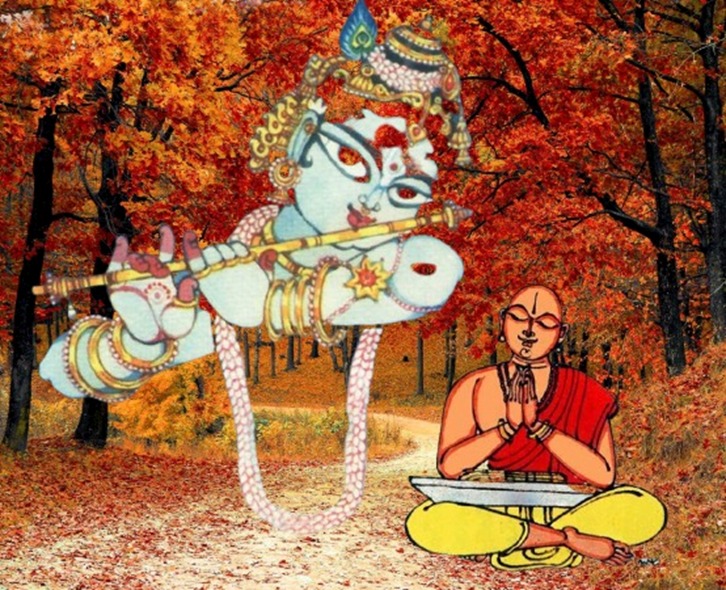
There is an incident similar to that Gopikas wanted Krishna to open His eyes gradually and spread his blissful looks. The doorkeepers of Vishnu in Vaikuntham knew that, like Gopiakas, the Sanaka and Sananda brothers may not bear the powerful first looks of Vishnu when he awakes from the Yoga Nidra, and hence they try to prevent their entry. Gopikas are like the field starved of water. They need a small shower and not heavy rain. His lotus eyes, pink in color, are half-open, like an ankle’s trinket. Krishna’s eyes are like the Sun and Moon. His fiery looks are supposed to punish those who prevent people from reaching Him. And His cool looks would bless the devotees reaching Him. Even then, Goda thinks it is not proper to compare the eyes of Krishna with the Sun and Moon, who are eclipsed frequently. She concludes, finally, His eyes can be compared with His eyes only.
God gets angry when jeevas approach him with the burden of several wrongs. He will not open his eyes fully. Neela keeps a hand on Him and pleads for his generosity, then He opens his eyes. His eyes get closed as Jeeva commits mistakes. Jeevi has to have a strong desire for His blessings, and that effort forms the basis for Neela’s recommendation and finally the blessings of god.
Ananya Gathi
Gopikas say we have no alternative to pursue. You are the only way for our salvation. We are not fighting with you or with anyone other. Kings were defeated in wars. Sometimes they were defeated by your arrows. We are defeated by your glory. We may not need any Jnani to guide us. We are Ajnaanis. We are lucky enough to reach your feet. We cannot go anywhere. Vibheeshana left Ravana when he was kicked out. He did not even visit his family to take them along. He flew with his followers to Rama’s camp on this side of the ocean. He stood in the sky and wanted to visit Rama. He says even if Rama does not accept him, he cannot go back and has no other go. It is called Ananya Gathi, a total lack of alternative routes.
How do you benefit if I look at you, asks Krishna. They say: We will be relieved of the pangs of separation from you. Separation from you is an inevitable curse.
Context of the 22nd Pāsuram in Tiruppāvai
The 22nd pāsuram explains: the discipline of vrata, the destruction of ego (ahaṅkāra) and possessiveness (mamakāra), repeated knocking at the Lord’s door, intellectual, emotional, and existential exhaustion of all self-effort (karma, jñāna, yoga). This pāsuram is not a request for boons; it is a plea for divine glance (kaṭākṣa). In Śrī Vaiṣṇava understanding, God’s glance itself is salvation. Thus, the 22nd pāsuram marks the threshold of complete Śaraṇāgati. The half-open eyes of the Lord symbolize this tension: fully open → unbearable radiance, instant annihilation of karma, fully closed → strict justice, no grace and half-open → grace operating within justice. This imagery is uniquely Śrī Vaiṣṇava and absent in Advaita or Bhakti traditions.
The Central Symbol: Half-Opened Lotus Eyes
Āṇḍāḷ does something radical: She does not ask the Lord to wake fully. Instead, she says: “Open your eyes slowly, gently, gradually.”
Why? 1. Grace must be bearable – Sudden mokṣa without inner readiness would destroy the jīva, 2 Divine mercy is educative, not violent, and 3. God respects the psychological fragility of the soul. This reflects Rāmānuja’s theology, where: liberation is relational, not instantaneous absorption, and the jīva remains conscious, grateful, and servile even in mokṣa.
Śrī Vaiṣṇava Meaning
Kingship symbolizes:
- ego
- autonomy
- false sovereignty
The defeated kings represent:
- souls who tried power, control, dharma, wealth, knowledge
- failed
- finally surrendered
This is why Rāmānuja chose Tiruppāvai as a prapatti text, not merely a poetic hymn.
Ananya-gatitva: “There Is No Alternative”
The repeated assertion: “We have no other refuge.” This is not emotional exaggeration. In Śrī Vaiṣṇavism, even backup plans invalidate śaraṇāgati. Vibhīṣaṇa’s surrender is cited as the archetype. He says: “Even if You reject me, I cannot go back.”
At its heart, the 22nd pāsuram teaches:
- Ego is the real bondage, not karma
- Grace operates when resistance ends
- God does not need to be awakened; we do
- Liberation is not escape, but relationship
- The Lord’s glance is not observation—it is re-creation
Why the 22nd Pāsuram Is Theologically Crucial
In the Śrī Vaiṣṇava tradition, this pāsuram:
- legitimizes Prapatti as an independent mokṣa-mārga
- balances justice and mercy
- explains divine delay without blaming God
- affirms accessibility of salvation
- transforms poetry into systematic theology
It is not merely devotional—it is doctrinally definitive.
Concluding Insight
If the earlier pāsurams prepare the seeker,
the 22nd pāsuram dissolves the seeker.
What remains is:
- the Lord who sees,
- and the soul that is seen.
That moment—when the half-open eyes meet surrendered helplessness—
is Śaraṇāgati fulfilled.
Law professor and eminent columnist
Madabhushi Sridhar Acharyulu, author of 63 books (in Telugu and English), Formerly Central Information Commissioner, Professor of NALSAR University, Bennett University (near Delhi), presently Professor and Advisor, Mahindra University, Hyderabad. Studied in Masoom Ali High School, AVV Junior College, CKM College, and Kakatiya University in Warangal. Madabhushi did LL.M., MCJ., and the highest law degree, LL.D. He won 4 Gold Medals at Kakatiya University and Osmania University.
Email: cicsridhar@gmail.com
Mobile: 8447651505