We need to protect the Constitution of India, Basic Structure, PILs, and the soul of India reflected in the preamble. Who? We, the people of India. What? Resolved. Sovereign Socialist Secular Democratic outlines its core objectives. To secure justice, liberty, and equality for all citizens, and to promote fraternity, ensuring the dignity of the individual and the unity and integrity of the nation. Preamble of the Constitution of India Drafted Drafted by Jawaharlal Nehru, it was adopted by the Constituent Assembly on November 26, 1949, and became effective on January 26, 1950
Moral and Constitutional obligation
The Preamble is an oath. Article 69 of the Indian Constitution outlines the process and form of the oath or affirmation that the Vice-President must take before entering office. The oath is administered by the President or a person appointed by them, and it requires the Vice-President to pledge true faith and allegiance to the Constitution of India and to discharge the duties of their office faithfully.

Similarly, the judges of the Supreme Court are also bound by the pledge or the oath. The oaths serve as a promise to uphold the Constitution, sovereignty, and integrity of India, and to perform the duties of the office without fear or favor. They can be taken either by swearing in the name of God or through a solemn affirmation. It is a commitment of allegiance to the Constitution, ensuring public officials faithfully and impartially discharge their duties, a promise to bear true faith and allegiance to the Constitution, and to perform duties to the best of one’s ability.
While sworn as a moral and ethical duty, taking an oath does not create a legal obligation but is a symbolic and moral commitment to serve the country and its people. If we call it a legal obligation, judges are bound to implement. If it is considered only an oral or ‘moral obligation, can they ignore it? We need to remind the recent judgment of five judges on the matter of the President’s reference, on 20 November 2025. They held:
- Lack of Clarity on “Reasonable Period”: The judgment does not provide a clear framework for what constitutes “prolonged inaction” or a “reasonable period,” which could lead to future litigation and a lack of predictability.
- Challenges in Enforcing Action: While courts can issue a “limited direction” to act, the lack of power to impose a deadline or a “deemed assent” mechanism means that enforcing compliance from a recalcitrant Governor could remain challenging.
- Challenges in Enforcing Action: While courts can issue a “limited direction” to act, the lack of power to impose a deadline or a “deemed assent” mechanism means that enforcing compliance from a recalcitrant Governor could remain challenging. The Center’s Role and Constitutional Democracy “The Indian Constitution has rejected and disagreed with both the Left and Right groups. The centre is destroying left, right, and centre” touches upon the centrist, liberal- democratic nature of the Constitution and the current challenges to it.
- Inclusion & Stability: By not aligning completely with one ideological extreme, the Constitution created a broad, flexible framework capable of accommodating diverse political groups and ensuring stability.
- Best System: Offers a robust system where power is limited by law (Constitution),
ensuring liberty, accountability, and political participation. - Lack of Sharp Direction: Critics from both the Left (for being too conservative) and the Right (for being too secular/socialist) argue the Constitution lacks a strong, clear ideological mandate.
- Erosion of Pluralism: If a dominant ‘center’ (usually referring to the ruling establishment) crushes all dissent and diversity, it undermines the very pluralism the Constitution was designed to protect.
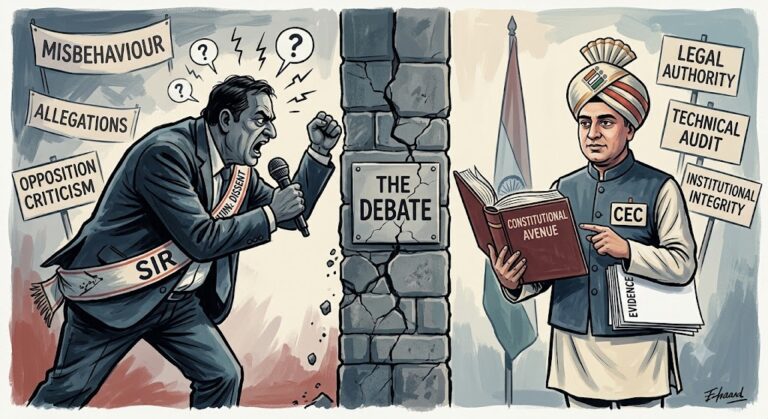
- Vulnerability: Highly dependent on the good faith and morality of the people and the functionaries who operate the system. Failures in Constitutional Morality/Integrity threaten the entire structure. In summary, concepts like Constitutional Morality and Integrity are crucial aspirations for a healthy democracy, acting as essential checks. Meanwhile, terms like Constitutional Criminality serve as critical lenses to identify and discuss the systemic decay or abuse of power when those aspirations fail. Let us remember the three monkeys of Gandhi. Recently, an AI-generated satire has in circulating on social media, like Facebook, etc.
(Third of 3-part article based on the “Constitutional Day Lecture’ on “the Constitutional Criminality & Democratic Morality” by this author, at BRAOU – Dr. B.R. Ambedkar University, Hyderabad.)
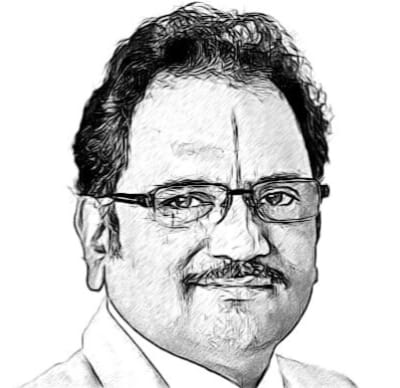
Law professor and eminent columnist
Madabhushi Sridhar Acharyulu, author of 63 books (in Telugu and English), Formerly Central Information Commissioner, Professor of NALSAR University, Bennett University (near Delhi), presently Professor and Advisor, Mahindra University, Hyderabad. Studied in Masoom Ali High School, AVV Junior College, CKM College, and Kakatiya University in Warangal. Madabhushi did LL.M., MCJ., and the highest law degree, LL.D. He won 4 Gold Medals at Kakatiya University and Osmania University.
Email: cicsridhar@gmail.com
Mobile: 8447651505