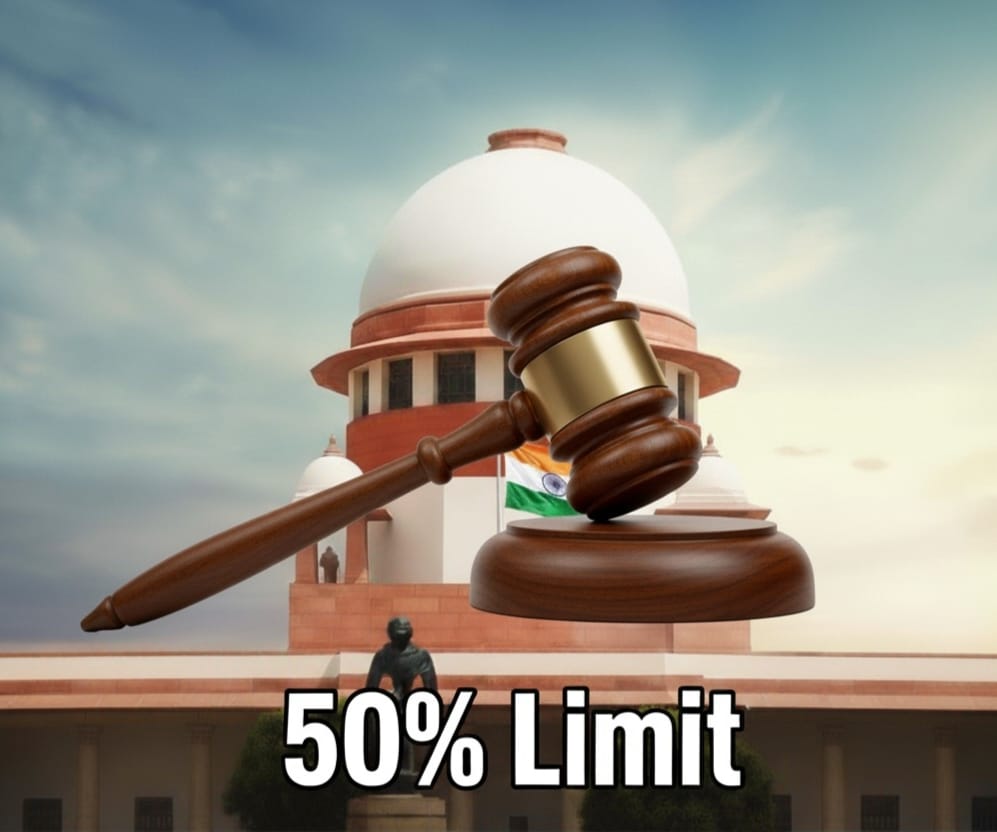
- The Constitutional Conflict at the Heart of the Telangana Quota Debate
The recent legal challenge in Telangana against the Revanth Reddy government’s G.O. No. 9, which increased Backward Classes (BC) reservation in local body elections to 42% (potentially pushing the total reservation well past the 50% mark), has reignited a crucial constitutional debate: Does the Indian Constitution mandate a 50% ceiling on total reservations, and what did the Supreme Court rule in the landmark ‘Indira Sawhney’ case?
The discussion centers on the balance between affirmative action for historically disadvantaged communities and the principle of equality and meritocracy.
Can Reservations Exceed 50%?
The Indian Constitution does not explicitly lay down a specific percentage limit for total reservations. However, Articles 15 (Prohibition of discrimination) and 16 (Equality of opportunity in matters of public employment) provide the basis for reservation.
- Article 15(4) and Article 16(4) are “enabling provisions” that permit the State to make special provisions or reservations for any backward class of citizens which, in the opinion of the State, is not adequately represented.
- The 50% limit is not a constitutional provision but a judicial mandate established by the Supreme Court through a series of judgments, most decisively in the Indira Sawhney case.
The Landmark : Indira Sawhney v. Union of India (1992)
The 1992 verdict, famously known as the Mandal Judgment, is the most authoritative ruling on the reservation ceiling. A nine-judge Constitution Bench of the Supreme Court, while upholding the reservation for Other Backward Classes (OBCs) in central government jobs, delivered a crucial ruling regarding the overall limit:
The 50% Ceiling Rule
The Supreme Court emphatically ruled that the total reservation for appointments or posts under Article 16(4) should not exceed 50% of the total seats in a given year.
Rationale: The Court reasoned that reservation must be “reasonable” and should not be allowed to defeat the right to equality guaranteed under Article 16(1), which is the primary rule. The majority opinion stated that the extent of reservation must be kept within reasonable limits, and the cap of 50% represents a fair balance between the principle of meritocracy and the necessity of affirmative action. Reservation is seen as a means to achieve social justice, not as an end in itself.
Initial Appointment: The judgment also clarified that reservations under Article 16(4) apply only to initial appointments and not to promotions (though subsequent constitutional amendments and judicial review have altered the position on reservations in promotions for SC/STs).
Creamy Layer: The Court introduced the concept of the “creamy layer” the socially and economically advanced persons within the backward classes who should be excluded from the benefits of reservation.
The “Exceptional Circumstances” Clause
While setting the 50% ceiling as the general rule, the Supreme Court did acknowledge a narrow exception. Justice B. P. Jeevan Reddy, writing for the majority, noted that the rule should not be inexorably applied in every case and that the limit could be relaxed “in extraordinary situations and in peculiar conditions”.
- For instance, in the case of far-flung and remote areas where the communities are outside the national mainstream and deserve special consideration, the percentage could exceed 50%.
- However, the Court cautioned that any such departure from the rule must be justified by exceptional and compelling circumstances.
The Case of Tamil Nadu’s 69% Reservation
The argument made by the Telangana government’s counsel, Abhishek Manu Singhvi, citing Tamil Nadu’s 69% reservation is highly relevant to this debate as it represents the most prominent legal deviation from the 50% rule.
- Tamil Nadu’s reservation policy, implemented through the Tamil Nadu Act, 1993, was challenged after the Indira Sawhney* judgment.
- To safeguard the Act, the State government, with the assent of the President of India, placed it under the Ninth Schedule of the Constitution via the 76th Constitutional Amendment Act, 1994.
- The Ninth Schedule was created to protect certain laws from judicial review, making them immune to challenge on the ground of violating fundamental rights (Articles 14, 19, and 21).
While the 69% reservation has been operational, the Supreme Court, in the 2007 I.R. Coelho case, ruled that laws placed in the Ninth Schedule after April 24, 1973 (the date of the Kesavananda Bharati judgment) are open to judicial review if they violate the basic structure of the Constitution, which includes the principle of equality. The validity of the Tamil Nadu Act is thus still under judicial scrutiny, though it continues to be in force.
The Ongoing Legal Tussle
The 50% ceiling is therefore a judicial doctrine designed to preserve the core of the right to equality. The legal battle in Telangana reflects a fundamental tension: State governments often cite compelling data on the backwardness and lack of adequate representation for certain communities as Telangana’s counsel argued to justify exceeding the cap. Conversely, petitioners rely on the clear mandate of the Indira Sawhney case, arguing that any breach of the 50% limit, except in the narrowest of “extraordinary situations,” violates the constitutional scheme of equality.The Supreme Court’s position remains firm on the 50% rule, though the legal system continues to grapple with the definition and justification for ‘exceptional circumstances’, making it a perpetually evolving and politically charged area of Indian law.
Judicial scrutiny- While the laws in the nine schedule are immune from review on grounds of violating fundamental rights, the Supreme Court ruledin the IR Coehlo vs. state of Tamil Nadu case (2007) that they are still subject to review if they violate the basic structure of the Constitution. According to legal experts, “The Telangana government and central government should work together on the issue and made the act under the purview of the Constituion and supreme Court. Then only, the issue can be solved.

Senior Journalist
Anand Gantela is a seasoned media professional with nearly three decades of experience across the spectrum of Indian journalism. Having worked extensively in both print and broadcast media, he has held key positions at renowned outlets such as Prajashakthi, Andhra Bhoomi, Mudra, Media India, Siti Cable, Mana Telugu, and Maa TV. From ground-level reporting to managing news bureaus and overseeing bulletin production, Anand has witnessed the evolution of news firsthand. His wealth of experience reflects a deep understanding of the dynamic and ever- evolving landscape of news reporting.
Email: gantela.anand@gmail.com
Mobile: 7893549889

It is good article
The article analysed the present government path on BC reservations. It seems the goverment brought it to get mileage than implementing it.