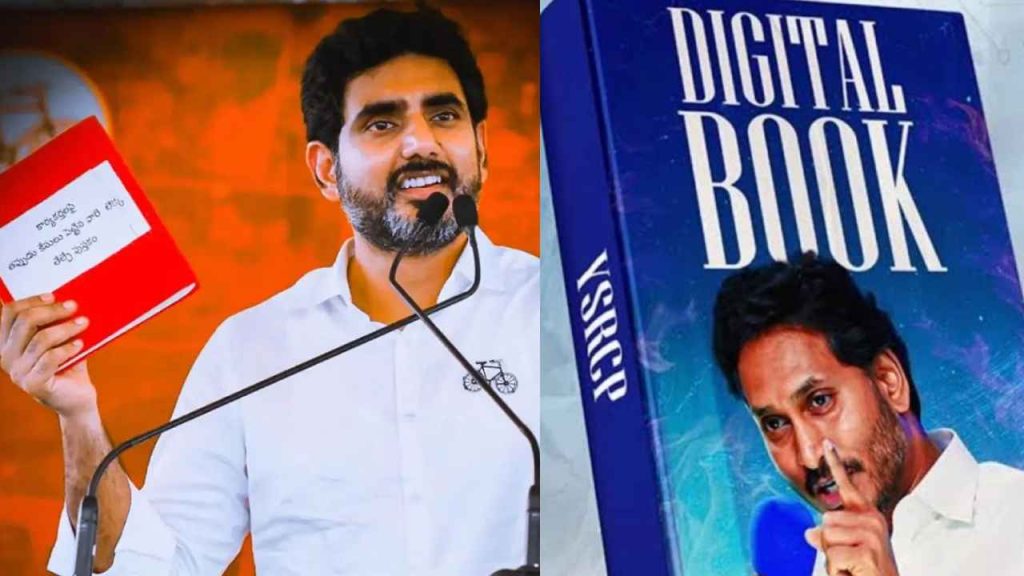
- Red Book versus Digital Book fight takes new shape
- High court found fault cases against social media activists
The political landscape of Andhra Pradesh is currently witnessing a fierce debate, with many drawing parallels between the current climate and the notorious era of ‘political vengeance’ that characterized the rivalry between the DMK’s M. Karunanidhi and the AIADMK’s J. Jayalalithaa in Tamil Nadu. In both scenarios, the ruling party stands accused of using its police and administrative power to target and harass leaders, activists, and officials associated with the opposition.

The Genesis of the ‘Red Book’
The current controversy in Andhra Pradesh began when Nara Lokesh, then a prominent opposition leader in the Telugu Desam Party (TDP) and now the Minister for Human Resources Development, Information Technology, Communication, and Real-Time Governance, coined the term “Red Book.”
During the TDP’s time in opposition, Lokesh frequently appeared in public meetings, holding up what he called the “Red Book.” This gesture was a dramatic pledge and a direct warning: he claimed to be recording the names of police officers, administrative officials, and YSR Congress Party (YSRCP) leaders who were allegedly harassing TDP leaders and cadre. He vowed that once the TDP returned to power, everyone in the “Red Book” would face legal consequences. The arrest of former chief minister Nara Chandrababu Naidu during YSTCP’s regime provoked Lokesh and TDP leaders and they came to conclusion of using “Red Book’ after they came to power.
Retribution and the ‘Red Book’ in Action
Lokesh’s “Red Book” statement was initially met with ridicule by the then-Chief Minister Y. S. Jagan Mohan Reddy and other YSRCP leaders, who dismissed it as “childish” and “derogatory.” However, with the TDP’s return to power, Lokesh appears to be taking his pledge seriously, leading to a visible crackdown on YSRCP figures.
Recent high-profile actions, which critics suggest are part of this political vendetta, include:
- The arrest of former minister Kakani Goverdhan Reddy in an illegal mining case.
- A case filed against former minister Ambati Rambabu for allegedly violating prohibition orders.
- The arrest of the brother-in-law of former minister Vidadala Rajani in an extortion case.
Controversial Cases and Judicial Scrutiny
Beyond the high-profile arrests, hundreds of YSRCP workers and social media activists have also faced a barrage of criminal cases. Two specific cases, involving Narra Ravinder and Sounder Reddy, have drawn significant attention and judicial criticism:
- Narra Ravinder’s Case: The High Court found fault with the government for filing serious criminal charges, including those related to continuing criminal activity and the Information Technology Act. Ravinder was reportedly moved between various police stations, and his wife faced harassment when police denied his whereabouts.
- Sounder Reddy’s Case: This case resulted in a major setback for the TDP government. The High Court, indicting police officials, observed that they had distorted the facts and violated the Supreme Court’s arrest protocols outlined in the landmark D.K. Basu case. The court noted significant discrepancies between the time of arrest recorded in the police remand report (8:30 pm), the mediators’ report (7:30 pm), and the actual Geo-data (6:30 pm). As a result, the High Court has ordered a CBI investigation into the alleged illegal arrest, dealing a considerable blow to the current administration.

The YSRCP’s Counter-Measure: The ‘Digital Book’
In response to what he terms a systematic campaign of harassment, former Chief Minister and YSRCP president Y. S. Jagan Mohan Reddy has launched his own counter-initiative: the ‘Digital Book’.
He has urged party workers and individuals to use a platform on the YSRCP website to upload and register the details of any harassment they have faced under the current TDP regime. Reddy stated that this digital repository will preserve every incident and serve as evidence. He pledged that a judicial commission would be appointed to investigate these details and ensure that the officials and individuals responsible for the alleged harassment are brought to justice once the YSRCP returns to power, thereby continuing the cycle of retaliatory politics.
Principal Correspondent, Prime Post
CS Kulasekhar Reddy had thirty five years experience in journalism. He worked in Udayam and Andhra Bhoomi as reporter and sub-editor. He highlighted various social issues in Chitthoor, Ananthpur, Kadapa and Kurnool districts. He covered assembly sessions and Secretariat happenings.
Email: sangatiksr@gmail.com
Mobile: 9000400679