The ancient temple town of Arunachalam (Tiruvannamalai) in Tamil Nadu has witnessed a significant surge in devotees from the Telugu-speaking states of Andhra Pradesh and Telangana over the last two decades. This growing devotion stems from a powerful blend of spiritual significance, the influence of modern sages, and a perceived source of positive, calming energy.
Reasons for Increased Telugu Devotees
The data highlights a substantial daily influx of Telugu pilgrims:
- Approximately 3,000 people travel through trains to Arunachalam daily from Tirupati and Renigunta after visiting Tirumala.
- Another 5,000 Telugu-speakers arrive via other routes (cars, buses) daily.
- This count multiplies manifold during the monthly ‘Full-Moon’ day.
- This increasing trend can be attributed to several factors:
- Powerful Sakthi and Ancient Planning: Arunachalam is a holy place of immense spiritual authority, considered a manifestation of Shiva himself. The temple, built by Chola kings in the 9th century, is one of the Panchabhoota Lingams, representing Agni (fire).
- Mental and Emotional Restoration: Devotees, including IT professionals, are increasingly drawn to Arunachalam as a place to relieve work pressure and seek mental strength and positive energy. As one software professional noted, the hill and the temple offer a significant boost to the mind.
- Spiritual and Physical Benefits: The site offers more than just religious fulfillment. Devotees believe that a single visit creates a strong desire to return. Moreover, the famous ‘Giri Pradakshinam’ (hill-perimeter-walk) is said to offer health benefits and a profound peace of mind, leaving the mind feeling fresh.
- The increasing rush has prompted local development, with new hotels being built and Telugu communities establishing sadanams (lodges/centers) to accommodate their state’s followers.
The Significance of ‘Giri Pradakshinam’
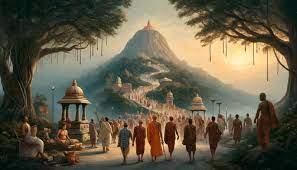
The practice of walking around the sacred Arunachala Hill—the ‘Giri Pradakshinam’—is central to the devotion and is a much-discussed topic among pilgrims.
Ramana Maharshi’s Influence: The great 20th-century sage, Ramana Maharshi, widely popularized the Giri Pradakshinam, emphasizing its role in achieving spiritual liberation.
Asta Lingas: The perimeter walk is said to be spiritually beneficial as it covers the shrines of the Asta Lingas (eight lingams): Indra, Agni, Yama, Niruthi, Varuna, Vayu, Kubera, and Eesana, along with Surya (Sun) and Chandra (Moon).
Global Appeal: The hill is revered by international visitors from countries like Spain, the US, and Sweden as an ideal spot for Meditation and Dhyana (contemplation). Devotees grant equal spiritual status to the main Shiva Lingam in the temple and the mountain itself.
The Temple and Hill’s Scale
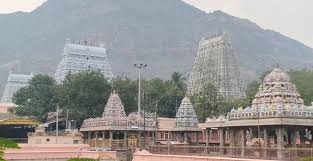
The Arunachaleswara Temple premises cover 25 acres and feature nine prominent gopurams (tower gateways). The largest and most famous is the Raja Gopuram, a 217-foot tower completed in 1516 by Sri Krishnadeva Raya of the Vijayanagar kingdom.
Scientific Studies on Shiva Temples
A study conducted by the Indian Institute of Technology (IIT), Roorkee, in collaboration with Amrita Vishwa Vidyapeetham and Uppsala University of Sweden, looked into the ancient planning models of eight major Shiva temples, including Arunachalam.
Integrated Planning: Researchers concluded that these temples are examples of superior ancient planning, deeply interwoven with mythology and ecology.
Fertile Regions: The study found that all eight temples—which also include Kedarnath, Kaleswaram, Srikalahasti, Kalviyur, Rameswaram, Chidambaram, and Kanchipuram—are located in historically fertile regions.
‘Shiva Sakthi Aksha Rekha’ (SSAR): Sivasakthi aksharekha is a concept referring to a nearly sacred geographic straight line along with longitude of 79 degree line in India, where various shiva temples started from Kedarnath to Rameswaram touching Kaleswaram, srisailam, Kanchipuram, Tiruvannamalai, chidambaram and kalviyur.
Editor, Prime Post
Ravindra Seshu Amaravadi, is a senior journalist with 38 years of experience in Telugu, English news papers and electronic media. He worked in Udayam as a sub-editor and reporter. Later, he was associated with Andhra Pradesh Times, Gemini news, Deccan Chronicle, HMTV and The Hans India. Earlier, he was involved in the research work of All India Kisan Sabha on suicides of cotton farmers. In Deccan Chronicle, he exposed the problems of subabul and chilli farmers and malpractices that took place in various government departments.
Email: ravindraseshu7@gmail.com
Mobile: 9063718675