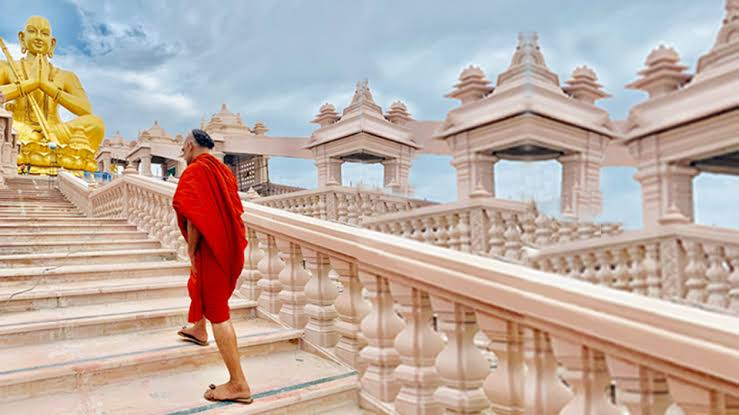
The glory of 108 Divya Desams, a 216-foot monument to Sri Ramanujacharya, and a monumental resolve built to endure for centuries.
Sapthathi Celebrations start on the 8th
His life’s work is a clarion call reminding the universe of Jagadguru Sri Ramanujacharya, the revolutionary saint from a millennium ago. Sri Chinna Jeeyar Swamy is a visionary ascetic who communicates India’s spiritual message to the entire world. On the occasion of Swamiji’s 70th birthday, while extending heartfelt greetings, one must reflect on a magnificent creation among his many spiritual, social, educational, medical, and humanitarian initiatives that will remain unforgettable for centuries to come: the Statue of Equality (Samatha Murthi) complex at Muchintal, near Hyderabad. Hyderabad is home to countless remarkable structures, yet the Statue of Equality stands above them all. “Equality” is a foundational, visionary ideal of the Indian Constitution, and achieving it is an ongoing endeavor. When everyone works together, the dream shared by both a humble student of the Constitution and a globally revered ascetic like Jeeyar Swamy moves closer to reality.
Having spent forty years writing about unimplemented laws and elusive justice, I was inspired during Ramanujacharya’s millennium celebrations to write a book encouraging people to stand tall and proudly claim this nation as their own. Guided by the blessings of Lord Hayagriva, my father and guru M.S. Acharya, and my Samashrayana Acharya, Madabhushi U.Ve. Venkata Narasimhacharya Desikulu, I embarked on Ramanuja Margam. During my tenure as Central Information Commissioner (2013–2018), the editorial team of Sakshi gave me the opportunity to serialize Ramanuja Margam in 40 parts, which was later published as a comprehensive book by Raghavendra Publications in Vijayawada, and is currently being serialized in the monthly magazine Swarga Giri.
Researching Ramanujacharya reveals fascinating historical connections—including accounts of him visiting the Orugallu (Warangal) kingdom during the reign of Prataparudra and praying at the ancient Pancharayala (Sri Krishna) Temple in Shayampet near Warangal a thousand years ago. On Swamiji’s birthday, I earnestly appeal to him to take up the restoration of the Shayampet Sri Krishna Temple to its former glory. For a visionary who built a monument of this magnitude for Ramanujacharya, reviving this historic temple would be a natural extension of his mission.
A Monumental Creation
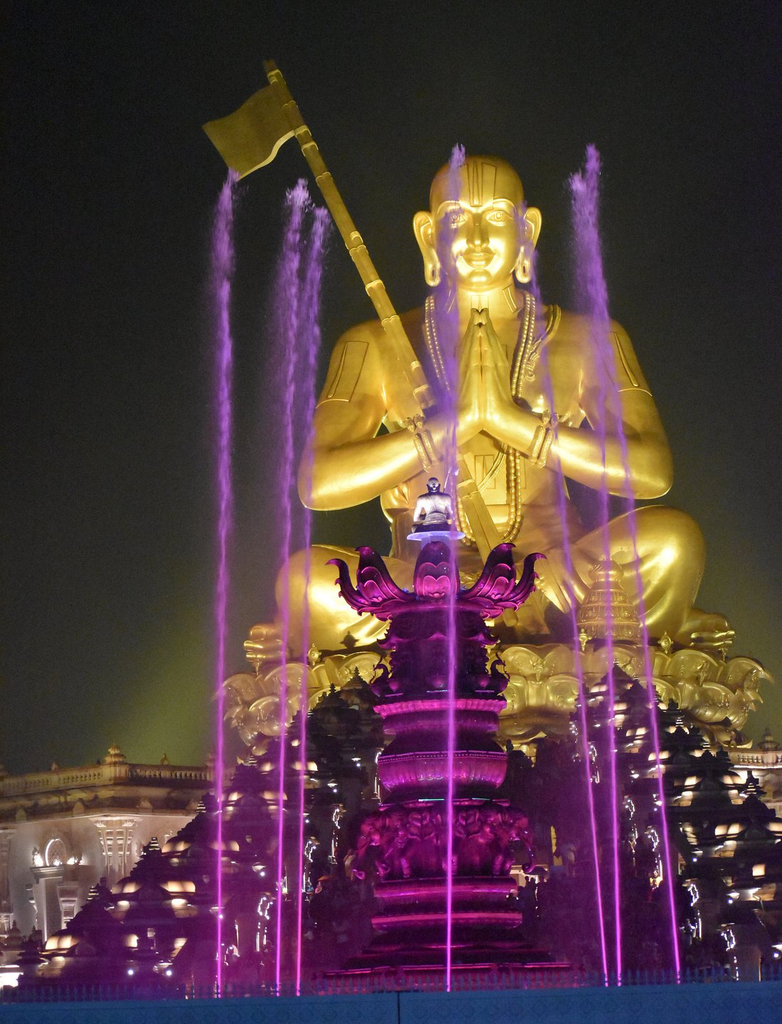
Dedicated to the nation on February 5, 2022, this grand complex—which captured global attention four years ago—must not be viewed merely as a tourist destination. When one considers the underlying philosophy, exhaustive research, sculptural artistry, engineering prowess, spiritual vision, and social message, it becomes clear that this is not a structure built for a single generation, but a timeless legacy for centuries to come. Rising 216 feet high and crafted from Panchaloha (a traditional five-metal alloy), the statue of Sri Ramanujacharya sits majestically atop a 54-foot-tall base building called the Bhadravedi, surrounded by replicas of the 108 Divya Desams (sacred Vaishnava temples). Sri Chinna Jeeyar Swamy conceptualized this entire project and personally guided every stage of its design.
Bringing 108 Sacred Temples to Telangana
After the formation of Telangana as a separate state, I often felt a sense of longing: not a single one of the 108 sacred Divya Desams, the holiest shrines in the Vaishnava tradition, was located within Telangana. Devotees had to travel across the country, particularly throughout South India, to visit them. Sri Chinna Jeeyar Swamy answered this void with extraordinary creativity and foresight. While an ordinary thought might be to “build a temple,” and a grander one to “establish a pilgrimage center,” Swamiji envisioned bringing the spiritual splendor of all 108 Divya Desams from across India into a single sacred campus.
Six Months of Rigorous Research
Recreating the 108 Divya Desams was far more complex than simply hiring sculptors to build temples. Each Divya Desam possesses its own unique spiritual significance, specific iconography for the presiding deity (Moolavar) and processional deity (Utsavar), distinct architectural towers (Vimanas), and local traditions. According to the official project history of the Statue of Equality, Chief Architect D.N.V. Prasad Sthapathi and his team conducted nearly six months of intensive research, concluding in December 2014. The team physically visited over 90 Divya Desams (98 according to project records) and captured approximately 12,000 photographs. After each visit, they prepared detailed sketches of the deities and studied the architectural grandeur of the Vimanas in consultation with local temple authorities and sacred texts (Agama and Shilpa Shastras). Consequently, the 108 temples at Muchintal are not mere symbolic replicas; they are scholarly, culturally authentic reconstructions.
Architecture, Engineering, and Execution
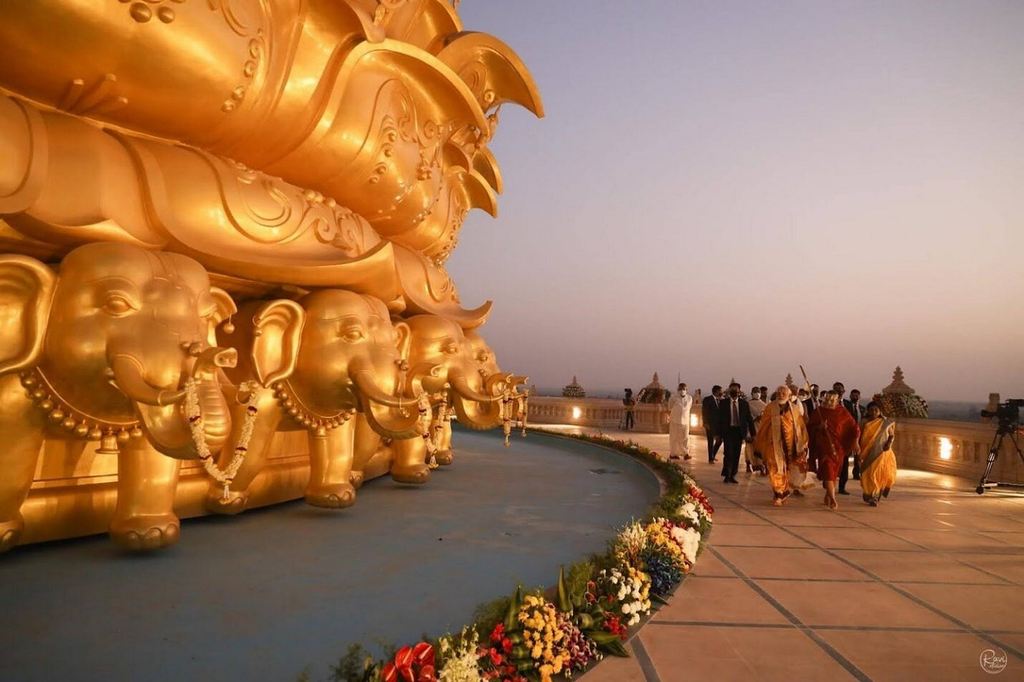
Conceptualized in 2014 to commemorate the 1,000th birth anniversary of Sri Ramanujacharya, the project took shape under the architectural leadership of D.N.V. Prasad Sthapathi and the direct supervision of Sri Chinna Jeeyar Swamy:
- The Bhadravedi (Base Structure): Standing 54 feet (16 meters) tall across three floors, the base houses a 6,000-square-meter ground floor depicting Ramanujacharya’s life and philosophy, a 27,870-square-meter second floor dedicated to daily worship, and a 1,365-square-meter third floor housing a Vedic digital library and research center, alongside an Omnimax theater designed in the shape of a planetarium.
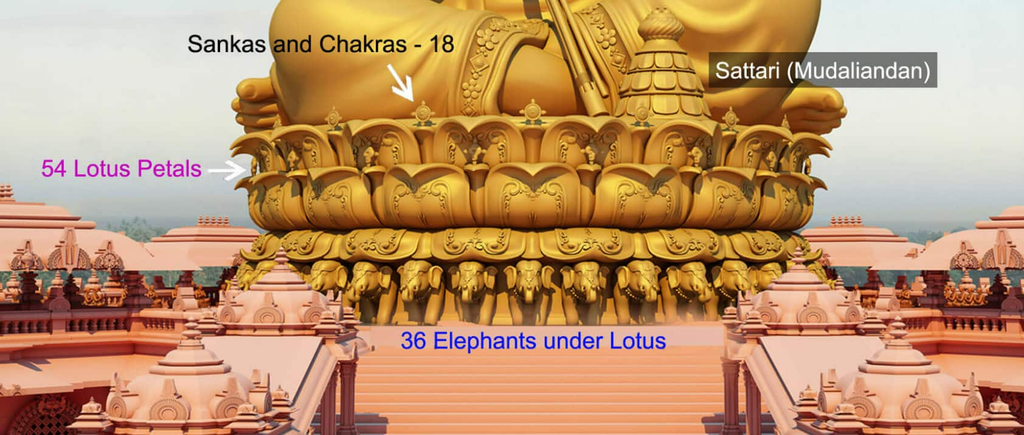
- The Lotus Pedestal: Atop the Bhadravedi sits a massive lotus with a diameter of 27 feet (8.2 meters), supported by 36 elephants, symbolizing the 24 cosmic principles (Tattvas) along with the Soul, God, and Guru.
- The Panchaloha Statue: Crafted from 700 tons of Panchaloha (gold, silver, copper, brass, and zinc) around a reinforced concrete core, the statue is one of the tallest sitting metal statues in the world. Following a contract awarded in August 2015 to Aerosun Corporation in Nanjing, China, the statue was cast in 1,600 individual pieces, shipped to Chennai Port in 54 consignments, and assembled on-site over 15 months (2017–2018) by a team of roughly 60 engineers, welders, and technicians.
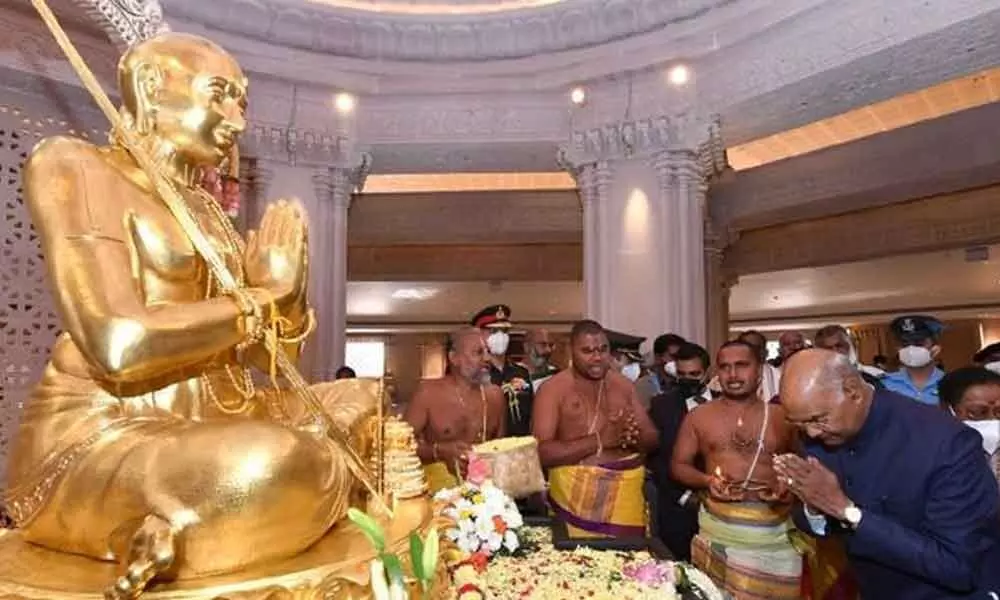
- The Golden Deity: Inside the Bhadravedi meditation hall resides a 54-inch (1.4-meter) idol made of 120 kilograms of pure gold, commemorating the 120 years Sri Ramanujacharya lived on earth.
- Not Just a Sculpture, But a Grand Resolve
To reach the final design of the 216-foot statue, nearly 15 models were created. Starting with a clay model sculpted under Swamiji’s direct watch during his 2014 Chaturmasya Deeksha in Shamshabad and finalized in February 2015, the design was 3D-scanned for digital refinement. Swamiji’s involvement went far beyond conceptualizing the project; he scrutinized every detail—the facial expressions, serene posture, monastic robes, and spiritual aura of the great Acharya. When inspecting a 1:10 scale model in China, Swamiji and his team identified and corrected 14 specific nuances to ensure perfection.
Comparison of India’s Iconic Monuments
While several monumental statues in India have been built using hundreds or thousands of crores of public taxpayer money, Sri Chinna Jeeyar Swamy accomplished this global landmark entirely through devotee contributions and meticulous financial management.
| Monument Name | Location | Approximate Cost | Funding Source |
| Statue of Equality (Sri Ramanujacharya) | Muchintal, Hyderabad (Telangana) | ₹1,000 Crore (Entire complex; ~₹216 Crore for the main statue) | 100% Devotee Donations (Zero government funds) |
| Statue of Unity (Sardar Vallabhbhai Patel) | Kevadia / Ekta Nagar (Gujarat) | ₹2,989 Crore | Government & Public Sector Undertaking (PSU) funds |
| Statue of Oneness (Adi Shankaracharya) | Omkareshwar (Madhya Pradesh) | ₹2,141 Crore (Entire project; ~₹200 Crore for the statue) | Madhya Pradesh State Government funds |
Highlights of Swamiji’s Achievement
- Recreation of 108 Divya Desams: Bringing exact black-stone replicas of 108 sacred shrines from across India into a single accessible location for everyday devotees.
- Prudent Resource Management: Delivering not just a 216-foot statue, but 108 temples, a three-story Bhadravedi, a digital library, a research center, a theater, and musical fountains within a ₹1,000 crore budget.
- Global Stature: Standing as the second-tallest sitting statue in the world.
A Living Center of Knowledge, Tradition, and Technology
Why is Sri Ramanujacharya honored as the Statue of Equality? Because his teachings championed human dignity, universal access to spirituality, and the eradication of social, cultural, and economic discrimination. If the Statue of Unity symbolizes national integration, the Statue of Equality proclaims that all human beings are equal in the eyes of the Divine, and that spirituality must unite rather than divide society.
To connect each of the 108 replica shrines to its original temple, the traditional Salagrama Murthi / Srimurthi consecration was observed. Furthermore, Swamiji himself recorded the self-guided audio tour explaining the history and significance of every single Divya Desam—a remarkable effort to educate the public rather than merely construct buildings.
Today, the complex integrates ancient wisdom with modern technology—incorporating AR, VR, MR, and XR experiences—so that younger generations can engage with history and culture in a language and medium familiar to them.
Humanitarian Vision Beyond the Monument
It would be unjust to confine Sri Chinna Jeeyar Swamy’s legacy to the Muchintal complex alone. Through institutions under his guidance, his message of equality is translated into tangible social action:
- Vikasa Tarangini: Active in healthcare, disaster relief, and rural development.
- Nethra Vidyalaya: Providing quality education to visually impaired students.
- Jeeyar Gurukulam: Offering free, value-based education to tribal children in remote areas.
- JIMS (Jeeyar Integrative Medical Services): Delivering accessible healthcare services.
According to official records, over 10,000 visually impaired, tribal, and underprivileged students have received educational support, and more than 100,000 individuals have benefited from healthcare, disaster relief, and humanitarian outreach. Preaching equality is one thing; educating a blind child, empowering a tribal youth, and healing the sick is living equality in practice.
Looking Toward Future Centuries
We usually measure the lifespan of buildings in years, but the Statue of Equality is built to endure for centuries. Yet its true permanence lies not in concrete, metal, or stone, but in the survival of its message—devotion, knowledge, service, and mutual respect. Sri Chinna Jeeyar Swamy is not merely a spiritual guru; he is an Acharya, an institution-builder, a creative thinker, and a bridge between tradition and modernity. What such endeavors require is not fear of scale, but conviction and perseverance. While monuments stand for centuries, it is the responsibility of younger generations to protect their spirit. Just as Ramanujacharya’s writings have endured for a thousand years, hundreds of sacred texts are being published under Swamiji’s guidance through JIVA—each book carrying the value of a million statues, spreading an undying fragrance of wisdom across the world.
On Sri Chinna Jeeyar Swamy’s 70th birthday, beyond wishing him a long and healthy life (Shatamanam Bhavati), we pray that his river of service continues to expand—that Muchintal grows ever brighter as a beacon of knowledge, and that Ramanujacharya’s timeless message of equality reaches every corner of human society.
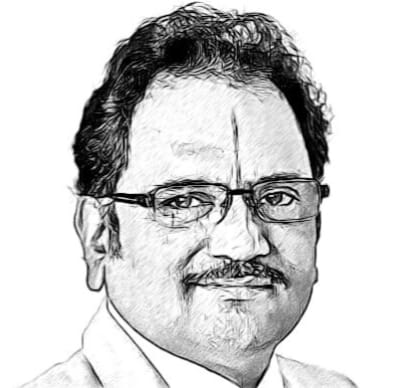
Law professor and eminent columnist
Madabhushi Sridhar Acharyulu, author of 63 books (in Telugu and English), Formerly Central Information Commissioner, Professor of NALSAR University, Bennett University (near Delhi), presently Professor and Advisor, Mahindra University, Hyderabad. Studied in Masoom Ali High School, AVV Junior College, CKM College, and Kakatiya University in Warangal. Madabhushi did LL.M., MCJ., and the highest law degree, LL.D. He won 4 Gold Medals at Kakatiya University and Osmania University.
Email: cicsridhar@gmail.com
Mobile: 8447651505