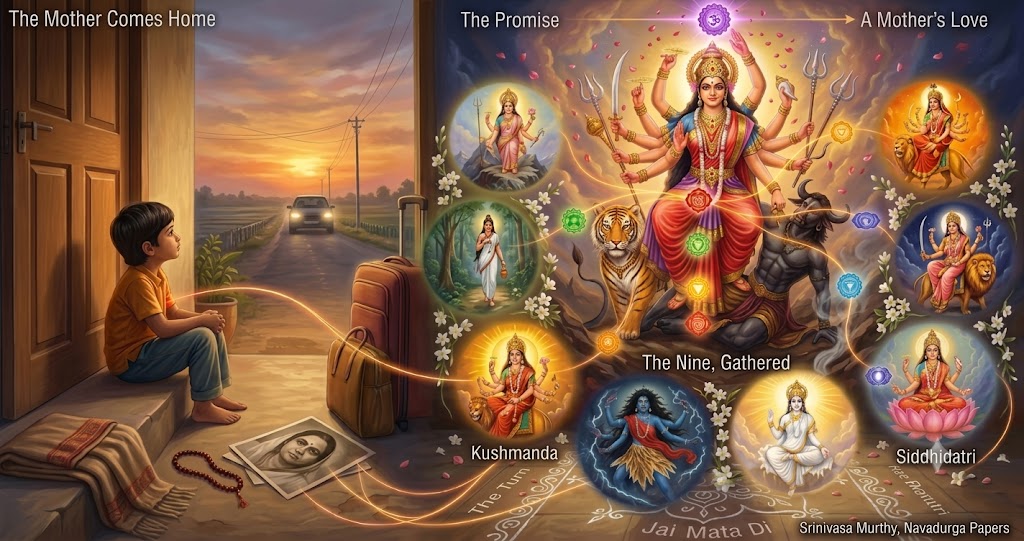
The Threshold
Do you remember the night before your mother came home?
Not from the office. Not from the market. From somewhere far. Somewhere you could not follow her to. A grandmother’s house. A hospital. A journey she had to make alone.
You knew she was coming. Nobody had to tell you. You had been counting the days. Then the hours. Then the minutes. You kept walking to the door. Not to go anywhere. Just to look. To check if the road was empty. To check if the light at the far end of the street was a car, and if the car was hers.
You straightened the same cushion three times. You asked, for the tenth time, what time she would reach. You could not eat properly. You could not sit still. You could not sleep, and you did not want to.
Every sound became her footsteps. Every shadow became her shape.
And then, at last, she came.
You did not run to her. You froze. Because the moment you had imagined for so long was actually happening, and it was too much for your small body to hold.
And she opened her arms. And the world became right again.
The Turn
That feeling has a name. It is called Navaratri.
Every year, for nine nights, the Mother comes home. Not to a temple. To a house. To your house.
She does not come because we have earned it. She does not come because we lit enough lamps or got the rituals exactly right. She comes because she is our Mother, and a mother comes home to her children. Not to the polished version. To the real ones. The tired ones. The ones still hoping.
And so the house prepares.
The floors are washed. The lamps are lit. The threshold is decorated with rice flour, in patterns so fine that they will be walked over by morning. The air fills with camphor and jasmine. In the south, dolls are arranged on stepped platforms, each one telling a story someone in the family chose to keep. In the north, clay pots are placed with reverence, holding her presence. In the west, women fast and sing. In the east, she is danced to, all night, barefoot, in circles.
Different houses. Different customs. One Mother.
Nine Nights, Nine Faces
Here is the thing about a mother. You do not meet her all at once.
First, you know only her warmth. A body. A heartbeat. A voice that means safety. You do not know her face yet. You only know that when she is near, nothing is wrong. Nothing can go wrong.
Then you know her voice. The songs she hums while working. The way she says your name. The way she calls you in from the street when the sun begins to fade.
Then you know her discipline. The rules you hated. The boundaries you resented. The things she would not let you do, and the reasons you understood only years later.
Then you know her patience. The way she waited for you to come back. The way she never said I told you so. The way she kept your plate warm, even when you were late.
Then you know her courage. The night she was trembling. The night she stood up anyway. And you learned, watching her, what courage actually looks like.
Then you know her silence. The night you were not well. You slept on her lap. She stayed awake the whole night. She did not say a word. She did not need to. She was simply there. And that was enough.
Then you know her forgiveness. The thing you did that you thought she would never forgive. The way she forgave it before you had even finished asking.
Then you know her wisdom. The sentence she said years ago that suddenly makes sense now. The thing you dismissed as old-fashioned that turns out to be true.
And then, one day, you look at her.
And you see her. Really see her.
You see the girl she was before she became your mother. The dreams she had. The places she never went and always wanted to. The things she sacrificed and always cherished to own.
You see the worry she carried and never spoke about. The nights she lay awake, so that the mornings would run smoothly.
You see the sorrow she hid behind the smile. The people she lost. The things she never got to say to them.
You see her hands. The ones that fed you, dressed you, held you, and are now slower than they used to be.
You see her tired eyes. And you realise they have been tired for years. You just never noticed.
And your heart breaks a little. Because you have been looking at her your whole life. And only now have you begun to see her completely.
That is what the nine nights are doing.
They are not introducing you to nine goddesses. They are introducing you to your Mother, one face at a time. The same way you came to know your own.
Different families. Different regions. Different years. The colours change. The Mother does not.
The Nine Forms
On the first night, she comes as a daughter. Shailaputri, the daughter of the mountain. She does not walk yet. She does not speak yet. She simply stands, and the ground beneath her becomes holy.
On the second night, she begins to move. Brahmacharini, walking slowly, a rosary in one hand and a water pot in the other. She is learning the path, and asking you to learn it with her.
On the third night, she finds her voice. Chandraghanta rings a bell, and the sound is courage. You realise you have been waiting for permission to be brave.
On the fourth night, she plays. Kushmanda, whose smile made the worlds. The texts say she laughed, and the cosmos appeared. A mother’s laughter, and the universe was born.
On the fifth night, she holds a child. Skandamata. She looks down at the small face in her arms, and you understand, perhaps for the first time, what your own mother felt when she first held you.
On the sixth night, she grows fierce. Katyayani, with a sword in her hand and no hesitation in her eyes. She does not fight for glory. She fights for the thing that must be protected.
On the seventh night, she becomes the dark. Kalaratri, unadorned, with no beauty left to hide behind. She is everything you have refused to look at. And she is looking back at you.
On the eighth night, morning comes. Mahagauri, luminous again, dressed in white. She is the stillness you feel after you have finally wept.
On the ninth night, she is complete. Siddhidatri, seated on a lotus, surrounded by the gods. She gives you the thing you did not know you were asking for. Not what you wanted. What you needed.
And on the tenth day, she does something no one expects.
She reveals that the nine were always one.
And that the nine were also you.
Before the Nine Nights Begin
Before you read any further, do one thing.
Think of your mother. Not the idea of her. The actual woman. Where is she right now? In another room? In another city? In a photograph on your wall? In your memory only?
If she is still here, call her. Not to tell her anything important. Just to hear her voice. Ask her something ordinary. What she ate today. What the weather is like. Whether she has taken her medicine.
If she is no longer here, sit with her for a moment. Let her arrive in your memory the way she used to arrive at the door.
This is Navaratri. It begins with her.
The Promise
These nine nights are not for the perfect. They are for the ones who know, in some quiet corner of themselves, that they have been waiting, and who are no longer ashamed of it.
She does not come because we deserve her. She comes because we are hers. That has always been enough.
So this year, do not rush her. Sit with her, one form at a time. The way you would sit with your mother over tea, in no hurry to say goodbye.
And if somewhere in your chest something loosens as you read these nine days, a small catch in the breath, a warmth behind the eyes, let it. That is not sentiment. That is recognition. That is the part of you that still remembers being someone’s child, stirring awake.
She is not far away in some ancient scripture. She is here. In the lamp you just lit. In the hush before the aarti bell. In the tired eyes of the woman who raised you.
She has been with you the whole time.
Look up now. She is already home.
Jai Mata Di.
Author Biography: – R Srinivasa Murthy, the author, is a corporate leader, an independent writer, and a student of Hindhu Philosophy. He Identifies as a Demystic, committed to removing unnecessary mysticism from traditions to offer practical systems for the next generation. His upcoming book, Logic of And: Sanatana Dharma as a Toolkit for the Contemporary Seeker, aims to bridge ancient wisdom with modern life to foster an inclusive, living civilisation.

With a journalistic long journey, we bring you https://primepost.news, a dynamic platform committed to unraveling the intricate tapestry of Indian politics, particularly delving deep into the heart of Telangana and Andhra Pradesh. Our blog is not just a source of news; it’s a reservoir of insights, analysis, and thought-provoking reviews.

Thank you 🙏 Very informative, and touches one’s heart! 💓
This is incredibly beautiful and emotional sir ❤️🙏